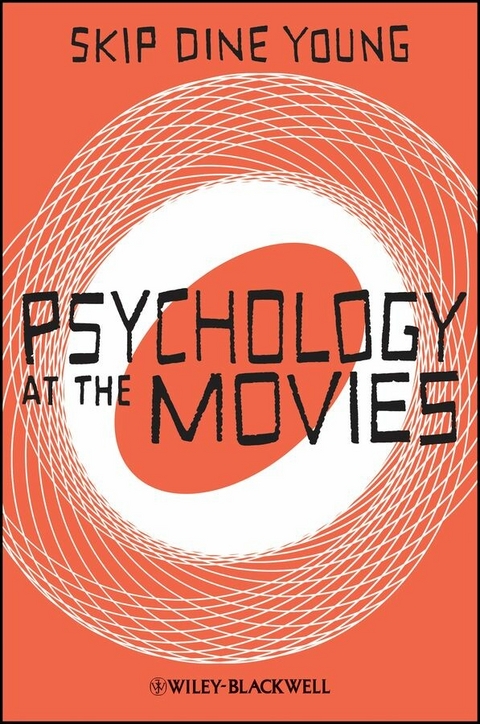
Psychology at the Movies (eBook)
John Wiley & Sons (Verlag)
978-1-119-94113-2 (ISBN)
- Uses the widest range of psychological approaches to explore movies, the people who make them, and the people who watch them
- Written in an accessible style with vivid examples from a diverse group of popular films, such as The Silence of the Lambs, The Wizard of Oz, Star Wars, Taxi Driver, Good Will Hunting, and A Beautiful Mind
- Brings together psychology, film studies, mass communication, and cultural studies to provide an interdisciplinary perspective
- Features an extensive bibliography for further exploration of various research fields
Skip Dine Young is a Professor of Psychology at Hanover College in Indiana. He is a licensed clinical psychologist with interests in popular culture, narrative psychology and human development.
Psychology at the Movies explores the insights to be gained by applying various psychological lenses to popular films including cinematic depictions of human behavior, the psychology of filmmakers, and the impact of viewing movies. Uses the widest range of psychological approaches to explore movies, the people who make them, and the people who watch them Written in an accessible style with vivid examples from a diverse group of popular films, such as The Silence of the Lambs, The Wizard of Oz, Star Wars, Taxi Driver, Good Will Hunting, and A Beautiful Mind Brings together psychology, film studies, mass communication, and cultural studies to provide an interdisciplinary perspective Features an extensive bibliography for further exploration of various research fields
Skip Dine Young is a Professor of Psychology at Hanover College in Indiana. He is a licensed clinical psychologist with interests in popular culture, narrative psychology and human development.
List of Illustrations and Figures xi
Acknowledgments xiii
1. Introduction--The Many Sides of Psychology and the
Many Faces of the Movies 3
Goals of Psychology at the Movies 6
Story, Entertainment and Art in the Movies 9
A Liberal Use of Psychology 10
A Symbolic Framework for the Psychology of Film 12
Organization of Psychology at the Movies 14
Further Reading 16
2. The Search for Meaning--Psychological Interpretations
in the Movies 19
Human Behavior in the Movies 21
Unconscious Conflict in the Movies 24
Archetypes in the Movies 28
Ideology in the Movies 30
Spectators in the Movies 33
Closing Shots: The Boons and Banes of Interpretation 37
Further Reading 39
3. Psychopathology, Psychotherapy and
Psycho--Psychologists and Their Patients in the
Movies 43
Representations of Psychological Disorders 44
Representations of Psychologists and Psychological Treatment
49
Closing Shots: The Impact of Representations of Psychology
55
Further Reading 60
4. Crazy Genius--The Psychology of Filmmakers 63
Psychobiography and Filmmakers 64
Auteurs: Profiles of Directors 65
Star-Gazing: Profiles of Actors 69
Psychology for Filmmakers: The Case ofWoody Allen 73
Closing Shots: Evaluating Psychobiography 76
Further Reading 77
5. Picturing the Audience--Psychological Profiles of
Moviegoers 81
Movie Audiences through the Years 83
The Movies PeopleWatch 85
The Movies People Like 88
Closing Shots: The Viewers behind the Numbers 91
Further Reading 91
6. The Cinematic Moment--Emotions and the Comprehension
of Movies 95
Cognitive Psychology and the Movies 96
The Perception of Movies 97
The Narrative Comprehension of Movies 99
The Emotional Comprehension of Movies 101
Brain Functioning and the Movies 107
Closing Shots: An Unlikely Partnership 109
Further Reading 110
7. Reflecting on the Screen--The Reception of Movies
113
Viewer Enjoyment of Movies 115
Viewer Interpretations of Movies 120
Closing Shots: The Challenges of Audience Response 126
Further Reading 127
8. The Movies Made Me Do It--The Effects of Film
131
Effects on Behavior 133
Effects on Thoughts and Emotions 139
Propaganda and Effects on Culture 143
Closing Shots: The Great Debate over Media Effects 145
Further Reading 149
9. Movies as Equipment for Living--The Functions of Film
153
Professional Functions of Movies 155
General Functions of Movies in Everyday Life 159
Personal Functions of Movies in Everyday Life 161
Closing Shots: Seeing Movies from a Different Angle 168
Further Reading 169
10. Conclusion--Putting the Pieces Together 173
An Appeal for Interdisciplinarity 177
Movies as Art 179
Appendix A: Mental Health Professionals in Top Box Office
Grossing Movies, 1990-1999 181
Appendix B: Three Top 50 Lists of Acclaimed Movies 183
Appendix C: Emotionally Arousing Movie Scenes 187
Appendix D: Therapeutic Movies 189
Endnotes 191
Bibliography 219
Filmography 239
Index 249
"From the beginning of the text, Psychology at the Movies
draws the reader in and provides a clear direction and foundation
to be built upon through the remainder of the text. Young's
ability to do so, not only allows this text to be read and applied
in various fields, but also could be used in any level of study.
From the movie buff who seeks to learn about their past time to
psychology and other social science students, this text offers a
balanced amount of both breadth and depth." (The
Journal of Popular Culture, 29 August 2013)
"In sum, Psychology at the Movies offers the basis for a
useful survey course in film and psychology, packaged in an
engaging format. As Young asserts, "Once you start looking
for it, you can't escape psychology in the movies" (p.
6). And he adds, "Sometimes . . . a movie stays with us, and
we reflect on it--for an hour, a week, a year or a
lifetime" (p. 114). With the increasing prevalence of
massive open online courses (MOOCS), Young's seminar has
potential to interest a very wide audience."
(PsycCRITIQUES, 6 February 2013)
| Erscheint lt. Verlag | 14.3.2012 |
|---|---|
| Sprache | englisch |
| Themenwelt | Kunst / Musik / Theater ► Film / TV |
| Geisteswissenschaften ► Psychologie ► Sozialpsychologie | |
| Sozialwissenschaften ► Kommunikation / Medien ► Medienwissenschaft | |
| Schlagworte | Communication & Social Interaction • Kommunikation u. soziale Interaktion • Psychologie • Psychology • Psychology, movies, film studies, media, entertainment, popular culture, mass communication |
| ISBN-10 | 1-119-94113-X / 111994113X |
| ISBN-13 | 978-1-119-94113-2 / 9781119941132 |
| Informationen gemäß Produktsicherheitsverordnung (GPSR) | |
| Haben Sie eine Frage zum Produkt? |
 PDF (Adobe DRM)
Kopierschutz: Adobe-DRM
Adobe-DRM ist ein Kopierschutz, der das eBook vor Mißbrauch schützen soll. Dabei wird das eBook bereits beim Download auf Ihre persönliche Adobe-ID autorisiert. Lesen können Sie das eBook dann nur auf den Geräten, welche ebenfalls auf Ihre Adobe-ID registriert sind.
Details zum Adobe-DRM
Dateiformat: PDF (Portable Document Format)
Mit einem festen Seitenlayout eignet sich die PDF besonders für Fachbücher mit Spalten, Tabellen und Abbildungen. Eine PDF kann auf fast allen Geräten angezeigt werden, ist aber für kleine Displays (Smartphone, eReader) nur eingeschränkt geeignet.
Systemvoraussetzungen:
PC/Mac: Mit einem PC oder Mac können Sie dieses eBook lesen. Sie benötigen eine
eReader: Dieses eBook kann mit (fast) allen eBook-Readern gelesen werden. Mit dem amazon-Kindle ist es aber nicht kompatibel.
Smartphone/Tablet: Egal ob Apple oder Android, dieses eBook können Sie lesen. Sie benötigen eine
Geräteliste und zusätzliche Hinweise
Buying eBooks from abroad
For tax law reasons we can sell eBooks just within Germany and Switzerland. Regrettably we cannot fulfill eBook-orders from other countries.
aus dem Bereich