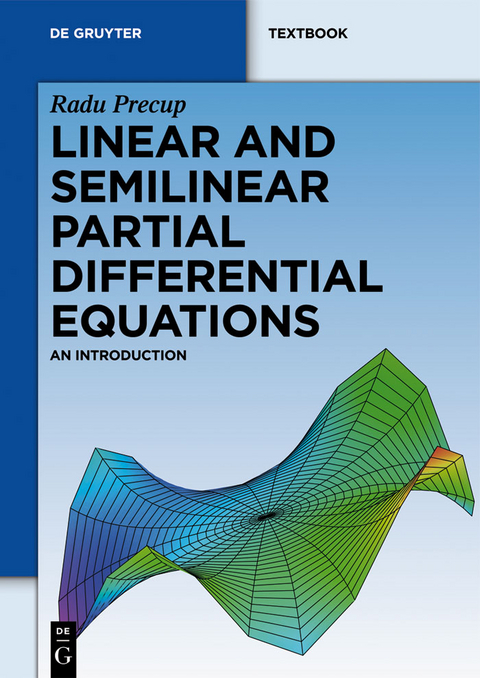
Linear and Semilinear Partial Differential Equations (eBook)
296 Seiten
De Gruyter (Verlag)
978-3-11-026905-5 (ISBN)
This textbook provides a brief and lucid introduction to the theory of linear partial differential equations. It clearly explains the transition from classical to generalized solutions and the natural way in which Sobolev spaces appear as completions of spaces of continuously differentiable functions. The solution operators associated to non-homogeneous equations are used to make transition to the theory of nonlinear PDEs. Organized on three parts, this material is suitable for three one-semester courses, a beginning one in the frame of classical analysis, a more advanced course in modern theory and a master course in semi-linear equations.
Radu Precup, Babe?-Bolyai University of Cluj-Napoca, Romania.
lt;!doctype html public "-//w3c//dtd html 4.0 transitional//en">
Radu Precup, Babeş-Bolyai University of Cluj-Napoca, Romania.
Preface 7
Notation 9
I Classical Theory 15
1 Preliminaries 17
1.1 Basic Differential Operators 17
1.2 Linear and Quasilinear Partial Differential Equations 19
1.3 Solutions of Some Particular Equations 22
1.4 Boundary Value Problems 24
1.4.1 Boundary Value Problems for Poisson’s Equation 24
1.4.2 Boundary Value Problems for the Heat Equation 25
1.4.3 Boundary Value Problems for the Wave Equation 26
2 Partial Differential Equations and Mathematical Modeling 27
2.1 Conservation Laws: Continuity Equations 27
2.2 Reaction-Diffusion Systems 30
2.3 The One-Dimensional Wave Equation 31
2.4 Other Equations in Mathematical Physics 32
3 Elliptic Boundary Value Problems 35
3.1 Green’s Formulas 35
3.2 The Fundamental Solution of Laplace’s Equation 36
3.3 Mean Value Theorems for Harmonic Functions 39
3.4 The Maximum Principle 40
3.5 Uniqueness and Continuous Dependence on Data for the Dirichlet Problem 43
3.6 Green’s Function of the Dirichlet Problem 44
3.7 Poisson’s Formula 45
3.8 Dirichlet’s Principle 48
3.9 The Generalized Solution of the Dirichlet Problem 51
3.10 Abstract Fourier Series 56
3.11 The Eigenvalues and Eigenfunctions of the Dirichlet Problem 59
3.12 The Case of Elliptic Equations in Divergence Form 64
3.13 The Generalized Solution of the Neumann Problem 65
3.14 Complements 69
3.14.1 Harnack’s Inequality 69
3.14.2 Hopf’s Maximum Principle 71
3.14.3 The Newtonian Potential 73
3.14.4 Perron’s Method 76
3.14.5 Layer Potentials 82
3.14.6 Fredholm’s Method of Integral Equations 84
3.15 Problems 85
4 Mixed Problems for Evolution Equations 101
4.1 The Maximum Principle for the Heat Equation 101
4.2 Vector-Valued Functions 104
4.3 The Cauchy-Dirichlet Problem for the Heat Equation 105
4.4 The Cauchy-Dirichlet Problem for the Wave Equation 113
4.5 Problems 116
5 The Cauchy Problem for Evolution Equations 123
5.1 The Fourier Transform 123
5.1.1 The Fourier Transform on L1 (Rn) 123
5.1.2 Fourier Transform and Convolution 124
5.1.3 The Fourier Transform on the Schwartz Space S (R”) 126
5.2 The Cauchy Problem for the Heat Equation 130
5.3 The Cauchy Problem for the Wave Equation 133
5.4 Nonhomogeneous Equations: Duhamel’s Principle 137
5.5 Problems 139
II Modern Theory 143
6 Distributions 145
6.1 The Fundamental Spaces of the Theory of Distributions 145
6.2 Distributions: Examples Operations with Distributions
6.2.1 Regular Distributions 147
6.2.2 The Dirac Distribution 148
6.2.3 Differentiation 148
6.2.4 Multiplication by a Smooth Function 150
6.2.5 Composition with a Smooth Function 151
6.2.6 Convolution 151
6.2.7 Distributions of Compact Support 153
6.2.8 Weyl’s Lemma 156
6.3 The Fourier Transform of Tempered Distributions 156
6.3.1 The Fourier Transform on S' (Rn) 157
6.3.2 The Fourier Transform on L2 (Rn) 158
6.3.3 Convolution in S' 158
6.4 Problems 159
7 Sobolev Spaces 163
7.1 The Sobolev Spaces Hm (O) 163
7.2 The Extension Operator 166
7.3 The Sobolev Spaces H0m (O) 170
7.4 Sobolev’s Continuous Embedding Theorem 173
7.5 Rellich-Kondrachov’s Compact Embedding Theorem 177
7.6 The Embedding of Hm (O) into C (O¯) 179
7.7 The Sobolev Space H-m (O) 181
7.8 Fourier Series in H-1 (O) 186
7.9 Generalized Solutions of the Cauchy Problems 189
8 The Variational Theory of Elliptic Boundary Value Problems 194
8.1 The Variational Method for the Dirichlet Problem 194
8.2 The Variational Method for the Neumann Problem 198
8.3 Maximum Principles for Weak Solutions 200
8.4 Regularity of Weak Solutions 205
8.5 Regularity of Eigenfunctions 212
8.6 Problems 215
III Semilinear Equations 219
9 Semilinear Elliptic Problems 222
9.1 The Nemytskii Superposition Operator 222
9.2 Application of Banach’s Fixed Point Theorem 225
9.3 Application of Schauder’s Fixed Point Theorem 227
9.4 Application of the Leray-Schauder Fixed Point Theorem 229
9.5 The Monotone Iterative Method 232
9.6 The Critical Point Method 234
9.7 Problems 239
10 The Semilinear Heat Equation 241
10.1 The Nonhomogeneous Heat Equation in H-1 (O) 241
10.2 Regularity Results 247
10.3 Application of Banach’s Fixed Point Theorem 252
10.4 Application of Schauder’s Fixed Point Theorem 255
10.5 Application of the Leray-Schauder Fixed Point Theorem 259
11 The Semilinear Wave Equation 262
11.1 The Nonhomogeneous Wave Equation in H-1 (O) 262
11.2 Application of Banach’s Fixed Point Theorem 266
11.3 Application of the Leray-Schauder Fixed Point Theorem 271
12 Semilinear Schrödinger Equations 276
12.1 The Nonhomogeneous Schrödinger Equation 276
12.2 Properties of the Schrödinger Solution Operator 280
12.3 Applications of Banach’s Fixed Point Theorem 282
12.4 Applications of Schauder’s Fixed Point Theorem 286
Bibliography 289
Index 292
| Erscheint lt. Verlag | 6.12.2013 |
|---|---|
| Reihe/Serie | De Gruyter Textbook | De Gruyter Textbook |
| Verlagsort | Berlin/Boston |
| Sprache | englisch |
| Themenwelt | Geisteswissenschaften |
| Mathematik / Informatik ► Mathematik ► Analysis | |
| Sozialwissenschaften ► Pädagogik | |
| Technik | |
| Schlagworte | elliptic boundary value problems • elliptic equation • heat equation • partial differential equation • Partial differential equations • Sobolev Space • Sobolev spaces • Variational theory • wave equation |
| ISBN-10 | 3-11-026905-8 / 3110269058 |
| ISBN-13 | 978-3-11-026905-5 / 9783110269055 |
| Informationen gemäß Produktsicherheitsverordnung (GPSR) | |
| Haben Sie eine Frage zum Produkt? |
 PDF (Wasserzeichen)
Größe: 1,4 MB
DRM: Digitales Wasserzeichen
Dieses eBook enthält ein digitales Wasserzeichen und ist damit für Sie personalisiert. Bei einer missbräuchlichen Weitergabe des eBooks an Dritte ist eine Rückverfolgung an die Quelle möglich.
Dateiformat: PDF (Portable Document Format)
Mit einem festen Seitenlayout eignet sich die PDF besonders für Fachbücher mit Spalten, Tabellen und Abbildungen. Eine PDF kann auf fast allen Geräten angezeigt werden, ist aber für kleine Displays (Smartphone, eReader) nur eingeschränkt geeignet.
Systemvoraussetzungen:
PC/Mac: Mit einem PC oder Mac können Sie dieses eBook lesen. Sie benötigen dafür einen PDF-Viewer - z.B. den Adobe Reader oder Adobe Digital Editions.
eReader: Dieses eBook kann mit (fast) allen eBook-Readern gelesen werden. Mit dem amazon-Kindle ist es aber nicht kompatibel.
Smartphone/Tablet: Egal ob Apple oder Android, dieses eBook können Sie lesen. Sie benötigen dafür einen PDF-Viewer - z.B. die kostenlose Adobe Digital Editions-App.
Buying eBooks from abroad
For tax law reasons we can sell eBooks just within Germany and Switzerland. Regrettably we cannot fulfill eBook-orders from other countries.
aus dem Bereich