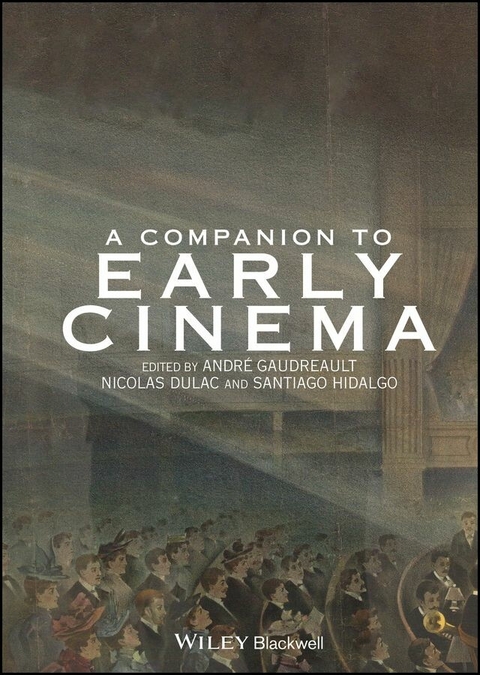
A Companion to Early Cinema (eBook)
John Wiley & Sons (Verlag)
978-1-118-29387-4 (ISBN)
- First collection of its kind to offer in one reference: original theory, new research, and reviews of existing studies in the field
- Features over 30 original essays from some of the leading scholars in early cinema and Film Studies, including Tom Gunning, Jane Gaines, Richard Abel, Thomas Elsaesser, and André Gaudreault
- Caters to renewed interest in film studies’ historical methods, with strict analysis of multiple and competing sources, providing a critical re-contextualization of films, printed material and technologies
- Covers a range of topics in early cinema, such as exhibition, promotion, industry, pre-cinema, and film criticism
- Broaches the latest research on the subject of archival practices, important particularly in the current digital context
André Gaudreault is Professor in Film Studies at the Université de Montréal, where he heads the research group GRAFICS (Groupe de recherche sur l’avènement et la formation des institutions cinématographique et scénique). He is also director of the bilingual journal Cinémas, published in Montreal. He has presented numerous scholarly papers and published extensively on film narration and early cinema.
Nicolas Dulac is Lecturer in Film Studies at the Université de Montréal. He has published on early cinema and turn-of-the-century popular culture in journals such as 1895 Revue d’Histoire du Cinéma, Cinema & Cie, and Early Popular Visual Culture.
Santiago Hidalgo is Lecturer in Film Studies at the Université de Montréal. He has published on early cinema, film criticism, and film historiography in Cinémas and in conference proceedings for events in Udine, Italy and Cerisy, France.
A COMPANION TO EARLY CINEMA This collection of essays by early cinema scholars from Europe and North America offers manifold perspectives on early cinema fiction which perfectly reflect the state of international research. Martin Loiperdinger, Universitaet Trier A fabulous selection of first-rate articles! Rick Altman, University of Iowa One of the most challenging books in recent film studies: in it, early cinema is both a historical object and a contemporary presence. As in a great novel, we can retrace the adventures of the past the films, styles, discourses, and receptions that made cinema the breakthrough reality it was in its first decades. But we can also come to appreciate how much of this reality is still present in our digital world. Francesco Casetti, Yale University A Companion to Early Cinema is an authoritative reference on the field of early cinema. Its 30 peer-reviewed chapters offer cutting-edge research and original perspectives on the major concerns in early cinema studies, and take an ambitious look at ideas and themes that will lead discussions about early cinema into the future. Including work by both established and up-and-coming scholars in early cinema, film theory, and film history, this will be the definitive volume on early cinema history for years to come and a must-have reference for all those working in the field.
André Gaudreault is Professor in Film Studies at the Université de Montréal, where he heads the research group GRAFICS (Groupe de recherche sur l'avènement et la formation des institutions cinématographique et scénique). He is also director of the bilingual journal Cinémas, published in Montreal. He has presented numerous scholarly papers and published extensively on film narration and early cinema. Nicolas Dulac is Lecturer in Film Studies at the Université de Montréal. He has published on early cinema and turn-of-the-century popular culture in journals such as 1895 Revue d'Histoire du Cinéma, Cinema & Cie, and Early Popular Visual Culture. Santiago Hidalgo is Lecturer in Film Studies at the Université de Montréal. He has published on early cinema, film criticism, and film historiography in Cinémas and in conference proceedings for events in Udine, Italy and Cerisy, France.
List of Contributors viii
Acknowledgments xiv
Introduction 1
Nicolas Dulac, André Gaudreault, and SantiagoHidalgo
Part I Early Cinema Cultures 13
1 The Culture Broth and the Froth of Cultures of So-called EarlyCinema 15
André Gaudreault
2 Toward a History of Peep Practice 32
Erkki Huhtamo
3 "We are Here and Not Here": LateNineteenth-Century Stage Magic and the Roots of Cinema in theAppearance (and Disappearance) of the Virtual Image 52
Tom Gunning
4 The Féerie between Stage and Screen 64
Frank Kessler
5 The Théâtrophone, an Anachronistic Hybrid Experimentor One of the First Immobile Traveler Devices? 80
Giusy Pisano
6 The "Silent" Arts: Modern Pantomime and the Makingof an Art Cinema in Belle Époque Paris: The Case of GeorgesWague and Germaine Dulac 99
Tami Williams
Part II Early Cinema Discourses 119
7 First Discourses on Film and the Construction of a"Cinematic Episteme" 121
François Albera
8 The Discourses of Art in Early Film, or, Why NotRancière? 141
Rob King
9 Sensationalism and Early Cinema 163
Annemone Ligensa
10 From Craft to Industry: Series and Serial ProductionDiscourses and Practices in France 183
Laurent Le Forestier
11 Early American Film Publications: Film Consciousness, SelfConsciousness 202
Santiago Hidalgo
12 Early Cinema and Film Theory 224
Roger Odin
Part III Early Cinema Forms 243
13 A Bunch of Violets 245
Ben Brewster
14 Modernity Stops at Nothing: The American Chase Film and theSpecter of Lynching 257
Jan Olsson
15 "The Knowledge Which Comes in Pictures":Educational Films and Early Cinema Audiences 277
Jennifer Peterson
16 Motion Picture Color and Pathé-Frères: TheAesthetic Consequences of Industrialization 298
Charles O ' Brien
Part IV Early Cinema Presentations 315
17 The European Fairground Cinema: (Re)defining and(Re)contextualizing the "Cinema of Attractions"317
Joseph Garncarz
18 Early Film Programs: An Overture, Five Acts, and an Interlude334
Richard Abel
19 "Half Real-Half Reel": Alternation FormatStage-and-Screen Hybrids 360
Gwendolyn Waltz
20 Advance Newspaper Publicity for the Vitascope and the MassAddress of Cinema 's Reading Public 381
Paul S. Moore
21 Storefront Theater Advertising and the Evolution of theAmerican Film Poster 398
Kathryn H. Fuller-Seeley
22 Bound by Cinematic Chains: Film and Prisons during the EarlyEra 420
Alison Griffiths
Part V Early Cinema Identities 441
23 Anonymity: Uncredited and Unknown in Early Cinema 443
Jane M. Gaines
24 The Invention of Cinematic Celebrity in the United Kingdom460
Andrew Shail
25 The Film Lecturer 487
Germain Lacasse
26 Richard Hoffman: A Collector's Archive 498
Richard Koszarski
Part VI Early Cinema Recollections 525
27 Early Films in the Age of Content; or, "Cinema ofAttractions" Pursued by Digital Means 527
Paolo Cherchi Usai
28 Multiple Originals: The (Digital) Restoration and Exhibitionof Early Films 550
Giovanna Fossati
29 Pointing Forward, Looking Back: Reflexivity and Deixis inEarly Cinema and Contemporary Installations 568
Nanna Verhoeff
30 Is Nothing New? Turn-of-the-Century Epistemes in Film History587
Thomas Elsaesser
Index 610
"This book is an authoritative reference on the field of early
cinema.It includes work by established and up-and-coming scholars
that offers the cutting-edge research and original perspectives.
Its 30 chapters are a must-have reference for those working in
field." (Wonderpedia, 19 September 2013)
"It goes without saying that it deserves to be on the library
shelves of institutions where the subject forms part of the
academic curriculum." (Reference Reviews, 1 June
2013)
"One of the strengths of this substantial 'companion' is that it
raises the issue of definition in a variety of provocative
ways." (Sight & Sound, 1 February 2013)
"The essays are well researched and display a refreshing diversity
of approaches. Even as the discipline of cinema and media studies
turns to newer media, early cinema continues to posses a certain
allure." (Nineteenth Century Theatre and Film, Summer
2013)
"This collection of essays by early cinema scholars from
Europe and North America offers manifold perspectives on early
cinema fiction which perfectly reflect the state of international
research." - Dr. Martin Loiperdinger, Universität
Trier
"A fabulous selection of first-rate essays! -Rick
Altman, University of Iowa
"One of the most thought-provoking books in recent film
studies: in it, early cinema is both a historical object and a
contemporary presence. As in a great novel, we can retrace the
adventures of the past - the films, styles, discourses, and
receptions, that made cinema the breakthrough reality it was in its
first decades. But we can also come to appreciate how much of this
reality is still present in our digital world." -Francesco
Casetti, Yale University
List of Contributors
Richard Abel is Robert Altman Collegiate Professor of Film Studies in Screen Arts & Cultures at the University of Michigan. Most recently he published Americanizing the Movies and “Movie-Mad” Audiences, 1910–1914 (2006), co-edited Early Cinema and the “National” (2008), and edited a paperback version of the Encyclopedia of Early Cinema (2010). His current project is Menus for Movie Land: Newspapers and the Emergence of American Film Culture, 1913–1916.
François Albera is Professor of History and Aesthetics of Cinema at the Université de Lausanne (Switzerland). A specialist in Soviet and Russian Cinema Studies, he has written Eisenstein et le constructivisme russe (1989), Albatros; des russes à Paris 1919–1929 (1995), and L’avant-garde au cinéma (2006), and edited many books, including S. M. Eisenstein: cinématisme (1980) and Les Formalistes russes et le cinéma, poétique du film (1995). Albera is also a regular contributor to 1895 Revue d’Histoire du Cinéma and was for many years its chief editor.
Ben Brewster has just retired from a position as Assistant Director of the Wisconsin Center for Film and Theater Research at the University of Wisconsin-Madison. He formerly taught at the University of Kent at Canterbury, and was editor of Screen. He has published on early and silent cinema in such journals as Screen, Cinema Journal, and Film History.
Paolo Cherchi Usai, Senior Curator of Film at George Eastman House in Rochester, NY, is Curator Emeritus of the National Film and Sound Archive of Australia and co-founder of the Pordenone Silent Film Festival and the L. Jeffrey Selznick School of Film Preservation. He directed the experimental film Passio (2007), adapted from his book The Death of Cinema (2001). His most recent work is Film Curatorship: Archives, Museums, and the Digital Marketplace (2008).
Nicolas Dulac is Lecturer in Film Studies at the Université de Montréal, where he is also a researcher for GRAFICS (Groupe de recherche sur l’avènement et la formation des institutions cinématographique et scénique). He has published on early cinema and turn-of-the-century popular culture in journals such as 1895 Revue d’Histoire du Cinéma, Cinéma & Cie, and Early Popular Visual Culture.
Thomas Elsaesser is Professor Emeritus of Film and Television Studies at the Universiteit van Amsterdam and, since 2006, Visiting Professor at Yale University. He has authored, edited, and co-edited some twenty volumes. Among his recent books as author are European Cinema: Face to Face with Hollywood (2005), Terror und Trauma (2007), Film Theory: An Introduction through the Senses (2010, with Malte Hagener), and The Persistence of Hollywood (2011).
Giovanna Fossati is Head Curator of EYE Film Institute Netherlands. She holds a Ph.D. in Media Studies (Universiteit Utrecht) and teaches in the MA Preservation and Presentation of the Moving Image (Universiteit van Amsterdam). Her recent publications include articles in The YouTube Reader (Pelle Snickars and Patrick Vonderau, eds., 2009) and the book From Grain to Pixel: The Archival Life of Film in Transition (2009).
Kathryn H. Fuller-Seeley is a Professor in the Department of Communication at Georgia State University. A cultural historian of film, radio, and television, she is the author of numerous essays and has written or edited four books, including, as editor, Hollywood in the Neighborhood: Historical Case Studies of Local Moviegoing (2008), and the single-author volumes At the Picture Show: Small Town Audiences and the Creation of Movie Fan Culture (2000) and Celebrate Richmond Theater (2001).
Jane M. Gaines is a Professor of Film Studies at Columbia University in New York. She has won national awards for two books: Contested Culture: The Image, the Voice, and the Law (1991) and Fire and Desire: Mixed Race Movies in the Silent Era (2001). She has published articles on intellectual property and early piracy as well as documentary film and video and co-edited Collecting Visible Evidence (1999). Currently, she is completing Fictioning Histories: Women Film Pioneers, a project for which she received an Academy of Motion Picture Arts and Sciences scholar award.
Joseph Garncarz is currently Privatdozent for Theater, Film, and Television Studies at the Universität zu Köln, Germany, and has regularly been a visiting professor at several European universities. A social historian of media, his publications include Hollywood in Deutschland: Zur Internationalisierung der Kinokultur 1925–1990 (2012) and Maßlose Unterhaltung: Zur Etablierung des Films in Deutschland 1896–1914 (2010). Many of his articles have been translated from German into English, French, Czech, and Polish.
André Gaudreault is a Professor in the Département d’histoire de l’art et d’études cinématographiques at the Université de Montréal. He is the author of From Plato to Lumière: Narration and Monstration in Literature and Cinema (2009) and Film and Attraction (2011), and the editor of American Cinema 1890–1909: Themes and Variations (2009). He is preparing with Philippe Gauthier a book entitled From Pathé to Griffith: Crosscutting in Early Cinema, to be published in 2013.
Alison Griffiths is Professor of Film and Media at Baruch College, The City University of New York and a member of the doctoral faculty in theater at the CUNY Graduate Center. She is the author of the award-winning volume Wondrous Difference: Cinema, Anthropology, and Turn-of-the-Century Visual Culture (2002), Shivers Down Your Spine: Cinema, Museums, and the Immersive View (2008) and numerous essays on pre-cinema, museums, and visual culture. Her current book project is entitled Screens behind Bars: Cinema, Prisons, and the Making of Modern America.
Tom Gunning is Edwin A. and Betty L. Bergman Distinguished Service Professor, Department of Cinema and Media, University of Chicago. He is the author of D. W. Griffith and the Origins of American Narrative Film (1993) and The Films of Fritz Lang; Allegories of Vision and Modernity (2008), as well as over a hundred articles. In 2009 he was awarded a Andrew A. Mellon Distinguished Achievement Award. He is working on a book on the invention of the moving image.
Santiago Hidalgo is a Lecturer in Film Studies at the Université de Montréal, where he has worked as researcher and translator for GRAFICS (Groupe de recherche sur l’avènement et la formation des institutions cinématographique et scénique). He was formerly coordinator of the Research Team on the History and Epistemology of Film Studies at Concordia University. He has published on the subject of early cinema and film criticism in Cinémas and in conference proceedings for events in Udine, Italy and Cerisy, France.
Erkki Huhtamo is a Professor of Design and Media Arts at the University of California, Los Angeles. He has published extensively on various aspects of media culture and media arts. Recently he co-edited with Jussi Parikka Media Archaeology: Approaches, Applications, and Implications (2011). His major monograph Illusions in Motion: Media Archaeology of the Moving Panorama and Related Spectacles is forthcoming in 2012.
Frank Kessler is a Professor of Media History at the Universiteit Utrecht. He has published widely on early cinema and the history of film theory. He co-founded and co-edited KINtop: Jahrbuch zur Erforschung des frühen Films and co-edits the KINtop-Schriften book series. From 2003 to 2007 he was the president of the international association DOMITOR. Together with Nanna Verhoeff he edited Networks of Entertainment: Early Film Distribution 1895–1915 (2007).
Rob King is an Assistant Professor of Cinema Studies and History at the University of Toronto. His published work includes The Fun Factory: The Keystone Film Company and the Emergence of Mass Culture (2009) and the co-edited collections Slapstick Comedy (2010) and Early Cinema and the “National” (2008).
Richard Koszarski is editor-in-chief of Film History: An International Journal. His books include Hollywood on the Hudson (2008), Fort Lee, the Film Town (2004), Von: The Life and Films of Erich von Stroheim (2001), and An Evening’s Entertainment (1990). He is currently Professor of English at Rutgers University.
Germain Lacasse is a Professor in the Département d’histoire de l’art et d’études cinématographiques at Université de Montréal. Specializing in early cinema and Quebec cinema, he is the author of a comparative study of the film lecturer in different countries. For the past several years, he has been directing a research project studying the historical and theoretical relationship between film and the oral tradition. His research projects focus on...
| Erscheint lt. Verlag | 17.7.2012 |
|---|---|
| Sprache | englisch |
| Themenwelt | Kunst / Musik / Theater ► Film / TV |
| Sozialwissenschaften | |
| Schlagworte | Archival • Criticism • Cultural Studies • Exhibition • Film • Filmforschung • Film Studies • Filmtheater • Geschichte des Filmtheaters • historical methods • History of Cinema • Industry • Kulturwissenschaften • Pre-cinema • Promotion |
| ISBN-10 | 1-118-29387-8 / 1118293878 |
| ISBN-13 | 978-1-118-29387-4 / 9781118293874 |
| Informationen gemäß Produktsicherheitsverordnung (GPSR) | |
| Haben Sie eine Frage zum Produkt? |
 EPUB (Adobe DRM)
Kopierschutz: Adobe-DRM
Adobe-DRM ist ein Kopierschutz, der das eBook vor Mißbrauch schützen soll. Dabei wird das eBook bereits beim Download auf Ihre persönliche Adobe-ID autorisiert. Lesen können Sie das eBook dann nur auf den Geräten, welche ebenfalls auf Ihre Adobe-ID registriert sind.
Details zum Adobe-DRM
Dateiformat: EPUB (Electronic Publication)
EPUB ist ein offener Standard für eBooks und eignet sich besonders zur Darstellung von Belletristik und Sachbüchern. Der Fließtext wird dynamisch an die Display- und Schriftgröße angepasst. Auch für mobile Lesegeräte ist EPUB daher gut geeignet.
Systemvoraussetzungen:
PC/Mac: Mit einem PC oder Mac können Sie dieses eBook lesen. Sie benötigen eine
eReader: Dieses eBook kann mit (fast) allen eBook-Readern gelesen werden. Mit dem amazon-Kindle ist es aber nicht kompatibel.
Smartphone/Tablet: Egal ob Apple oder Android, dieses eBook können Sie lesen. Sie benötigen eine
Geräteliste und zusätzliche Hinweise
Buying eBooks from abroad
For tax law reasons we can sell eBooks just within Germany and Switzerland. Regrettably we cannot fulfill eBook-orders from other countries.
aus dem Bereich