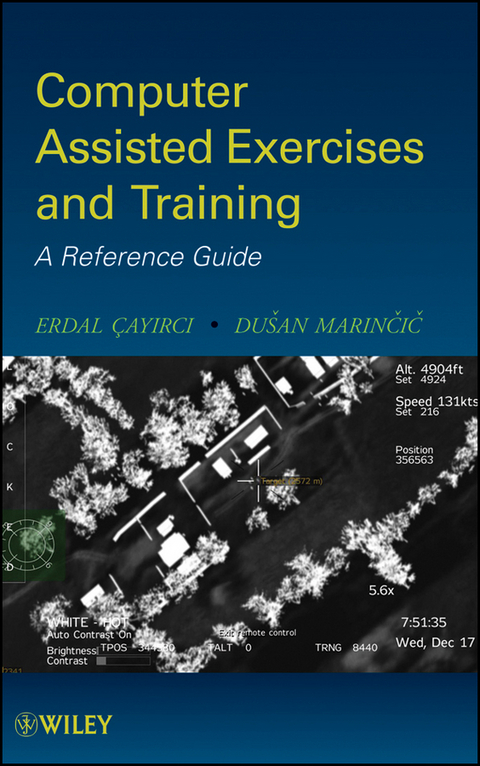
Computer Assisted Exercises and Training (eBook)
312 Seiten
John Wiley & Sons (Verlag)
978-0-470-49861-3 (ISBN)
Readers can turn to this indispensable reference guide for
comprehensive and lucid coverage of the operational, technical, and
organizational knowledge needed to harness successful and
constructive computer assisted exercises (CAX) and war games. It is
geared also toward large civilian organizations that are looking to
teach and test their strategies and procedures without the added
cost of manpower. Divided into two clear parts, the book
covers:
* Fundamentals and Theory--conflict and warfare; probability
and statistics; simulation; distributed simulation; and
experimentation and analysis
* Combat Modeling, Computer Assisted Exercises, and
Practice--CAX architectures; CAX process; combat modeling; CAX
support tools; communications/information system issues, technical
risks, and risk miti-gation; and exercise centers and
facilities
Computer Assisted Exercises and Training: A Reference Guide is
indispensable reading for research engineers, computer scientists,
software engineers working with modeling and simulation, homeland
security specialists, staff in simulation training centers,
military strategists and commanders, and many others. It also
serves as a valuable textbook for modeling and simulation courses
at the upper-undergraduate and graduate levels.
Erdal Çayirci, Chief CAX Support Branch, NATO Joint Warfare Center, Norway, retired from the army as colonel in 2005. His research interests include military construction simulation sensor networks, mobile communications, and tactical communications. He was an editor for IEEE Transactions on Mobile Computing and the journals Ad Hoc Networks and Wireless Networks. DuSan Marincic is Subject Matter Expert, NATO Joint Warfare Center, Norway. His areas of interest have been the dynamics of a global security environment, multivariate analysis of societal security dimensions in the area of complex emergencies, and computer simulation modeling of peace operations.
PREFACE.
ABOUT AUTHORS.
PART I FUNDAMENTALS AND THEORY.
1 Introduction.
1.1 Contemporary Security Environment.
1.2 Exercises.
1.3 Military Simulation.
1.4 Scope of the Book.
1.5 Structure of the Book.
1.6 Electronic Resources for the Book.
1.7 Review Questions.
2 Conflict and Warfare.
2.1 Paradigms of War.
2.2 Evolution of Warfare.
2.3 Operations.
2.4 Comprehensive Approach to Operations.
2.5 Review Questions.
3 Statistics and Probability.
3.1 Descriptive Statistics: Population, Sample, Central
Tendency, and Dispersion.
3.2 Probability.
3.3 Random Variable.
3.4 Inferential Statistics.
3.5 Review Questions.
4 Simulation.
4.1 Pseudorandom Number Generation and Realization of Random
Variables.
4.2 Static Simulation.
4.3 Dynamic Simulation.
4.4 Phases in a Simulation.
4.5 Review Questions.
5 Distributed Simulation.
5.1 Distributed Interactive Simulation.
5.2 High-Level Architecture.
5.3 Base Object Model (BOM).
5.4 Review Questions.
6 Experimentation and Analysis.
6.1 Design of Experiment.
6.2 Execution of Experiments.
6.3 Data Analysis, Reporting, and Presentation.
6.4 Review Questions.
PART II COMBAT MODELING, COMPUTER-ASSISTED EXERCISES, AND
PRACTICE.
7 Computer-Assisted Exercise (CAX) Architectures.
7.1 Distributed Exercises and Distributed Simulation.
7.2 Multilevel and Multiresolution Exercises.
7.3 Cross-Level, Joint, and Combined Exercises.
7.4 Excon Structure.
7.5 Response Cells.
7.6 Training Audience.
7.7 Review Questions.
8 CAX PROCESS.
8.1 Exercise Specification.
8.2 Planning and Preparation.
8.3 Execution.
8.4 Analysis.
8.5 Review Questions.
9 Combat Modeling.
9.1 Terrain Modeling.
9.2 Attrition and Movement.
9.3 Challenges in the Quantification for Nonkinetic Warfare.
9.4 Automated Forces.
9.5 Challenges and Approaches in the Implementation.
9.6 Combat Model Data.
9.7 Verification and Validation of Combat Models.
9.8 Experimentation and Analysis of Operational Plans.
9.9 Review Questions.
10 Computer-Assisted Exercise Support Tools.
10.1 Military Constructive Simulations and Ancillary Tools.
10.2 Planning and Management Tools.
10.3 Mediation-Ware.
10.4 Review Questions.
11 Communications/Information System Issues, Technical Risks,
and Risk Mitigation.
11.1 Hardware and Software Requirements.
11.2 Communications and QoS Requirements.
11.3 Security Issues and Challenges.
11.4 Game Crashes, Checkpoints, and Crash Recovery.
11.5 Shadow/Run Ahead Games.
11.6 Backups and Archives.
11.7 Networking Service Outages and Other Reasons for
Failure.
11.8 Review Questions.
12 Exercise Centers and Facilities.
12.1 Organization of a Training/Exercise Center.
12.2 Design Principles for Training/Exercise Center
Facilities.
12.3 Review Question.
REFERENCES.
ACRONYMS.
INDEX.
| Erscheint lt. Verlag | 16.7.2009 |
|---|---|
| Sprache | englisch |
| Themenwelt | Mathematik / Informatik ► Informatik |
| Sozialwissenschaften ► Politik / Verwaltung | |
| Technik ► Elektrotechnik / Energietechnik | |
| Schlagworte | Computer Science • Drahtlose Kommunikation • Electrical & Electronics Engineering • Elektrotechnik u. Elektronik • Informatik • Mobile & Wireless Communications • Programmierung u. Software-Entwicklung • Programming & Software Development • Software engineering • Software-Engineering |
| ISBN-10 | 0-470-49861-7 / 0470498617 |
| ISBN-13 | 978-0-470-49861-3 / 9780470498613 |
| Informationen gemäß Produktsicherheitsverordnung (GPSR) | |
| Haben Sie eine Frage zum Produkt? |
 PDF (Adobe DRM)
Kopierschutz: Adobe-DRM
Adobe-DRM ist ein Kopierschutz, der das eBook vor Mißbrauch schützen soll. Dabei wird das eBook bereits beim Download auf Ihre persönliche Adobe-ID autorisiert. Lesen können Sie das eBook dann nur auf den Geräten, welche ebenfalls auf Ihre Adobe-ID registriert sind.
Details zum Adobe-DRM
Dateiformat: PDF (Portable Document Format)
Mit einem festen Seitenlayout eignet sich die PDF besonders für Fachbücher mit Spalten, Tabellen und Abbildungen. Eine PDF kann auf fast allen Geräten angezeigt werden, ist aber für kleine Displays (Smartphone, eReader) nur eingeschränkt geeignet.
Systemvoraussetzungen:
PC/Mac: Mit einem PC oder Mac können Sie dieses eBook lesen. Sie benötigen eine
eReader: Dieses eBook kann mit (fast) allen eBook-Readern gelesen werden. Mit dem amazon-Kindle ist es aber nicht kompatibel.
Smartphone/Tablet: Egal ob Apple oder Android, dieses eBook können Sie lesen. Sie benötigen eine
Geräteliste und zusätzliche Hinweise
Buying eBooks from abroad
For tax law reasons we can sell eBooks just within Germany and Switzerland. Regrettably we cannot fulfill eBook-orders from other countries.
aus dem Bereich