


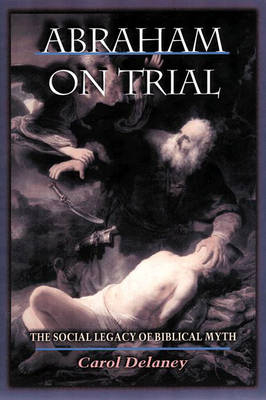
Abraham on Trial
The Social Legacy of Biblical Myth
Seiten
1998
Princeton University Press (Verlag)
978-0-691-05985-3 (ISBN)
Princeton University Press (Verlag)
978-0-691-05985-3 (ISBN)
- Titel ist leider vergriffen;
keine Neuauflage - Artikel merken
Through his desire to obey God at all costs, even if it meant sacrificing his son, Abraham became the definitive model of faith for Judaism, Christianity and Islam. This study of the legacy of this biblical and qur'anic story explores how the sacrifice of children became the focus of faith.
This work questions the foundations of faith that have made a virtue out of the willingness to sacrifice a child. Through his desire to obey God at all costs, even if it meant sacrificing his son, Abraham became the definitive model of faith for the major world religions of Judaism, Christianity and Islam. In this examination of the legacy of this biblical and qur'anic story, the author explores how the sacrifice rather than the protection of children became the focus of faith, to the point where the abuse and betrayal of children has today become widespread and sometimes institutionalized. Delaney's analysis offers a different perspective on what unites and divides the peoples of sibling religions derived from Abraham, and a way to overcome the increasing violence among them. Delaney critically examines evidence from Jewish, Christian and Muslim interpretations, from archaeology and Freudian theory, as well as a recent trial in which a father sacrificed his child in obedience to God's voice, and shows how the meaning of Abraham's story is bound up with a specific notion of fatherhood.
The pre-eminence of the father (which is part of the meaning of the name Abraham) comes from the still operative theory of procreation in which men transmit life by means of their "seed", an image that encapsulates the generative, creative power that symbolically allies men with God. Kinship and origin myths, the cultural construction of fatherhood and motherhood, suspicions of actual child sacrifices in ancient times, and a revisiting of Freud's Oedipus complex contribute to this book's discussion. Delaney shows how the story of Abraham legitimates a hierarchical structure of authority, a specific form of family, definitions of gender and the value of obedience that have become a foundation of society. The book asks whether we should perpetuate this story and the lessons it teaches.
This work questions the foundations of faith that have made a virtue out of the willingness to sacrifice a child. Through his desire to obey God at all costs, even if it meant sacrificing his son, Abraham became the definitive model of faith for the major world religions of Judaism, Christianity and Islam. In this examination of the legacy of this biblical and qur'anic story, the author explores how the sacrifice rather than the protection of children became the focus of faith, to the point where the abuse and betrayal of children has today become widespread and sometimes institutionalized. Delaney's analysis offers a different perspective on what unites and divides the peoples of sibling religions derived from Abraham, and a way to overcome the increasing violence among them. Delaney critically examines evidence from Jewish, Christian and Muslim interpretations, from archaeology and Freudian theory, as well as a recent trial in which a father sacrificed his child in obedience to God's voice, and shows how the meaning of Abraham's story is bound up with a specific notion of fatherhood.
The pre-eminence of the father (which is part of the meaning of the name Abraham) comes from the still operative theory of procreation in which men transmit life by means of their "seed", an image that encapsulates the generative, creative power that symbolically allies men with God. Kinship and origin myths, the cultural construction of fatherhood and motherhood, suspicions of actual child sacrifices in ancient times, and a revisiting of Freud's Oedipus complex contribute to this book's discussion. Delaney shows how the story of Abraham legitimates a hierarchical structure of authority, a specific form of family, definitions of gender and the value of obedience that have become a foundation of society. The book asks whether we should perpetuate this story and the lessons it teaches.
Carol Delaney is Associate Professor in Cultural and Social Anthropology at Stanford University. She has a Master's degree in Theological Studies from Harvard Divinity School and a Doctorate in Cultural Anthropology from the University of Chicago. Her other works include The Seed and the Soil: Gender and Cosmology in Turkish Village Society.
| Zusatzinfo | 14 halftones |
|---|---|
| Verlagsort | New Jersey |
| Sprache | englisch |
| Maße | 152 x 229 mm |
| Gewicht | 652 g |
| Themenwelt | Religion / Theologie ► Christentum ► Bibelausgaben / Bibelkommentare |
| Geisteswissenschaften ► Religion / Theologie ► Judentum | |
| Geisteswissenschaften ► Religion / Theologie ► Islam | |
| Sozialwissenschaften ► Soziologie | |
| ISBN-10 | 0-691-05985-3 / 0691059853 |
| ISBN-13 | 978-0-691-05985-3 / 9780691059853 |
| Zustand | Neuware |
| Informationen gemäß Produktsicherheitsverordnung (GPSR) | |
| Haben Sie eine Frage zum Produkt? |
Mehr entdecken
aus dem Bereich


aus dem Bereich
Buch | Softcover (2021)
De Gruyter (Verlag)
CHF 44,90


