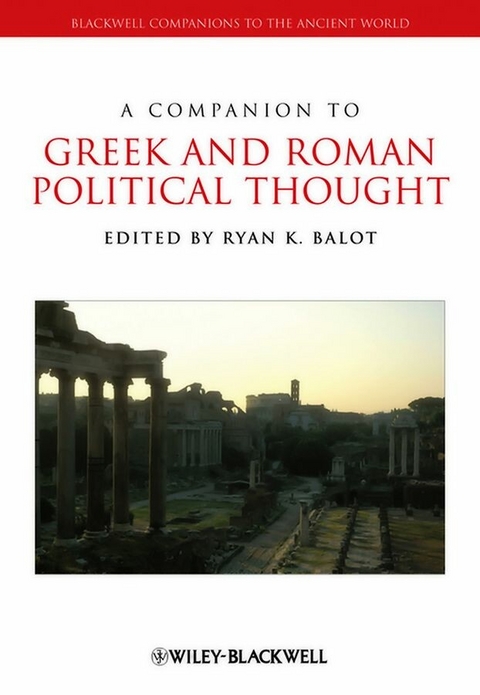
A Companion to Greek and Roman Political Thought (eBook)
John Wiley & Sons (Verlag)
978-1-118-55668-9 (ISBN)
- Offers a broad survey of ancient political thought from Archaic Greece through Late Antiquity
- Approaches ancient political philosophy from both a normative and historical focus
- Examines Greek and Roman political thought within historical context and contemporary debate
- Explores the role of ancient political thought in a range of philosophies, such as the individual and community, human rights, religion, and cosmopolitanism
Ryan K. Balot is Associate Professor of Political Science at the University of Toronto. The author of Greed and Injustice in Classical Athens (2001) and Greek Political Thought (Blackwell, 2006), he specializes in the history of political thought.
A COMPANION TO GREEK AND ROMAN POLITICAL THOUGHT Justice, virtue, and citizenship were at the center of political life in ancient Greece and Rome and were frequently discussed by classical poets, historians, and philosophers. This Companion illuminates Greek and Roman political thought in all its range, diversity, and depth. Thirty-four essays from leading scholars in history, classics, philosophy, and political science provide stimulating discussions of classical political thought, ranging from the Archaic Greek epics to the final days of the Roman Empire and beyond. These essays strike a judicious yet thought-provoking balance between theoretical and historical perspectives. A Companion to Greek and Roman Political Thought is an authoritative guide to the ancient Greek and Roman political questions that continue to shape and challenge the modern world.
Ryan K. Balot is Associate Professor of Political Science at the University of Toronto. The author of Greed and Injustice in Classical Athens (Princeton, 2001) and Greek Political Thought (Blackwell, 2006), he specializes in the history of political thought.
Notes on Contributors x
Acknowledgments xvi
Note on Translations xvii
List of Abbreviations xviii
Part I The Broad View 1
1 Introduction: Rethinking the History of Greek and Roman Political Thought 3
Ryan K. Balot
2 What is Politics in the Ancient World? 20
Dean Hammer
3 Early Greek Political Thought in Its Mediterranean Context 37
Kurt A. Raaflaub
4 Civic Ideology and Citizenship 57
P. J. Rhodes
5 Public Action and Rational Choice in Classical Greek Political Theory 70
Josiah Ober
6 Imperial Ideologies, Citizenship Myths, and Legal Disputes in Classical Athens and Republican Rome85
Craige B. Champion
7 Gendered Politics, or the Self-Praise of Andres Agathoi 100
Giulia Sissa
8 The Religious Contexts of Ancient Political Thought 118
Robin Osborne
Part II Democracies and Republics 131
9 Democracy Ancient and Modern 133
Peter Liddel
10 ''Rights,'' Individuals, and Communities in Ancient Greece 149
Paul Cartledge and Matt Edge
11 Personal Freedom in Greek Democracies, Republican Rome, and Modern Liberal States 164
Robert W. Wallace
12 The Mixed Constitution in Greek Thought 178
David E. Hahm
13 Republican Virtues 199
Malcolm Schofield
14 Roman Democracy? 214
W. Jeffrey Tatum
Part III The Virtues and Vices of One-Man Rule 229
15 The Uses and Abuses of Tyranny 231
Sara Forsdyke
16 Hellenistic Monarchy in Theory and Practice 247
Arthur M. Eckstein
17 The Ethics of Autocracy in the Roman World 266
Carlos F. Noreña
Part IV The Passions of Ancient Politics 281
18 Political Animals: Pathetic Animals 283
Giulia Sissa
19 Anger, Eros, and Other Political Passions in Ancient Greek Thought 294
Paul W. Ludwig
20 Some Passionate Performances in Late Republican Rome 308
Robert A. Kaster
Part V The Athens of Socrates, Plato, and Aristotle 321
21 The Trial and Death of Socrates 323
Debra Nails
22 The Politics of Plato's Socrates 339
Rachana Kamtekar
23 Freedom, Tyranny, and the Political Man: Plato's Republic and Gorgias, a Study in Contrasts 353
Arlene W. Saxonhouse
24 Plato on the Sovereignty of Law 367
Zena Hitz
25 ''Naturalism'' in Aristotle's Political Philosophy 382
Timothy Chappell
26 The Ethics of Aristotle's Politics 399
David J. Depew
Part VI Constructing Political Narrative 419
27 Imitating Virtue and Avoiding Vice: Ethical Functions of Biography, History, and Philosophy 421
Charles W. Hedrick, Jr
28 Greek Drama and Political Thought 440
John Gibert
29 Character in Politics 456
Philip A. Stadter
Part VII Antipolitics 471
30 Cosmopolitan Traditions 473
David Konstan
31 False Idles: The Politics of the ''Quiet Life'' 485
Eric Brown
32 Citizenship and Signs: Rethinking Augustine on the Two Cities 501
Todd Breyfogle
Part VIII Receptions 527
33 Republicanism: Ancient, Medieval, and Beyond 529
Christopher Nadon
34 Twentieth Century Revivals of Ancient Political Thought: Hannah Arendt and Leo Strauss 542
Catherine H. Zuckert
References 557
Index of Subjects 620
Index Locorum 650
"This is an extremely valuable volume, a must for every library; perhaps the paperback will be priced within the reach of at least some individuals." (The Heythrop Journal, 14 April 2015)
"Of note is the indispensable list of primary sources and a prodigious bibliography of secondary texts. These alone probably justify the purchase price." (CHOICE, 2009)
Notes on Contributors
Ryan K. Balot is Associate Professor of Political Science at the University of Toronto. The author of Greed and Injustice in Classical Athens (2001) and Greek Political Thought (2006), he specializes in the history of political thought. He received his doctorate in Classics at Princeton and his BA degrees in Classics from the University of North Carolina-Chapel Hill and Corpus Christi College, Oxford, where he studied as a Rhodes Scholar. Balot is currently at work on Courage and Its Critics in Democratic Athens, from which he has published articles in the American Journal of Philology, Classical Quarterly, Ancient Philosophy, and Social Research.
Todd Breyfogle is Director of Seminars for the Aspen Institute. He studied at Colorado College and Corpus Christi College, Oxford (as a Rhodes Scholar) before earning his PhD from the Committee on Social Thought at the University of Chicago. He is coeditor of a five-volume commentary on Augustine’s City of God (forthcoming from Oxford University Press) and edited Literary Imagination, Ancient and Modern: Essays in Honor of David Grene (1999). He has authored numerous articles on subjects ranging from Augustine, to J. S. Bach, to contemporary political theory.
Eric Brown is Associate Professor of Philosophy at Washington University in St Louis, and the author of several articles on Greek and Roman philosophy, and of Stoic Cosmopolitanism (forthcoming). Before moving to St Louis, he studied Classics and Philosophy at the universities of Cambridge, Pittsburgh, and Chicago.
Paul Cartledge is A. G. Leventis Professor of Greek Culture within the Faculty of Classics at the University of Cambridge and a Fellow of Clare College; he also holds the visiting position of Hellenic Parliament Global Distinguished Professor in the Theory and History of Democracy at New York University. His latest book is Ancient Greek Political Thought in Practice (2009).
Craige B. Champion is Associate Professor of Ancient History and Classics and Chair of the History Department in the Maxwell School of Citizenship and Public Affairs at Syracuse University. In 2004, he won the Daniel Patrick Moyni-han Award in recognition of scholarly productivity, teaching excellence, and community service. His scholarly interests lie in the history of the hellenistic world and the Middle Roman Republic, and Greek and Roman historiography. He has had an enduring interest in the ancient Greek historian Polybius. He is the author of Cultural Politics in Polybius’s Histories (2004), editor of Roman Imperialism: Readings and Sources (2004), and coeditor, with Arthur M. Eckstein, of a new, annotated, two-volume English-language edition of Polybius, The Landmark Edition of Polybius’ Histories (forthcoming). He has published numerous articles and review essays on ancient Greek and Roman history and historiography.
Timothy Chappell is Professor of Philosophy at The Open University, Milton Keynes, England, and Director of the Open University Ethics Centre. His books are Values and Virtues: Aristote-lianism in Contemporary Ethics (2007); The Inescapable Self (2005); Reading Plato’s Theaetetus (2004); Human Values: New Essays in Ethics and Natural Law (edited with David Oderberg, 2004); Understanding Human Goods (1998); Philosophy of the Environment (1997); The Plato Reader (1996); and Aristotle and Augustine on Freedom (1995).
David J. Depew is Professor in the Department of Communication Studies and the interdisciplinary Project on the Rhetoric of Inquiry (POROI) at the University of Iowa. He writes on the philosophy, history, and rhetoric of biology and its relation to culture in ancient and modern times, with special attention to Aristotle and Darwinism. He is coauthor with Marjorie Grene of Philosophy of Biology: An Episodic History (2004). Recent publications include “Consequence Etiology and Biological Teleology in Aristotle and Darwin,” (2008).
Arthur M. Eckstein is Professor of History at the University of Maryland, and a specialist in the history of the hellenistic world and Roman imperialism under the Republic. He has published four books, a coedited book, and 50 major scholarly articles. His two most recent books, Mediterranean Anarchy, Interstate War, and the Rise of Rome (2006) and Rome Enters the Greek East: From Anarchy to Hierarchy in the Hellenistic Mediterranean, 230–170 BC (2008), are pioneering efforts at combining modern international-systems theory with ancient history.
Matt Edge has recently completed his PhD at the University of Cambridge, on the notion of individual freedom in classical Athens and its modern equivalent, and is in the process of submitting this for publication as a number of articles. His main interests are in political and moral philosophy, particularly the concepts of liberty, cosmopolitanism, and socialism.
Sara Forsdyke is Associate Professor in the Department of Classical Studies at the University of Michigan. She is the author of Exile, Ostracism, and Democracy: The Politics of Expulsion in Ancient Greece (2005) and numerous articles on Greek history, Herodotus, and Greek political thought.
John Gibert is Associate Professor of Classics at the University of Colorado at Boulder. He is the author of Change of Mind in Greek Tragedy (1995), coauthor (with C. Collard and M. J. Cropp) of Euripides: Selected Fragmentary Plays II (2004), and has written articles, chapters, and reviews on Greek drama, religion, and philosophy (including “The Sophists,” in the Blackwell Guide to Ancient Philosophy). His current project is an edition with commentary of Euripides’ Ion.
David E. Hahm is Professor of Greek and Latin at the Ohio State University, Columbus. He is the author of The Origins of Stoic Cosmology, as well as articles on Plato, Aristotle, hellenistic philosophy and science, and the historiography of philosophy in antiquity. His current projects include Polybius’ political theory and Greek physical philosophy.
Dean Hammer is the John W. Wetzel Professor of Classics and Professor of Government at Franklin and Marshall College. He is the author of The Iliad as Politics: The Performance of Political Thought (2002), as well as articles on ancient and modern political thought in the American Journal of Philology, Historia, Political Theory, Classical Journal, Arethusa, and Phoenix. His book Roman Political Thought and the Return to the World (2008) explores the relationship between Roman and modern political thought.
Charles W. Hedrick, Jr has taught at the University of California at Santa Cruz since 1990, and he is currently Professor in the History Department there. He is the author of articles, chapters, and books. His principal publications include The Decrees of the Demotionidai (1990); History and Silence: Purge and Rehabilitation of Memory in Late Antiquity (2000); and Ancient History: Monuments and Documents (2006). He is also joint editor of Demokratia: A Conversation on Democracies, Ancient and Modern (1996) and of the exhibition catalog The Birth of Democracy: An Exhibition (1993).
Zena Hitz is Assistant Professor of Philosophy at the University of Maryland, Baltimore County. She received her degree in 2005 from Princeton University’s classical philosophy program and specializes in ancient political philosophy. She has written essays on Plato’s critique of democracy and on Aristotle on friendship, and is currently working on the philosophical origins of the ideal of the rule of law.
Rachana Kamtekar is Assistant Professor of Philosophy at the University of Arizona. She is a co-editor (with Sara Ahbel-Rappe) of A Companion to Socrates (2006) and the author of several articles on Plato, Stoicism, and moral psychology. She is currently writing a book on Plato’s psychology entitled The Powers of Plato’s Psychology.
Robert A. Kaster is Professor of Classics and Kennedy Foundation Professor of Latin Language and Literature at Princeton University. He is the author of Guardians of Language: The Grammarian and Society in Late Antiquity (1988); Emotion, Restraint, and Community in Ancient Rome (2005); commentaries on Suetonius’ De Grammaticis et Rhetoribus (1995) and Cicero’s Pro Sestio (2006); and articles on Roman literature and culture.
David Konstan is the John Rowe Workman Professor of Classics and the Humanistic Tradition, and Professor of Comparative Literature, at Brown University. His most recent books are The Emotions of the Ancient Greeks (2006); a translation of Aspasius’ commentary on Aristotle’s Nicomachean Ethics (2006); Terms for Eternity (with Ilaria Ramelli, 2007); and Lucrezio e la psicologia epicurea (trans. Ilaria Ramelli, 2007; in English as A Life Worthy of the Gods: The Materialist Psychology of Epicurus, 2008). He was president of the American Philological Association in 1999.
Peter Liddel is Lecturer in Ancient History at the University of Manchester. His research is...
| Erscheint lt. Verlag | 21.12.2012 |
|---|---|
| Reihe/Serie | Blackwell Companions to the Ancient World |
| Blackwell Companions to the Ancient World | Blackwell Companions to the Ancient World |
| Sprache | englisch |
| Themenwelt | Geschichte ► Allgemeine Geschichte ► Altertum / Antike |
| Sozialwissenschaften ► Politik / Verwaltung ► Politische Theorie | |
| Schlagworte | Ancient & Classical History • Antike • Antike u. klassische Geschichte • Classical Studies • Greek and Roman political thought, Greek political thought, Roman political thought, ancient political thought, Classical political thought, Greek Democracy, Classical Philosophy • Humanistische Studien • Philosophie • Philosophy • Political & Economic Philosophy • Political Philosophy & Theory • Political Science • Politikwissenschaft • Politische Philosophie • Politische Philosophie u. Politiktheorie • Politische u. Ãkonomische Philosophie • Politische u. Ökonomische Philosophie |
| ISBN-10 | 1-118-55668-2 / 1118556682 |
| ISBN-13 | 978-1-118-55668-9 / 9781118556689 |
| Informationen gemäß Produktsicherheitsverordnung (GPSR) | |
| Haben Sie eine Frage zum Produkt? |
 EPUB (Adobe DRM)
Kopierschutz: Adobe-DRM
Adobe-DRM ist ein Kopierschutz, der das eBook vor Mißbrauch schützen soll. Dabei wird das eBook bereits beim Download auf Ihre persönliche Adobe-ID autorisiert. Lesen können Sie das eBook dann nur auf den Geräten, welche ebenfalls auf Ihre Adobe-ID registriert sind.
Details zum Adobe-DRM
Dateiformat: EPUB (Electronic Publication)
EPUB ist ein offener Standard für eBooks und eignet sich besonders zur Darstellung von Belletristik und Sachbüchern. Der Fließtext wird dynamisch an die Display- und Schriftgröße angepasst. Auch für mobile Lesegeräte ist EPUB daher gut geeignet.
Systemvoraussetzungen:
PC/Mac: Mit einem PC oder Mac können Sie dieses eBook lesen. Sie benötigen eine
eReader: Dieses eBook kann mit (fast) allen eBook-Readern gelesen werden. Mit dem amazon-Kindle ist es aber nicht kompatibel.
Smartphone/Tablet: Egal ob Apple oder Android, dieses eBook können Sie lesen. Sie benötigen eine
Geräteliste und zusätzliche Hinweise
Buying eBooks from abroad
For tax law reasons we can sell eBooks just within Germany and Switzerland. Regrettably we cannot fulfill eBook-orders from other countries.
aus dem Bereich