Sampling of Populations (eBook)
John Wiley & Sons (Verlag)
978-0-470-37458-0 (ISBN)
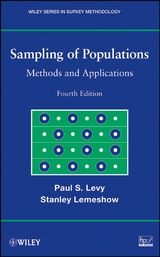
Sampling of Populations, Fourth Edition continues to serve as an all-inclusive resource on the basic and most current practices in population sampling. Maintaining the clear and accessible style of the previous edition, this book outlines the essential statistical methodsfor survey design and analysis, while also exploring techniques that have developed over the past decade.
The Fourth Edition successfully guides the reader through the basic concepts and procedures that accompany real-world sample surveys, such as sampling designs, problems of missing data, statistical analysis of multistage sampling data, and nonresponse and poststratification adjustment procedures. Rather than employ a heavily mathematical approach, the authors present illustrative examples that demonstrate the rationale behind common steps in the sampling process, from creating effective surveys to analyzing collected data. Along with established methods, modern topics are treated through the book's new features, which include:
- A new chapter on telephone sampling, with coverage of declining response rates, the creation of 'do not call' lists, and the growing use of cellular phones
- A new chapter on sample weighting that focuses on adjustments to weight for nonresponse, frame deficiencies, and the effects of estimator instability
- An updated discussion of sample survey data analysis that includes analytic procedures for estimation and hypothesis testing
- A new section on Chromy's widely used method of taking probability proportional to size samples with minimum replacement of primary sampling units
- An expanded index with references on the latest research in the field
All of the book's examples and exercises can be easily worked out using various software packages including SAS, STATA, and SUDAAN, and an extensive FTP site contains additional data sets. With its comprehensive presentation and wealth of relevant examples, Sampling of Populations, Fourth Edition is an ideal book for courses on survey sampling at the upper-undergraduate and graduate levels. It is also a valuable reference for practicing statisticians who would like to refresh their knowledge of sampling techniques.
Paul S. Levy is Senior Research Fellow at RTI International and Professor Emeritus of Epidemiology and Biostatistics in the School of Public Health at the University of Illinois. A Fellow of both the American Statistical Association and the American College of Epidemiology, Dr. Levy has authored or coauthored over 225 articles in his areas of research interest, which include sample survey methodology, design of epidemiological studies, and methodology relevant to analysis of data from observational studies.
Stanley Lemeshow, PhD, is Professor of Biostatistics and Dean of the College of Public Health at The Ohio State University. He has over thirty-five years of academic experience in the areas of regression, categorical data methods, and sampling methods. A Fellow of the American Statistical Association, Dr. Lemeshow is the coauthor of Applied Survival Analysis, Second Edition and Applied Logistic Regression, Second Edition, both published by Wiley.
A trusted classic on the key methods in population sampling now in a modernized and expanded new edition Sampling of Populations, Fourth Edition continues to serve as an all-inclusive resource on the basic and most current practices in population sampling. Maintaining the clear and accessible style of the previous edition, this book outlines the essential statistical methodsfor survey design and analysis, while also exploring techniques that have developed over the past decade. The Fourth Edition successfully guides the reader through the basic concepts and procedures that accompany real-world sample surveys, such as sampling designs, problems of missing data, statistical analysis of multistage sampling data, and nonresponse and poststratification adjustment procedures. Rather than employ a heavily mathematical approach, the authors present illustrative examples that demonstrate the rationale behind common steps in the sampling process, from creating effective surveys to analyzing collected data. Along with established methods, modern topics are treated through the book's new features, which include: A new chapter on telephone sampling, with coverage of declining response rates, the creation of "e;do not call"e; lists, and the growing use of cellular phones A new chapter on sample weighting that focuses on adjustments to weight for nonresponse, frame deficiencies, and the effects of estimator instability An updated discussion of sample survey data analysis that includes analytic procedures for estimation and hypothesis testing A new section on Chromy's widely used method of taking probability proportional to size samples with minimum replacement of primary sampling units An expanded index with references on the latest research in the field All of the book's examples and exercises can be easily worked out using various software packages including SAS, STATA, and SUDAAN, and an extensive FTP site contains additional data sets. With its comprehensive presentation and wealth of relevant examples, Sampling of Populations, Fourth Edition is an ideal book for courses on survey sampling at the upper-undergraduate and graduate levels. It is also a valuable reference for practicing statisticians who would like to refresh their knowledge of sampling techniques.
Paul S. Levy is Senior Research Fellow at RTI International and Professor Emeritus of Epidemiology and Biostatistics in the School of Public Health at the University of Illinois. A Fellow of both the American Statistical Association and the American College of Epidemiology, Dr. Levy has authored or coauthored over 225 articles in his areas of research interest, which include sample survey methodology, design of epidemiological studies, and methodology relevant to analysis of data from observational studies. Stanley Lemeshow, PhD, is Professor of Biostatistics and Dean of the College of Public Health at The Ohio State University. He has over thirty-five years of academic experience in the areas of regression, categorical data methods, and sampling methods. A Fellow of the American Statistical Association, Dr. Lemeshow is the coauthor of Applied Survival Analysis, Second Edition and Applied Logistic Regression, Second Edition, both published by Wiley.
Sampling of Populations: Methods and Applications 5
Contents 9
Tables 18
Boxes 22
Figures 24
Getting Files from the Wiley ftp and Internet Sites 25
List of Data Sites Provided on Web Site 26
Preface to the Fourth Edition 27
PART 1 BASIC CONCEPTS 35
1. Uses of Sample Surveys 37
1.1 Why Sample Surveys Are Used 37
1.2 Designing Sample Surveys 39
1.2.1 Sample Design 39
1.2.2 Survey Measurements 40
1.2.3 Survey Operations 40
1.2.4 Statistical Analysis and Report Writing 41
1.3 Preliminary Planning of a Sample Survey 41
Exercises 42
Bibliography 43
2. The Population and the Sample 45
2.1 The Population 45
2.1.1 Elementary Units 47
2.1.2 Population Parameters 47
2.2 The Sample 52
2.2.1 Probability and Nonprobability Sampling 52
2.2.2 Sampling Frames, Sampling Units, and Enumeration Units 53
2.3 Sampling Measurements and Summary Statistics 54
2.2.4 Estimation of Population Characteristics 56
2.3 Sampling Distributions 59
2.4 Characteristics of Estimates of Population Parameters 64
2.4.1 Bias 65
2.4.2 Mean Square Error 66
2.4.3 Validity, Reliability, and Accuracy 69
2.5 Criteria for a Good Sample Design 70
2.6 Summary 71
Exercises 71
Bibliography 76
PART 2 MAJOR SAMPLING DESIGNS AND ESTIMATION PROCEDURES 77
3. Simple Random Sampling 79
3.1 What Is a Simple Random Sample? 79
3.1.1 How to Take a Simple Random Sample 80
3.1.2 Probability of an Element Being Selected 81
3.2 Estimation of Population Characteristics Under Simple Random Sampling 83
3.2.1 Estimation Formulas 83
3.2.2 Numerical Computation of Estimates and Their Standard Errors 84
3.3 Sampling Distributions of Estimated Population Characteristics 89
3.4 Coefficients of Variation of Estimated Population Parameters 92
3.5 Reliability of Estimates 95
3.6 Estimation of Parameters for Subdomains 98
3.7 How Large a Sample Do We Need? 104
3.8 Why Simple Random Sampling Is Rarely Used 109
3.9 Summary 110
Exercises 110
Bibliography 113
4. Systematic Sampling 117
4.1 How To Take a Systematic Sample 117
4.2 Estimation of Population Characteristics 118
4.3 Sampling Distribution of Estimates 120
4.4 Variance of Estimates 124
4.5 A Modification That Always Yields Unbiased Estimates 132
4.6 Estimation of Variances 134
4.7 Repeated Systematic Sampling 137
4.7.1 Use of Stata For Estimation In Repeated Systematic Sampling 141
4.7.2 Use of SUDAAN for Estimation in Repeated Systematic Sampling 143
4.8 How Large a Sample Do We Need? 145
4.9 Using Frames That Are Not Lists 147
4.10 Summary 148
Exercises 148
Bibliography 154
5. Stratification and Stratified Random Sampling 155
5.1 What Is a Stratified Random Sample? 155
5.2 How to Take a Stratified Random Sample 156
5.3 Why Stratified Sampling? 156
5.4 Population Parameters for Strata 162
5.5 Sample Statistics for Strata 167
5.6 Estimation of Population Parameters from Stratified Random Sampling 168
5.7 Summary 173
Exercises 173
Bibliography 176
6. Stratified Random Sampling: Further Issues 177
6.1 Estimation of Population Parameters 177
6.2 Sampling Distributions of Estimates 178
6.3 Estimation of Standard Errors 180
6.4 Estimation of Characteristics of Subgroups 182
6.5 Allocation of Sample to Strata 184
6.5.1 Equal Allocation 185
6.5.2 Proportional Allocation: Self-Weighting Samples 185
6.5.3 Optimal Allocation 192
6.5.4 Optimal Allocation and Economics 194
6.6 Stratification After Sampling 202
6.7 How Large a Sample Is Needed? 209
6.8.Construction of Stratum Boundaries and Desired Number of Strata 213
6.9 Summary 217
Exercises 218
Bibliography 222
7. Ratio Estimation 223
7.1 Ratio Estimation Under Simple Random Sampling 224
7.2 Estimation of Ratios for Subdomains Under Simple Random Sampling 232
7.3 Poststratified Ratio Estimates Under Simple Random Sampling 234
7.4 Ratio Estimation of Totals Under Simple Random Sampling 238
7.5 Comparison of Ratio Estimate with Simple Inflation Estimate 244
7.6 Approximation to the Standard Error of the Ratio Estimated Total 245
7.7 Determination of Sample Size 246
7.8 Regression Estimation of Totals 247
7.9 Ratio Estimation in Stratified Random Sampling 249
7.10 Summary 252
Exercises 252
Bibliography 256
8. Cluster Sampling: Introduction and Overview 257
8.1 What Is Cluster Sampling? 258
8.2 Why Is Cluster Sampling Widely Used? 260
8.3 A Disadvantage of Cluster Sampling: High Standard Errors 262
8.4 How Cluster Sampling Is Treated in This Book 263
8.5 Summary 263
Exercises 264
Bibliography 264
9. Simple One-Stage Cluster Sampling 265
9.1 How to Take a Simple One-Stage Cluster Sample 266
9.2 Estimation of Population Characteristics 266
9.3 Sampling Distributions of Estimates 284
9.4 How Large a Sample Is Needed? 288
9.5 Reliability of Estimates and Costs Involved 290
9.6 Choosing a Sampling Design Based on Cost and Reliability 292
9.7 Summary 297
Exercises 297
Bibliography 302
10. Two-Stage Cluster Sampling: Clusters Sampled with Equal Probability 303
10.1 Situation in Which all Clusters Have the Same Number Ni of Enumeration Units 304
10.1.1 How to Take a Simple Two-Stage Cluster Sample 304
10.1.2 Estimation of Population Characteristics 305
10.1.3 Estimation of Standard Errors 307
10.1.4 Sampling Distribution of Estimates 318
10.1.5 How Large a Sample Is Needed? 323
10.1.6 Choosing the Optimal Cluster Size n Considering Costs 326
10.1.7 Some Shortcut Formulas for Determining the Optimal Number n 329
10.2 Situation in Which Not All Clusters Have the Same Number Ni of Enumeration Units 334
10.2.1 How to Take a Simple Two-Stage Cluster Sample for This Design 334
10.2.2 Estimation of Population Characteristics 335
10.2.3 Estimation of Standard Errors of Estimates 335
10.2.4 Sampling Distribution of Estimates 345
10.2.5 How Large a Sample Do We Need? 348
10.2.6 Choosing the Optimal Cluster Size n Considering Costs 351
10.3 Systematic Sampling as Cluster Sampling 353
10.4 Summary 354
Exercises 355
Bibliography 364
11. Cluster Sampling in Which Clusters Are Sampled with Unequal Probability: Probability Proportional to Size Sampling 365
11.1 Motivation for Not Sampling Clusters with Equal Probability 366
11.2 Two General Classes of Estimators Valid for Sample Designs in Which Units Are Selected with Unequal Probability 370
11.2.1 The Horvitz-Thompson Estimator 370
11.2.2 The Hansen-Hurwitz Estimator 371
11.3 Probability Proportional to Size Sampling 374
11.3.1 Probability Proportional to Size Sampling with Replacement: Use of the Hansen-Hurwitz Estimator 376
11.3.2 PPS Sampling When the Measure of Size Variable Is not the Number of Enumeration Units 384
11.3.3 How to Take a PPS Sample with Replacement 387
11.3.4 Sequential Methods of PPS Sampling with Replacement– Chromy's Probability with Minimum Replacement (PMR) Method 387
11.3.5 How Large a Sample Is Needed for a Two-Stage Sample in Which Clusters Are Selected PPS with Replacement? 390
11.3.6 Telephone PPS Sampling: The Mitofsky-Waksberg Method of Random Digit Dialing 393
11.4 Further Comment on PPS Sampling 395
11.5 Summary 395
Exercises 396
Bibliography 398
12. Variance Estimation in Complex Sample Surveys 401
12.1 Linearization 402
12.2 Replication Methods 407
12.2.1 The Balanced Repeated Replication Method 407
12.2.2 Jackknife Estimation 415
12.2.3 Estimation of Interviewer Variability by Use of Replicated Sampling (Interpenetrating Samples) 418
12.3 Summary 420
Exercises 421
Technical Appendix 424
Bibliography 426
PART 3 SELECTED TOPICS IN SAMPLE SURVEY METHODOLOGY 429
13. Nonresponse and Missing Data in Sample Surveys 431
13.1 Effect of Nonresponse on Accuracy of Estimates 431
13.2 Methods of Increasing the Response Rate in Sample Surveys 433
13.2.1 Increasing the Number of Households Contacted Successfully 433
13.2.2 Increasing the Completion Rate in Mail Questionnaires 434
13.2.3 Decreasing the Number of Refusals in Face-to-Face Telephone Interviews 434
13.2.4 Using Endorsements 435
13.3 Mail Surveys Combined with Interviews of Nonrespondents 436
13.3.1 Determination of Optimal Fraction of Initial Nonrespondents to Subsample for Intensive Effort 437
13.3.2 Determination of Sample Size Needed for a Two-Stage Mail Survey 439
13.4 Other Uses of Double (or Two–Phase) Sampling Methodology 440
13.5 Item Nonresponse: Methods of Imputation 442
13.5.1 Mechanisms by Which Missing Values Arise 442
13.5.2 Some Methods for Analyzing Data in the Presence of Missing Values 445
13.5.3 Some Imputation Methods 446
13.6 Multiple Imputation 450
13.7 Summary 453
Exercises 453
Bibliography 459
14. Selected Topics in Sample Design and Estimation Methodology 461
14.1 World Health Organization EPI Surveys: A Modification of PPS Sampling for Use in Developing Countries 461
14.2 Quality Assurance Sampling 463
14.3 Sample Sizes for Longitudinal Studies 466
14.3.1 Simple Random Sampling 467
14.3.2 Simple One-Stage Cluster Sampling 468
14.3.3 Cluster Sampling with More Than One Domain 469
14.4 Estimation of Prevalence of Diseases from Screening Studies 470
14.5 Estimation of Rare Events: Network Sampling 474
14.6 Estimation of Rare Events: Dual Samples 478
14.7 Estimation of Characteristics for Local Areas: Synthetic Estimation 480
14.8 Extraction of Sensitive Information: Randomized Response Techniques 483
14.9 Summary 485
Exercises 485
Bibliography 486
15. Telephone Survey Sampling 489
15.1 Introduction 489
15.1.1 The Twentieth Century 489
15.1.2 The Twenty-First Century 490
15.2 History of Telephone Sampling in the United States 490
15.2.1 Early Design of Telephone Surveys 491
15.2.2 Random Digit Dialing 491
15.2.3 Mitofsky-Waksberg Sampling Method 492
15.2.4 List-Assisted Random Digit Dialing Methods 492
15.3 Within-Household Selection Techniques 493
15.3.1 Probability-Based Methods 494
15.3.2 Quasi-Probability Methods 494
15.3.3 Nonprobability Methods 495
15.3.4 Minimally Intrusive Method 495
15.4 Steps in the Telephone Survey Process 495
15.4.1 Computer-Assisted Telephone Interviewing 496
15.4.2 Quality Control in Telephone Surveys 497
15.5 Drawing and Managing a Telephone Survey Sample 497
15.5.1 Drawing the Sample 497
15.5.2 Managing the Sample 498
15.5.3 Developing an Analysis File 499
15.5.4 Data Weighting and Adjustment 500
15.6 Post-Survey Data Enhancement Procedures 500
15.6.1 Data Weighting 500
15.6.2 Steps in the Weighting Process 500
15.6.3 Compensation for Exclusion of Nontelephone Households 508
15.7 Imputation of Missing Data 510
15.8 Declining Coverage and Response Rates 511
15.9 Addressing the Problems with Cell Phones 512
15.9.1 Research on Cell Phone Surveys 513
15.9.2 Sampling from the Cell Phone Frame 513
15.10 Address-Based Sampling 516
Exercises 517
Bibliography 518
16. Constructing the Survey Weights 523
16.1 Introduction 523
16.2 Objectives of Weighting 526
16.2.1 Basic Concepts 526
16.2.2 Weighting to Reduce Frame Bias 528
16.2.3 Weighting to Reduce Nonresponse Bias 529
16.2.4 Weighting to Reduce Sampling Variance 530
16.3 Constructing the Sampling Weights 532
16.3.1 Base Weights 533
16.3.2 Nonresponse Adjustments 535
16.3.3 Frame Coverage Adjustments 539
16.3.4 Constructing the Final Weights 544
16.4 Estimation and Analysis Issues 545
16.4.1 Effect of Weighting on the Variance 545
16.4.2 Using Weights in Analysis 547
16.5 Summary 548
Bibliography 549
17 Strategies for Design-Based Analysis of Sample Survey Data 551
17.1 Steps Required for Performing a Design-Based Analysis 552
17.2 Analysis Issues for "Typical" Sample Surveys 562
17.3 Summary 569
Technical Appendix 569
Bibliography 570
Appendix 571
Answers to Selected Exercises 577
Index 605
"The book remains a very appropriately written text for classroom use, especially for students studying public health or epidemiology, or for undergraduate majors in statistics and related fields." (Biometrics, June 2009)
| Erscheint lt. Verlag | 28.9.2011 |
|---|---|
| Reihe/Serie | Wiley Series in Survey Methodology |
| Wiley Series in Survey Methodology | Wiley Series in Survey Methodology |
| Zusatzinfo | Charts: 2 B&W, 0 Color; Drawings: 2 B&W, 0 Color; Screen captures: 70 B&W, 0 Color; Tables: 0 B&W, 0 Color; Graphs: 4 B&W, 0 Color |
| Sprache | englisch |
| Themenwelt | Mathematik / Informatik ► Mathematik ► Statistik |
| Mathematik / Informatik ► Mathematik ► Wahrscheinlichkeit / Kombinatorik | |
| Medizin / Pharmazie ► Allgemeines / Lexika | |
| Sozialwissenschaften ► Soziologie ► Empirische Sozialforschung | |
| Schlagworte | accessible • allinclusive resource • BASIC • Bevölkerungsstatistik • Bevölkerungsstatistik • Book • Classic • Continues • Current • Design • Edition • Essential • Evaluation & Research Methods • Evaluierung u. Researchmethoden • Key • Methoden der Daten- u. Stichprobenerhebung • Methods • methodsfor • modernized • New • Population • Populations • Practices • previous • Psychological Methods, Research & Statistics • Psychologie • Psychologische Methoden, Forschung u. Statistik • Psychology • Sampling • samplingnow • Statistical • Statistics • Statistik • Stichprobe • Style • Survey • Survey Research Methods & Sampling |
| ISBN-10 | 0-470-37458-6 / 0470374586 |
| ISBN-13 | 978-0-470-37458-0 / 9780470374580 |
| Informationen gemäß Produktsicherheitsverordnung (GPSR) | |
| Haben Sie eine Frage zum Produkt? |
 PDF (Adobe DRM)
Kopierschutz: Adobe-DRM
Adobe-DRM ist ein Kopierschutz, der das eBook vor Mißbrauch schützen soll. Dabei wird das eBook bereits beim Download auf Ihre persönliche Adobe-ID autorisiert. Lesen können Sie das eBook dann nur auf den Geräten, welche ebenfalls auf Ihre Adobe-ID registriert sind.
Details zum Adobe-DRM
Dateiformat: PDF (Portable Document Format)
Mit einem festen Seitenlayout eignet sich die PDF besonders für Fachbücher mit Spalten, Tabellen und Abbildungen. Eine PDF kann auf fast allen Geräten angezeigt werden, ist aber für kleine Displays (Smartphone, eReader) nur eingeschränkt geeignet.
Systemvoraussetzungen:
PC/Mac: Mit einem PC oder Mac können Sie dieses eBook lesen. Sie benötigen eine
eReader: Dieses eBook kann mit (fast) allen eBook-Readern gelesen werden. Mit dem amazon-Kindle ist es aber nicht kompatibel.
Smartphone/Tablet: Egal ob Apple oder Android, dieses eBook können Sie lesen. Sie benötigen eine
Geräteliste und zusätzliche Hinweise
Buying eBooks from abroad
For tax law reasons we can sell eBooks just within Germany and Switzerland. Regrettably we cannot fulfill eBook-orders from other countries.
aus dem Bereich