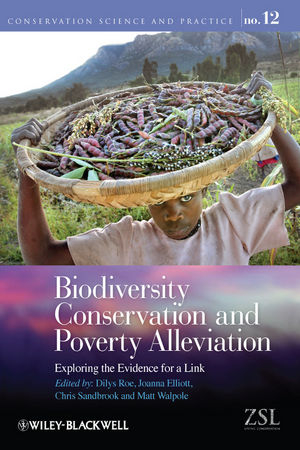
Biodiversity Conservation and Poverty Alleviation (eBook)
John Wiley & Sons (Verlag)
978-1-118-42851-1 (ISBN)
Biodiversity conservation and poverty alleviation are both important societal goals demanding increasing international attention. While they may seem to be unrelated, the international policy frameworks that guide action to address them make an explicit assumption that conserving biodiversity will help to tackle global poverty. Part of the Conservation Science and Practice Series published with the Zoological Society of London, this book explores the validity of that assumption. The book addresses a number of critical questions:
- Which aspects of biodiversity are of value to the poor?
- Does the relationship between biodiversity and poverty differ according to particular ecological conditions?
- How do different conservation interventions vary in their poverty impacts?
- How do distributional and institutional issues affect the poverty impacts of interventions?
- How do broader issues such as climate change and the global economic system affect the biodiversity – poverty relationship at different scales?
This volume will be of interest to policy-makers, practitioners and researchers concerned with understanding the potential - and limitations - of integrated approaches to biodiversity conservation and poverty alleviation.
Dilys Roe is a senior researcher in IIED's Natural Resources Group and leads their work on biodiversity. Since 2004, Dilys has coordinated the Poverty and Conservation Learning Group - a network of organisations that is intended to improve dialogue on poverty-conservation linkages. While the majority of Dilys' work focusses on biodiversity-development/conservation-poverty issues, she also has a research interest in community-based natural resource management and community-based conservation; ecosystem-based adaptation and high biodiversity REDD+.
Joanna Elliott is Vice President for Programme Design at the African Wildlife Foundation and a Visiting Fellow in IIED's Natural Resources Group. Joanna has worked extensively in the field and at policy levels on biodiversity-development linkages, and has led applied research programmes on land use economics, conservation enterprise development and measuring the socio-economic impacts of conservation.
Chris Sandbrook is a Lecturer in Conservation Leadership at the United Nations Environment Programme World Conservation Monitoring Centre (UNEP-WCMC). In this role he helps to run the Masters in Conservation Leadership course at the University of Cambridge. Chris has diverse research interests, including the implications of market-based approaches to conservation such as ecotourism and REDD, the relationship between great ape conservation and poverty alleviation, and the values held by those working in conservation.
Matt Walpole is Head of the Ecosystem Assessment Programme at UNEP-WCMC. In this role Matt oversees a diverse portfolio focusing on improving the uptake and use of information on biodiversity and its values, including its role in supporting livelihoods and poverty alleviation, amongst policymakers. Matt’s research interests include a focus on interdisciplinary approaches to conservation research and practice and exploring the widespread links between poverty and conservation.
Biodiversity conservation and poverty alleviation are both important societal goals demanding increasing international attention. While they may seem to be unrelated, the international policy frameworks that guide action to address them make an explicit assumption that conserving biodiversity will help to tackle global poverty. Part of the Conservation Science and Practice Series published with the Zoological Society of London, this book explores the validity of that assumption. The book addresses a number of critical questions: Which aspects of biodiversity are of value to the poor? Does the relationship between biodiversity and poverty differ according to particular ecological conditions? How do different conservation interventions vary in their poverty impacts? How do distributional and institutional issues affect the poverty impacts of interventions? How do broader issues such as climate change and the global economic system affect the biodiversity poverty relationship at different scales? This volume will be of interest to policy-makers, practitioners and researchers concerned with understanding the potential - and limitations - of integrated approaches to biodiversity conservation and poverty alleviation.
Dilys Roe is a senior researcher in IIED's Natural Resources Group and leads their work on biodiversity. Since 2004, Dilys has coordinated the Poverty and Conservation Learning Group - a network of organisations that is intended to improve dialogue on poverty-conservation linkages. While the majority of Dilys' work focusses on biodiversity-development/conservation-poverty issues, she also has a research interest in community-based natural resource management and community-based conservation; ecosystem-based adaptation and high biodiversity REDD+. Joanna Elliott is Vice President for Programme Design at the African Wildlife Foundation and a Visiting Fellow in IIED's Natural Resources Group. Joanna has worked extensively in the field and at policy levels on biodiversity-development linkages, and has led applied research programmes on land use economics, conservation enterprise development and measuring the socio-economic impacts of conservation. Chris Sandbrook is a Lecturer in Conservation Leadership at the United Nations Environment Programme World Conservation Monitoring Centre (UNEP-WCMC). In this role he helps to run the Masters in Conservation Leadership course at the University of Cambridge. Chris has diverse research interests, including the implications of market-based approaches to conservation such as ecotourism and REDD, the relationship between great ape conservation and poverty alleviation, and the values held by those working in conservation. Matt Walpole is Head of the Ecosystem Assessment Programme at UNEP-WCMC. In this role Matt oversees a diverse portfolio focusing on improving the uptake and use of information on biodiversity and its values, including its role in supporting livelihoods and poverty alleviation, amongst policymakers. Matt's research interests include a focus on interdisciplinary approaches to conservation research and practice and exploring the widespread links between poverty and conservation.
Contributors ix
Preface and Acknowledgements xiii
Introduction 1
1. Linking Biodiversity Conservation and Poverty Alleviation:
What, Why and Where? 3
Dilys Roe, Joanna Elliott, Chris Sandbrook and Matt
Walpole
Part I Biodiversity, Ecosystem Services and Poverty -
The Potential for Synergies 19
2. The Potential, Realised and Essential Ecosystem Service
Benefits of Biodiversity Conservation 21
Will R. Turner, Katrina Brandon, Thomas M. Brooks, Claude
Gascon,Holly K. Gibbs, Keith Lawrence, Russell A. Mittermeier and
Elizabeth R. Selig
3. Poverty Reduction and Biodiversity Conservation: Using the
Concept of Ecosystem Services to Understand the Linkages 36
Heidi Wittmer, Augustin Bergh¨ofer and Pavan
Sukhdev
4. Dependence of the Poor on Biodiversity: Which Poor, What
Biodiversity? 52
Bhaskar Vira and Andreas Kontoleon
Part II Biodiversity and Poverty Relationships in Different
Ecological Settings 85
5. Forests, Poverty and Conservation: An Overview of the Issues
87
Brian Belcher
6. Biodiversity and Poverty in Coastal Environments 100
Jock Campbell and Philip Townsley
7. Linking Biodiversity and Poverty Alleviation in the Drylands
- The Concept of 'Useful' Biodiversity 113
Michael Mortimore
8. Biodiversity Isn't Just Wildlife - Conserving
Agricultural Biodiversity as a Vital Contribution to Poverty
Reduction 127
Willy Douma
Part III Poverty Impacts of Different Conservation
Interventions 143
9. Does Conserving Biodiversity Work to Reduce Poverty? A State
of Knowledge Review 145
Craig Leisher, M. Sanjayan, Jill Blockhus, S. Neil Larsen and
Andreas Kontoleon
10. Protected Areas - What People Say about Well-Being
160
George Holmes and Dan Brockington
11. Species Conservation and Poverty Alleviation - The
Case of Great Apes in Africa 173
Chris Sandbrook and Dilys Roe
12. Community-Based Natural Resource Management (CBNRM) and
Reducing Poverty in Namibia 191
Brian T.B. Jones, Anna Davis, Lara Diez and Richard W.
Diggle
13. Conservation Enterprise:What Works, Where and forWhom?
206
Joanna Elliott and Daudi Sumba
Part IV Distributional and Institutional Issues 223
14. Payments for Environmental Services: Conservation with
Pro-Poor Benefits 225
Sven Wunder and Jan Borner
15. Pastoralism and Conservation - Who Benefits? 239
Katherine Homewood, Pippa Chenevix Trench and Dan
Brockington
16. Local Organisations - An Entry Point for Conservation
and Poverty Reduction 253
David H. L. Thomas
17. Poverty Reduction Isn't Just about Money: Community
Perceptions of Conservation Benefits 270
Fikret Berkes
Part V Biodiversity and Poverty Relationships in the Context
of Global Challenges 287
18. Biodiversity, Poverty and Climate Change: New Challenges and
Opportunities 289
Kathy MacKinnon
19. Conservation in the Anthropocene: Biodiversity, Poverty and
Sustainability 304
William M. Adams
20. Tackling Global Poverty: What Contribution Can Biodiversity
and Its Conservation Really Make? 316
Dilys Roe, Joanna Elliott, Chris Sandbrook and Matt
Walpole
Index 329
"This helpful book goes some way towards dispelling some
of those myths and challenging those assumptions . . . The authors
finally stress the importance of recognizing that biodiversity
conservation and poverty alleviation are both inherently political
processes." (Oryx, 1 October 2013)
"It would be an excellent source of information for policy
makers, researchers, and students in various environmental
disciplines. Summing Up. Recommended.
Lower-division undergraduates through
professionals/practitioners." (Choice, 1
September 2013)
| Erscheint lt. Verlag | 16.11.2012 |
|---|---|
| Reihe/Serie | Conservation Science and Practice |
| Conservation Science and Practice | Conservation Science and Practice |
| Sprache | englisch |
| Themenwelt | Naturwissenschaften ► Biologie ► Ökologie / Naturschutz |
| Naturwissenschaften ► Geowissenschaften ► Geologie | |
| Sozialwissenschaften ► Soziologie | |
| Technik | |
| Schlagworte | action • Alleviation • Aspects • assumption • attention • biodiversity • Biowissenschaften • Book • Conservation Science • Critical • Development & the Environment • Development Studies • Entwicklungsforschung • Entwicklung u. Umwelt • Explicit • Frameworks • goals • Guide • important societal • international • Life Sciences • Naturschutzbiologie • Number • Policy • Poor • questions • Validity |
| ISBN-10 | 1-118-42851-X / 111842851X |
| ISBN-13 | 978-1-118-42851-1 / 9781118428511 |
| Informationen gemäß Produktsicherheitsverordnung (GPSR) | |
| Haben Sie eine Frage zum Produkt? |
 EPUB (Adobe DRM)
Kopierschutz: Adobe-DRM
Adobe-DRM ist ein Kopierschutz, der das eBook vor Mißbrauch schützen soll. Dabei wird das eBook bereits beim Download auf Ihre persönliche Adobe-ID autorisiert. Lesen können Sie das eBook dann nur auf den Geräten, welche ebenfalls auf Ihre Adobe-ID registriert sind.
Details zum Adobe-DRM
Dateiformat: EPUB (Electronic Publication)
EPUB ist ein offener Standard für eBooks und eignet sich besonders zur Darstellung von Belletristik und Sachbüchern. Der Fließtext wird dynamisch an die Display- und Schriftgröße angepasst. Auch für mobile Lesegeräte ist EPUB daher gut geeignet.
Systemvoraussetzungen:
PC/Mac: Mit einem PC oder Mac können Sie dieses eBook lesen. Sie benötigen eine
eReader: Dieses eBook kann mit (fast) allen eBook-Readern gelesen werden. Mit dem amazon-Kindle ist es aber nicht kompatibel.
Smartphone/Tablet: Egal ob Apple oder Android, dieses eBook können Sie lesen. Sie benötigen eine
Geräteliste und zusätzliche Hinweise
Buying eBooks from abroad
For tax law reasons we can sell eBooks just within Germany and Switzerland. Regrettably we cannot fulfill eBook-orders from other countries.
aus dem Bereich