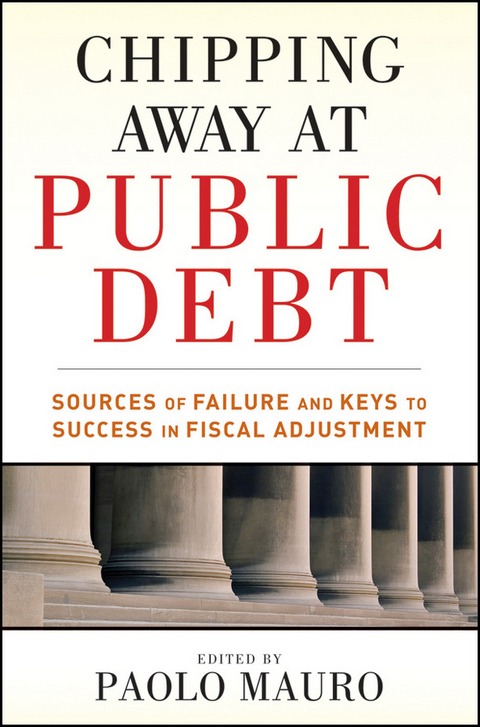
Chipping Away at Public Debt (eBook)
PAOLO MAURO is a Division Chief in the IMF's Fiscal Affairs Department. He has published several articles in top economics journals and is coauthor of Emerging Markets and Financial Globalization: Sovereign Bond Spreads in 1870-1913 and Today. The IMF is an organization of 187 countries, working to foster global monetary cooperation, secure financial stability, facilitate international trade, promote high employment and sustainable economic growth, and reduce poverty around the world. Its Fiscal Affairs Department provides policy and technical advice on public finance issues to member countries.
Foreword ix
Acknowledgments xi
Introduction xiii
CHAPTER 1 Canada: A Success Story 1
Cemile Sancak, Lucy Qian Liu, and Taisuke Nakata
Introduction 1
Background 2
Plans versus Outcomes: Macroeconomic Factors 7
Nature and Composition of Adjustment 13
Structural Reforms 21
Extent to which Adjustments Were Sustained 23
Conclusion 25
Notes 27
CHAPTER 2 United States: The Quest for Fiscal Discipline31
Jiri Jonas
Introduction 31
First Attempt: Balanced Budget and Emergency Deficit Control Act1985 33
Second Attempt: Omnibus Budget Reconciliation Act of 1990 36
Third Attempt: Omnibus Budget Reconciliation Act of 1993 38
Actual versus Projected Fiscal Performance under Omnibus BudgetReconciliation Act of 1993 42
1990s Deficit Reduction: Good Policy or Good Luck? 44
Easy Won, Easy Lost? 50
Conclusion 52
Notes 54
CHAPTER 3 France: Virtue and Fortune 57
Edouard Martin, Irina Tytell, and Irina Yakadina
Introduction: Factors Underlying the Need for FiscalConsolidation 57
Early Attempts at Fiscal Adjustment 61
A First Attempt at Medium-Term Fiscal Consolidation,1994-97 64
A More Systematic Approach to Medium-Term Budgeting:Consolidation Experiences under the Stability and Growth Pact72
Conclusion 81
Notes 82
CHAPTER 4 Germany: Fiscal Adjustment Attempts With and WithoutReforms 85
Christian Breuer, Jan Gottschalk, and Anna Ivanova
Introduction 85
1975-79 Consolidation Attempt 88
1981-85 Consolidation Attempt 93
1991-95 Consolidation Attempt 99
2003-07 Consolidation Attempt 105
Lessons 110
Notes 112
CHAPTER 5 United Kingdom: Four Chancellors Facing Challenges115
Toni Ahnert, Richard Hughes, and Keiko Takahashi
Introduction 115
Selection of Consolidation Plans 116
Background, Content, and Performance of the Four AdjustmentPlans 117
Determinants of Success and Failure 125
Lessons from Success and Failure 138
Appendix 5A. United Kingdom: Fiscal Adjustment Plans andOutturns 140
Notes 150
CHAPTER 6 Italy: Medium-Term Fiscal Planning under FrequentGovernment Changes 153
Fabrizio Balassone, Sandro Momigliano, and Pietro Rizza
Introduction 153
A Brief History of Italy's Fiscal Planning Framework155
Short-Term Origins of Medium-Term Failures 157
A Narrative of Design and Performance of Pre- and Post-EuropeanMonetary Unit Plans 162
Implementing Plans for the Year Ahead 165
Two Important Plans Analyzed in Detail 167
Conclusion 172
Notes 174
CHAPTER 7 Japan: Fiscal Adjustment Plans and MacroeconomicShocks 177
Keiko Takahashi and Kiichi Tokuoka
Introduction 177
The 1997 Fiscal Structural Reform Act 178
Medium-Term Fiscal Adjustment Plans: Fiscal Year 2002 and theFollowing 189
Conclusion 203
Appendix 7A: The Bohn Fiscal Sustainability Test 206
Appendix 7B: Timeline of Medium-Term Fiscal Adjustment Plans inJapan 209
Notes 209
CHAPTER 8 The Performance of Large Fiscal Adjustment Plans inthe European Union: A Cross-Country Statistical Analysis 213
S. Ali Abbas, Fuad Hasanov, Paolo Mauro, and JunhyungPark
Introduction 213
Data, Sample Selection, and Methodology 216
Descriptive Analysis 219
Regression Analysis 232
Conclusion 241
Appendix 8A: Data Issues and Cyclical Adjustment 243
Appendix 8B: Timeline for European Monetary Integration(1990-2009) 245
Notes 246
CHAPTER 9 Conclusion 249
Key Findings: What Failed and What Worked in Past Attempts atFiscal Adjustment 251
Implications for Planned Adjustments 255
Notes 258
References 259
About the Project Team 267
Index 271
"This analytical cross-country study of fiscal adjustment will be
highly relevant for several countries, especially those in the euro
area that, in the context of the new European governance, will
follow a path of public debt reduction in the years ahead."
--Carlo Azeglio Ciampi, Emeritus President of the Italian
Republic (President, 1999-2006; Finance Minister,
1996-1999)
"Unfortunately, out of necessity, the issues of debt and deficit
dominate the national debate in too many countries. The experience
of others can often provide a guide to solutions--what to do
and what not to do. In this context, this book will prove
invaluable."
--The Right Honorable Paul Martin, former Finance Minister
(1993-2002) and Prime Minister (2003-2006) of
Canada
"Budget consolidation may well be the defining macroeconomic
issue for the industrialized world over the next decade. The budget
debate is as unbalanced as the budget. Ideology and rhetoric
dominate in places where evidence and logic should dominate. This
important book balances the debate by providing careful and
analytic evidence on all the important tradeoffs. It is a must-read
for everyone concerned about our fiscal future."
--Lawrence H. Summers, University Professor at Harvard
University; former Director, National Economic Council
(2009-2011); Secretary of the U.S. Treasury
(1999-2001)
"Reducing public debt will be the main policy issue for the next
decade. This volume greatly helps us understand how to do it in a
way that achieves the intended objectives despite unexpected events
that will inevitably occur. We don't know as much as we should
about fiscal policy: this volume improves our understanding with a
careful analysis of many international examples of fiscal
adjustment. A great read."
--Alberto Alesina, Professor of Political Economy, Harvard
University
"How should countries around the world deal with their
burgeoning levels of national debt? This timely book's detailed
case studies illustrate that though failure is common, there is
also more than one path to success and a number of key principles
that can serve as a guide to navigation."
--Alan J. Auerbach, Professor of Economics and Law, Director
of the Burch Center for Tax Policy and Public Finance, University
of California, Berkeley
"There are few questions more important in the U.S. and Europe
today than how public debt will be brought under control.
Chipping Away at Public Debt reviews a wealth of experience
with large-scale fiscal adjustment plans in advanced economies,
drawing on country studies as well as statistical analysis. The
authors reach useful and sometimes unexpected conclusions. In
particular, economic factors such as 'growth surprises' are perhaps
even more important than political factors in determining
success."
--Dani Rodrik, Professor of International Political Economy,
John F. Kennedy School of Government, Harvard University
| Erscheint lt. Verlag | 17.6.2011 |
|---|---|
| Sprache | englisch |
| Themenwelt | Sozialwissenschaften ► Politik / Verwaltung ► Staat / Verwaltung |
| Wirtschaft ► Volkswirtschaftslehre ► Wirtschaftspolitik | |
| Schlagworte | Economics • Financial Economics • Finanzökonomie • Finanzökonomie • Paolo Mauro, public debt, fiscal deficit, International Monetary Fund, IMF, Emerging Markets and Financial Globalization, fiscal policy, fiscal adjustment. How Markets Fail, deficit, government debt, budget deficit • Volkswirtschaftslehre |
| ISBN-13 | 9781118113042 / 9781118113042 |
| Informationen gemäß Produktsicherheitsverordnung (GPSR) | |
| Haben Sie eine Frage zum Produkt? |
 EPUB (Adobe DRM)
Größe: 3,4 MB
Kopierschutz: Adobe-DRM
Adobe-DRM ist ein Kopierschutz, der das eBook vor Mißbrauch schützen soll. Dabei wird das eBook bereits beim Download auf Ihre persönliche Adobe-ID autorisiert. Lesen können Sie das eBook dann nur auf den Geräten, welche ebenfalls auf Ihre Adobe-ID registriert sind.
Details zum Adobe-DRM
Dateiformat: EPUB (Electronic Publication)
EPUB ist ein offener Standard für eBooks und eignet sich besonders zur Darstellung von Belletristik und Sachbüchern. Der Fließtext wird dynamisch an die Display- und Schriftgröße angepasst. Auch für mobile Lesegeräte ist EPUB daher gut geeignet.
Systemvoraussetzungen:
PC/Mac: Mit einem PC oder Mac können Sie dieses eBook lesen. Sie benötigen eine
eReader: Dieses eBook kann mit (fast) allen eBook-Readern gelesen werden. Mit dem amazon-Kindle ist es aber nicht kompatibel.
Smartphone/Tablet: Egal ob Apple oder Android, dieses eBook können Sie lesen. Sie benötigen eine
Geräteliste und zusätzliche Hinweise
Buying eBooks from abroad
For tax law reasons we can sell eBooks just within Germany and Switzerland. Regrettably we cannot fulfill eBook-orders from other countries.
 PDF (Ohne DRM)
Digital Rights Management: ohne DRM
Dieses eBook enthält kein DRM oder Kopierschutz. Eine Weitergabe an Dritte ist jedoch rechtlich nicht zulässig, weil Sie beim Kauf nur die Rechte an der persönlichen Nutzung erwerben.
Dateiformat: PDF (Portable Document Format)
Mit einem festen Seitenlayout eignet sich die PDF besonders für Fachbücher mit Spalten, Tabellen und Abbildungen. Eine PDF kann auf fast allen Geräten angezeigt werden, ist aber für kleine Displays (Smartphone, eReader) nur eingeschränkt geeignet.
Systemvoraussetzungen:
PC/Mac: Mit einem PC oder Mac können Sie dieses eBook lesen. Sie benötigen dafür einen PDF-Viewer - z.B. den Adobe Reader oder Adobe Digital Editions.
eReader: Dieses eBook kann mit (fast) allen eBook-Readern gelesen werden. Mit dem amazon-Kindle ist es aber nicht kompatibel.
Smartphone/Tablet: Egal ob Apple oder Android, dieses eBook können Sie lesen. Sie benötigen dafür einen PDF-Viewer - z.B. die kostenlose Adobe Digital Editions-App.
Buying eBooks from abroad
For tax law reasons we can sell eBooks just within Germany and Switzerland. Regrettably we cannot fulfill eBook-orders from other countries.
aus dem Bereich