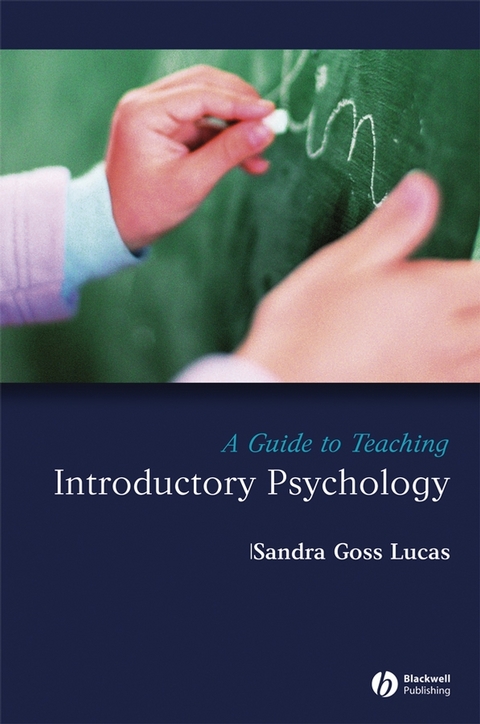
A Guide to Teaching Introductory Psychology (eBook)
John Wiley & Sons (Verlag)
978-1-4443-0175-5 (ISBN)
- A concise and accessible guide to teaching introductory courses in Psychology
- Begins with an orienting history of the course? Evaluates current trends in teaching and offers suggestions for developing personal techniques
- Addresses a number of relevant issues, including how to teach difficult topics; linking course content to everyday experience; developing and using class presentations, lectures, and active learning ideas; and increasing interest in course topics
- Supported by a website that provides links to useful websites and handouts that instructors can use in their classes (http://www.blackwellpublishing.com/teachpsychscience/lucas/)
Sandra Goss Lucas is Director of Introductory Psychology in the Department of Psychology at the University of Illinois. Her teaching awards include the University of Illinois Campus Award for Excellence in Undergraduate Teaching and the Alpha Lambda Delta Award for Outstanding Teacher of Freshmen. Her publications include Teaching Psychology: A Step by Step Guide (with Douglas A. Bernstein, 2004).
A Guide to Teaching Introductory Psychology focuses on the critical aspects of teaching introductory psychology to undergraduate students. It includes ideas, tips, and strategies for effectively teaching this course and provides useful answers to commonly asked questions. A concise and accessible guide to teaching introductory courses in Psychology Begins with an orienting history of the course Evaluates current trends in teaching and offers suggestions for developing personal techniques Addresses a number of relevant issues, including how to teach difficult topics; linking course content to everyday experience; developing and using class presentations, lectures, and active learning ideas; and increasing interest in course topics Supported by a website that provides links to useful websites and handouts that instructors can use in their classes (http://www.blackwellpublishing.com/teachpsychscience/lucas/)
Sandra Goss Lucas is Director of Introductory Psychology in the Department of Psychology at the University of Illinois. Her teaching awards include the University of Illinois Campus Award for Excellence in Undergraduate Teaching and the Alpha Lambda Delta Award for Outstanding Teacher of Freshmen. Her publications include Teaching Psychology: A Step by Step Guide (with Douglas A. Bernstein, 2004).
Series Editors' Preface viii
Acknowledgments xi
1. An Introduction to Introductory Psychology 1
What is Introductory Psychology? 2
What Do I Teach? 3
How Do I Teach? 11
Who Are Your Introductory Psychology Students? 15
Using This Book 17
In Summary 21
References and Further Reading 21
2. Getting Ready to Teach 24
Beginning to Plan 24
The Course Syllabus 26
Evaluating Student Learning 28
Managing Your Classroom 35
The First Days of Class 40
Summary 44
References and Further Reading 44
3. Introduction, Research Methods, Culture 48
Getting Started 48
Teaching the Content 52
Classroom Tips 55
References 61
Additional Suggested Readings for Instructors 61
4. Human Development 62
Getting Started 62
Teaching the Content 65
Classroom Tips 70
References 74
Additional Suggested Readings for Instructors 75
5. Biological Psychology 76
Getting Started 76
Teaching the Content 79
Classroom Tips 81
References 91
Additional Suggested Readings for Instructors 91
6. Sensation and Perception 92
Getting Started 92
Teaching the Content 96
Classroom Tips 103
References 115
Additional Suggested Readings for Instructors 116
7. Consciousness, Motivation, and Emotion 117
Getting Started 117
Teaching the Content 122
Classroom Tips 132
References 140
Additional Suggested Readings for Instructors 143
8. Learning and Memory 144
Getting Started 144
Teaching the Content 147
Classroom Tips 155
References 166
Additional Suggested Readings for Instructors 167
9. Cognition, Language, and Cognitive Abilities 168
Getting Started 168
Teaching the Content 172
Classroom Tips 183
References 192
Additional Suggested Readings for Instructors 195
10. Health, Stress, Coping, and Personality 196
Getting Started 196
Teaching the Content 201
Classroom Tips 209
References 220
Additional Suggested Readings for Instructors 221
11. Mental Disorders and Therapies 222
Getting Started 222
Teaching the Content 227
Classroom Tips 235
References 242
Additional Suggested Readings for Instructors 243
12. Social Psychology 244
Getting Started 244
Teaching the Content 248
Classroom Tips 256
References 267
Additional Suggested Readings for Instructors 270
13. Ending Your Course, Reflecting on it, and Getting Ready for the Next Time 271
Reflections During the Semester 271
The Last Class Session 274
End-of-Term Reflections 276
Self-Evaluation 278
Tips From Experienced Teachers 279
Some Final Thoughts 282
References 283
Appendix: Professional Development Resources in the Teaching of Psychology 285
Index 292
"We are pleased to recommend this book as a meaningful addition to instructors' resource libraries. The activities presented are clearly suitable for introductory and advanced courses. Moreover, the suggested readings and an appendix that delineates teaching organizations and related conferences provide numerous opportunities for professional development." (PsycCRITIQUES, March 2009)
"No course is more important to our discipline than the
introductory psychology class. Sandra Goss Lucas, the coordinator
for Introductory Psychology at the University of Illinois, brings
together the collective wisdom of her years of experience in
teaching and teacher training to deliver a wonderfully useful book.
If department heads want to evidence a genuine commitment to
teaching, they should give this book to all faculty and graduate
students involved in the teaching of this course. It is a treasure
house of good ideas from a great teacher."
-Ludy T. Benjamin, Jr., Texas A&M University
"Sandra Goss Lucas's book, A Guide to Teaching Introductory
Psychology will be invaluable for those teaching intro psych
for the first time, and even old codgers who have taught intro
psych more than 50 times will find new useful and interesting
ideas. My copy has 'Good', 'Neat' and other laudatory comments on
the margins of many pages."
-W. J. McKeachie, University of Michigan
"Sandy Goss Lucas offers instructors of Introductory
Psychology a fully-equipped, functional toolbox, filled with
specific, concrete details that can immediately be applied in
teaching. This toolbox will be most helpful to instructors teaching
the course for the first time, who will undoubtedly breathe a sigh
of relief when they realize that, far from being alone and
isolated, they are part of large group of people who readily share
their approaches, innovations, practices, and challenges. Seasoned
instructors will also find much in this book that will be valuable
to them, because the advice offered by Goss Lucas, the selection of
topics, and her concrete suggestions are all deeply informed by
classroom experience--she knows what works and what does not.
"
-Robert W. Hendersen, Professor & Chair,
Psychology, Grand Valley State University
| Erscheint lt. Verlag | 22.1.2009 |
|---|---|
| Reihe/Serie | Teaching Psychological Science |
| Teaching Psychological Science | Teaching Psychological Science |
| Sprache | englisch |
| Themenwelt | Geisteswissenschaften ► Psychologie |
| Sozialwissenschaften ► Pädagogik ► Erwachsenenbildung | |
| Schlagworte | Aspects • Course • Critical • Current • difficult • evaluates • Experience • focuses • Goss • Guide • History • introductory • Issues • Learning Theory & Research • Lerntheorie u. -forschung • Number • Orienting • Personal • Psychologie • Psychology • relevant • Sandy • suggestions • techniques • Topics • Trends • undergraduate • Volume |
| ISBN-10 | 1-4443-0175-6 / 1444301756 |
| ISBN-13 | 978-1-4443-0175-5 / 9781444301755 |
| Informationen gemäß Produktsicherheitsverordnung (GPSR) | |
| Haben Sie eine Frage zum Produkt? |
 PDF (Adobe DRM)
Kopierschutz: Adobe-DRM
Adobe-DRM ist ein Kopierschutz, der das eBook vor Mißbrauch schützen soll. Dabei wird das eBook bereits beim Download auf Ihre persönliche Adobe-ID autorisiert. Lesen können Sie das eBook dann nur auf den Geräten, welche ebenfalls auf Ihre Adobe-ID registriert sind.
Details zum Adobe-DRM
Dateiformat: PDF (Portable Document Format)
Mit einem festen Seitenlayout eignet sich die PDF besonders für Fachbücher mit Spalten, Tabellen und Abbildungen. Eine PDF kann auf fast allen Geräten angezeigt werden, ist aber für kleine Displays (Smartphone, eReader) nur eingeschränkt geeignet.
Systemvoraussetzungen:
PC/Mac: Mit einem PC oder Mac können Sie dieses eBook lesen. Sie benötigen eine
eReader: Dieses eBook kann mit (fast) allen eBook-Readern gelesen werden. Mit dem amazon-Kindle ist es aber nicht kompatibel.
Smartphone/Tablet: Egal ob Apple oder Android, dieses eBook können Sie lesen. Sie benötigen eine
Geräteliste und zusätzliche Hinweise
Buying eBooks from abroad
For tax law reasons we can sell eBooks just within Germany and Switzerland. Regrettably we cannot fulfill eBook-orders from other countries.
aus dem Bereich