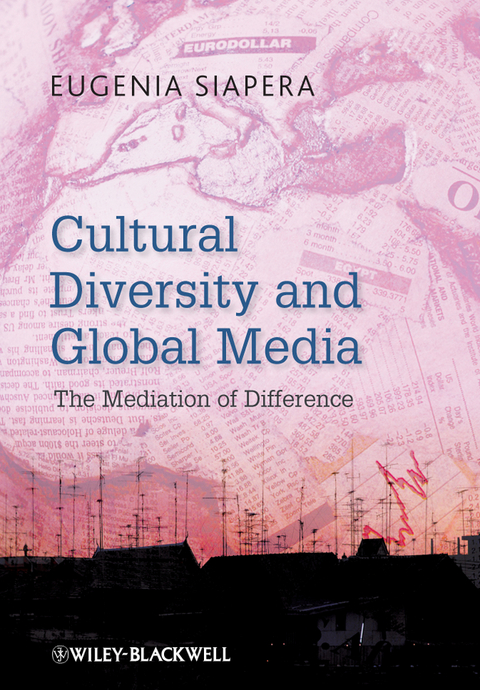
Cultural Diversity and Global Media (eBook)
John Wiley & Sons (Verlag)
978-1-4443-1914-9 (ISBN)
Eugenia Siapera is lecturer in Media and Communications at the Aristotle University of Thessaloniki, Greece. She is the author (with Lincoln Dahlberg) of Radical Democracy and the Internet (2007) and (with Joss Hands) At the Interface (2004).
1 (Re)thinking Cultural Diversity and the Media 1
1.1 The Crises of Multiculturalism 1
1.2 The Mediation of Cultural Diversity 5
1.3 The Structure of the Book 8
2 Theorizing the Nation 14
2.1 Theories of the Nation 14
2.2 A Word on Globalization 25
2.3 Conclusions 26
3 Varieties of Multiculturalism 29
3.1 A Typology of European Multiculturalism 29
3.2 Multiculturalism in Immigration Countries: US and Canada 36
3.3 Constitutively Different: India and Nigeria 41
3.4 Conclusions 44
4 Theories of Multiculturalism 46
4.1 Multicultural Dilemmas 46
4.2 Essentialism or Fluidity? 47
4.3 Universalism or Particularism? 51
4.4 Recognition or Redistribution? 54
4.5 Conclusions 58
5 Media Theories and Cultural Diversity 60
5.1 Socio-Psychological Approaches to Media 61
5.2 Medium Theory 64
5.3 Political-Economic Theories of the Media 66
5.4 Socio-Cultural Approaches to the Media 70
5.5 Mediation: The Difference Media Make 72
5.6 Conclusions 75
6 Media Production and Diversity 78
6.1 Media Production and Mediation 78
6.2 Media Corporations 79
6.3 Media Organizations and Media Logics 81
6.4 Media Workers 85
6.5 Conclusions 92
7 Minority and Diasporic Media: Controversies and Contributions 94
7.1 Why Study Minority Media? 94
7.2 Issues of Terminology 94
7.3 Theorizing the Role(s) of Diasporic Media 97
7.4 Diasporic Media: a Typology 102
7.5 The Politics of Diasporic Media 106
7.6 Conclusions 110
8 Theories of Representation 111
8.1 The Work of Representation 111
8.2 Stereotyping: the Cognitive Aspects of Representation 112
8.3 Framing and Discourse: a First Link to Ideology 116
8.4 Semiosis, Discourse, and Representation: an Historical Analysis 120
8.5 The Performative Force of Representation 124
8.6 Conclusions: Representation and Mediation 127
9 Regimes of Representation 131
9.1 The Multiplicity of Representations 131
9.2 The Racist Regime of Representation 132
9.3 The Domesticated Regime of Representation 139
9.4 The Regime of Commodification 143
9.5 Conclusions 146
10 Self-Representations of Cultural Diversity 149
10.1 Representational Dilemmas 149
10.2 The Essentialist Regime of Representation 150
10.3 The Alternative Regime of Representation 157
10.4 Conclusions 164
11 Audiences and Cultural Diversity 165
11.1 What Do People Do with the Media? 165
11.2 Audience Reception of Mediated Cultural Diversity 166
11.3 Ethno-Cultural Groups as Audiences 170
11.4 Media Consumption and Identity 176
11.5 Right to Reply: How Can Audiences Respond? 177
11.6 Conclusions 182
12 Cultural Diversity Online 183
12.1 The Difference the Internet Makes 183
12.2 Network Society and Cultural Diversity 184
12.3 Mediation of Cultural Diversity Internet Style 187
12.4 Conclusions 196
Bibliography 198
Index 213
"It is easy to read, clearly written and well organised". (Times Higher Education Supplement, 4 November 2010)
In Cultural Diversity and Global Media we learn that understanding the mediation of cultural diversity requires a comparative, global outlook. This is an invaluable contribution to the study of cultural diversity and media, providing both the tools and background necessary to study media representations of cultural diversity critically. It will help students and faculty alike to understand how discourse and media engage cultural diversity within increasingly complex global contexts. Kent Ono, University of Illinois at Urbana-Champaign
| Erscheint lt. Verlag | 15.1.2010 |
|---|---|
| Sprache | englisch |
| Themenwelt | Sozialwissenschaften ► Ethnologie |
| Sozialwissenschaften ► Kommunikation / Medien ► Medienwissenschaft | |
| Sozialwissenschaften ► Politik / Verwaltung | |
| Sozialwissenschaften ► Soziologie | |
| Schlagworte | actively • Analysis • argues • Communication & Media Studies • Complexity • constructs • Cultural • Cultural Difference • Cultural diversity • debates • Diversity • Kommunikation u. Medienforschung • media • Media Criticism • Media Studies • Medienforschung • Medienkritik • Multiculturalism • Order • Position • Production • Relationship • siapera • Society • thorough • Understandings |
| ISBN-10 | 1-4443-1914-0 / 1444319140 |
| ISBN-13 | 978-1-4443-1914-9 / 9781444319149 |
| Informationen gemäß Produktsicherheitsverordnung (GPSR) | |
| Haben Sie eine Frage zum Produkt? |
 PDF (Adobe DRM)
Kopierschutz: Adobe-DRM
Adobe-DRM ist ein Kopierschutz, der das eBook vor Mißbrauch schützen soll. Dabei wird das eBook bereits beim Download auf Ihre persönliche Adobe-ID autorisiert. Lesen können Sie das eBook dann nur auf den Geräten, welche ebenfalls auf Ihre Adobe-ID registriert sind.
Details zum Adobe-DRM
Dateiformat: PDF (Portable Document Format)
Mit einem festen Seitenlayout eignet sich die PDF besonders für Fachbücher mit Spalten, Tabellen und Abbildungen. Eine PDF kann auf fast allen Geräten angezeigt werden, ist aber für kleine Displays (Smartphone, eReader) nur eingeschränkt geeignet.
Systemvoraussetzungen:
PC/Mac: Mit einem PC oder Mac können Sie dieses eBook lesen. Sie benötigen eine
eReader: Dieses eBook kann mit (fast) allen eBook-Readern gelesen werden. Mit dem amazon-Kindle ist es aber nicht kompatibel.
Smartphone/Tablet: Egal ob Apple oder Android, dieses eBook können Sie lesen. Sie benötigen eine
Geräteliste und zusätzliche Hinweise
Buying eBooks from abroad
For tax law reasons we can sell eBooks just within Germany and Switzerland. Regrettably we cannot fulfill eBook-orders from other countries.
aus dem Bereich