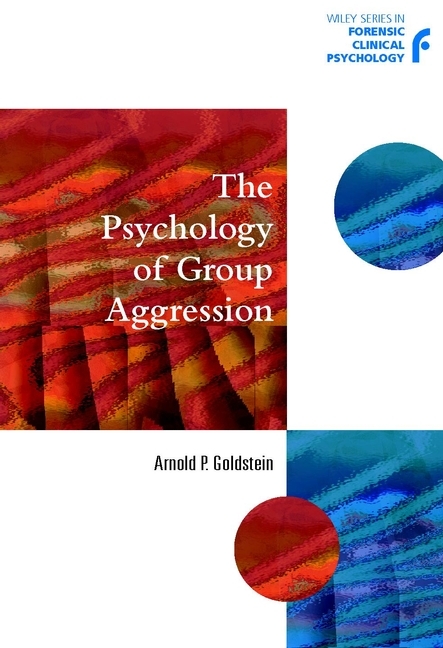
The Psychology of Group Aggression (eBook)
John Wiley & Sons (Verlag)
978-0-470-85454-9 (ISBN)
Arnold P. Goldstein then provides a unique and valuable insight into the different types and levels of intensity of anti-social behavior, examines its causes and considers its costs. In separate chapters he considers low intensity aggression, including ostracism, hazing, teasing; mid-intensity, e.g. bullying, harassment; and high intensity aggression e.g. mobs and gangs. In a final section, he considers management and intervention techniques, both those widely employed and emerging methods.
An important work for both a pure and an applied audience, this will be a key reference for many, including clinical and forensic psychologists, psychiatrists, criminal justice workers, social psychologists and academics and students in criminology, psychology and sociology.
Published in the Wiley Series in Forensic Clinical Psychology
Series Editors:
Professor Clive Hollin, University of Leicester, UK
and Dr Mary McMurran, Cardiff University, UK
Arnold P. Goldstein was the Director of the Center for Research on Aggression at Syracuse University, Director of the New York State Task Force on Juvenile Gangs, and co-founder of the International Center for Aggression Replacement Training. He served on the American Psychological Association Commission on Youth Violence and on the Council of Representatives for the International Society for Research on Aggression. A prolific writer, he authored more than 55 books and 100 articles on violence, aggression, delinquency, abuse, and related topics. His work was honored with numerous awards, including the Career Achievement Award from the American Psychological Association's Committee on Children, Youth, and Families, the Senior Scientist Award from the APA Psychology Division, and the 2002 Devereux Massachusetts Legacy of Caring Award. Just before his death in 2002, Professor Goldstein was nominated for a Nobel Prize.
People in groups act aggressively as a group, not as a collection of individuals. The Psychology of Group Aggression's comprehensive journey starts with group dynamics theory and research by reviewing its relationship to aggression. Arnold P. Goldstein then provides a unique and valuable insight into the different types and levels of intensity of anti-social behavior, examines its causes and considers its costs. In separate chapters he considers low intensity aggression, including ostracism, hazing, teasing; mid-intensity, e.g. bullying, harassment; and high intensity aggression e.g. mobs and gangs. In a final section, he considers management and intervention techniques, both those widely employed and emerging methods. An important work for both a pure and an applied audience, this will be a key reference for many, including clinical and forensic psychologists, psychiatrists, criminal justice workers, social psychologists and academics and students in criminology, psychology and sociology. Published in the Wiley Series in Forensic Clinical Psychology Series Editors: Professor Clive Hollin, University of Leicester, UK and Dr Mary McMurran, Cardiff University, UK
Arnold P. Goldstein was the Director of the Center for Research on Aggression at Syracuse University, Director of the New York State Task Force on Juvenile Gangs, and co-founder of the International Center for Aggression Replacement Training. He served on the American Psychological Association Commission on Youth Violence and on the Council of Representatives for the International Society for Research on Aggression. A prolific writer, he authored more than 55 books and 100 articles on violence, aggression, delinquency, abuse, and related topics. His work was honored with numerous awards, including the Career Achievement Award from the American Psychological Association's Committee on Children, Youth, and Families, the Senior Scientist Award from the APA Psychology Division, and the 2002 Devereux Massachusetts Legacy of Caring Award. Just before his death in 2002, Professor Goldstein was nominated for a Nobel Prize.
About the Author.
Series Editors' Preface.
Preface.
PART I: INTRODUCTION.
Aggression-Relevant Group Dynamics.
PART II: FORMS AND FORMULATIONS.
Low-Level Aggression
Bullying and Harassment
Delinquent Gangs
The Mob
PART III: INTERVENTION.
Established and Emerging Interventions.
References.
Index.
"...Essential..." (The Psychologist, July 2003)
"...a brief, well-structured and focused book
elucidating the general social processes that maintain group
aggression...(Clinical Psychology, Nov 2003)
| Erscheint lt. Verlag | 31.1.2003 |
|---|---|
| Reihe/Serie | Wiley Series in Forensic Clinical Psychology |
| Wiley Series in Forensic Clinical Psychology | Wiley Series in Forensic Clinical Psychology |
| Sprache | englisch |
| Themenwelt | Geisteswissenschaften ► Psychologie ► Sozialpsychologie |
| Sozialwissenschaften ► Soziologie | |
| Schlagworte | Act • Aggression • aggressions • aggressively • antisocial • Behavior • Chapters • Collection • Comprehensive • Different • Dynamics • Forensic Psychology • Forensische Psychologie • Goldstein • Group • Gruppenverhalten • Individuals • intensity • journey • levels • People • Psychologie • Psychology • Relationship • starts • theory • Types • valuable |
| ISBN-10 | 0-470-85454-5 / 0470854545 |
| ISBN-13 | 978-0-470-85454-9 / 9780470854549 |
| Informationen gemäß Produktsicherheitsverordnung (GPSR) | |
| Haben Sie eine Frage zum Produkt? |
 PDF (Adobe DRM)
Kopierschutz: Adobe-DRM
Adobe-DRM ist ein Kopierschutz, der das eBook vor Mißbrauch schützen soll. Dabei wird das eBook bereits beim Download auf Ihre persönliche Adobe-ID autorisiert. Lesen können Sie das eBook dann nur auf den Geräten, welche ebenfalls auf Ihre Adobe-ID registriert sind.
Details zum Adobe-DRM
Dateiformat: PDF (Portable Document Format)
Mit einem festen Seitenlayout eignet sich die PDF besonders für Fachbücher mit Spalten, Tabellen und Abbildungen. Eine PDF kann auf fast allen Geräten angezeigt werden, ist aber für kleine Displays (Smartphone, eReader) nur eingeschränkt geeignet.
Systemvoraussetzungen:
PC/Mac: Mit einem PC oder Mac können Sie dieses eBook lesen. Sie benötigen eine
eReader: Dieses eBook kann mit (fast) allen eBook-Readern gelesen werden. Mit dem amazon-Kindle ist es aber nicht kompatibel.
Smartphone/Tablet: Egal ob Apple oder Android, dieses eBook können Sie lesen. Sie benötigen eine
Geräteliste und zusätzliche Hinweise
Buying eBooks from abroad
For tax law reasons we can sell eBooks just within Germany and Switzerland. Regrettably we cannot fulfill eBook-orders from other countries.
aus dem Bereich