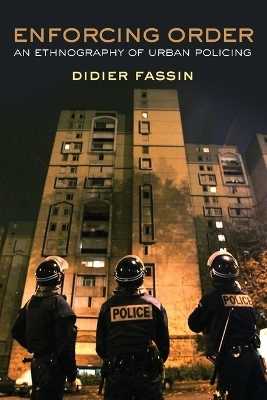
Enforcing Order
Polity Press (Verlag)
9780745664804 (ISBN)
Richly documented and compellingly told, this unique account of contemporary urban policing shows that, instead of enforcing the law, the police are engaged in the task of enforcing an unequal social order in the name of public security.
Didier Fassin is James D. Wolfensohn Professor at the Institute for Advanced Study, Princeton. His previous works include The Empire of Trauma and When Bodies Remember.
Acknowledgements
Preliminary Remarks
Preface to the Engish Edition
Prologue - Interpellation
In which the author comes to understand that it is sometimes dangerous to wait for a bus in the outer city on New Year’s Eve. How policing practice provides the language for a philosophical theory, and how a philosophical theory supplies the meaning of policing practice. That this is not a testimony, and that indignation is not rage.
Introduction - Inquiry
How the present research was authorized and then forbidden, and that this censorship is revelatory of petty exceptions in a democratic regime. That an ethnography of the police requires resisting the dual temptation of exoticism and culturalism. That a study is often the result of the converging effects of chance and necessity.
Chapter 1 - Situation
How an imaginary of war came to be established in the relations between the police and the projects. That a brief history of the social question and security issues is essential in order to understand the context in which law enforcement faces classes reputed to be dangerous. That the creation of more aggressive special units was judged necessary to deal with the alleged disorder in the outer cities.
Chapter 2 - Ordinary
How the daily work of police officers is far removed from the image they had of it when they joined the force, and the illusion they continue to maintain of it. That evaluation of the work of urban patrols yields such unexpected results that it is not taken into account by government. That inaction generates action, and what this phenomenon of spontaneous generation means for the residents of the projects.
Chapter 3 - Interactions
How stops and frisks serve purposes other than those they are supposed to serve, and prove more effective in perpetuating a social order than in maintaining public order. That the way police officers speak about the individuals with whom they deal throws light on their way of operating in the outer cities. That the theater of police intervention sometimes plays comedies in which not all spectators laugh at the same moment.
Chapter 4 - Violence
How a criminal court can offer valuable lessons on excessive use of force by the police in the outer cities. That by not reducing violence to its physical aspect and not limiting the definition of it to the legal sense, one can gain a different understanding of it. That there are many ways of preventing police brutality from being prosecuted
Chapter 5 - Discrimination
How police officers and sociologists challenge the existence of discriminatory practices that the rest of the French population is convinced prevail. That racist ideas do not automatically lead to discriminatory practices, but that the two are far from incompatible. That institutions show more tolerance toward institutional racism than toward its victims.
Chapter 6 - Politics
How some signs are not deceiving, but may
nevertheless be surprising in a democratic regime. That local practices enjoy great autonomy with respect to national guidelines, but that government policy has some influence on the everyday work of law enforcement. That the corollary of the increasing criminalization of behaviors is an unprecedented casting of the police as victims.
Chapter 7 - Morality
How police officers disappointed by the justice of the courts began to practice street justice. That jokes in the precinct can prove more serious than is customarily maintained. That a code of ethics is not enough to interpret the ethical forces at work in the behavior of police officers and the moral impasse in which the police find themselves.
Conclusion - Democracy
How the French police preferred the model of the cop in the United States to the style of the British bobby, and what was the result. That the imposition of the rationale of security has a high social cost for contemporary societies. That the interests of ethnography are intimately bound with those of democracy.
Epilogue - Time
In which the author looks back to a not-so-distant past, observes that the more things change the more they do not stay the same, wonders about the present as it is experienced by certain segments of French society and ignored by the others, and expresses concerns about the future.
Notes
Bibliography
| Erscheint lt. Verlag | 6.9.2013 |
|---|---|
| Verlagsort | Oxford |
| Sprache | englisch |
| Maße | 155 x 229 mm |
| Gewicht | 431 g |
| Themenwelt | Recht / Steuern ► EU / Internationales Recht |
| Sozialwissenschaften ► Ethnologie | |
| Sozialwissenschaften ► Soziologie ► Spezielle Soziologien | |
| ISBN-13 | 9780745664804 / 9780745664804 |
| Zustand | Neuware |
| Informationen gemäß Produktsicherheitsverordnung (GPSR) | |
| Haben Sie eine Frage zum Produkt? |
aus dem Bereich