


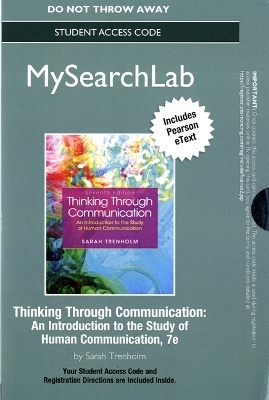
MyLab Search with Pearson eText -- Standalone Access Card -- for Thinking Through Communication
Pearson (Hersteller)
978-0-205-95561-9 (ISBN)
- Titel ist leider vergriffen;
keine Neuauflage - Artikel merken
Packages
Access codes for Pearson's MyLab & Mastering products may not be included when purchasing or renting from companies other than Pearson; check with the seller before completing your purchase.
Used or rental books
If you rent or purchase a used book with an access code, the access code may have been redeemed previously and you may have to purchase a new access code.
Access codes
Access codes that are purchased from sellers other than Pearson carry a higher risk of being either the wrong ISBN or a previously redeemed code. Check with the seller prior to purchase.
-- A balanced introduction to basic theories and principles of communication
Thinking Through Communication covers a full range of topics—from the history of communication study to the methods used by current communications scholars to understand human interaction. The text explores communication in a variety of traditional contexts: interpersonal, group, organizational, public, intercultural, and computer-mediated.
Written in a clear, lively style, this text helps both majors and non-majors develop a better understanding of communication as a field of study.
This text is available in a variety of formats – print and digital. Check your favorite digital provider for your eText, including CourseSmart, Kindle, Nook, and more. To learn more about our programs, pricing options and customization, click the Choices tab.
Learning Goals
Upon completing this book, readers will be able to:
Understand basic communications theories and principles
Explore the effects of new media on communication
Understand the relationship between gender and communication
Note: MySearchLab does not come automatically packaged with this text. To purchase MySearchLab, please visit www.mysearchlab.com or you can purchase a ValuePack of the text + MySearchLab (at no additional cost): ValuePack ISBN-10: 0205902359 / ValuePack ISBN-13: 9780205902354.
1) Brief Table of Contents
2) Full Table of Contents
1) Brief Table of Contents
Part I: Introduction to Communication
Chapter 1: The Communication Tradition
Chapter 2: Definitions, Models, and Perspectives
Part II: Listening and Language
Chapter 3: Decoding Messages: Listening and Perception
Chapter 4: Encoding Messages: Spoken Language
Chapter 5: Encoding Messages: Nonverbal Communication
Part III: Communication Contexts
Chapter 6: Interpersonal Communication
Chapter 7: Group Communication
Chapter 8: Organizational Communication
Chapter 9: Public Communication
Chapter 10: Preparing and Presenting Public Speeches
Chapter 11: Communication and the Media
Chapter 12: Intercultural Communication
Chapter 13: Methods of Discovery
2) Full Table of Contents
Part I: Introduction to Communication
Chapter 1: The Communication Tradition
A Brief History of Communication Study
Communication Today: Contemporary Departments of Rhetoric and Communication Theory
Chapter 2: Definitions, Models, and Perspectives
Defining Communication
How Models Help Us Understand Communication
It All Depends on Your Point of View: Four Perspectives
What to Look for When You Look at Communication
Part II: Listening and Language
Chapter 3: Decoding Messages: Listening and Perception
What Is Listening?
The Listening Process
Designing Messages That Are Easy to Listen To
Chapter 4: Encoding Messages: Spoken Language
What Is Language?
The Subsystems of Language
Pragmatic Styles and Structures
Language and Social Identity
Language Choices and Pragmatic Effects
Chapter 5: Encoding Messages: Nonverbal Communication
What Is Nonverbal Communication?
The Nonverbal Codes
Increasing Nonverbal Skills
Part III: Communication Contexts
Chapter 6: Interpersonal Communication
What Is Interpersonal Communication?
Managing Interpersonal Communication
Relational Development: Stages in Intimate Dyads
Increasing Relational Skills
New Media, New Relationships
Becoming a More Responsible Communicator
Chapter 7: Group Communication
What Is a Group?
Managing Group Communication
Group Development: Phases in Problem-Solving Groups
Strengthening Group Discussion Skills
Communicating in Virtual Groups
Becoming a More Responsible Communicator
Chapter 8: Organizational Communication
What Is an Organization?
Managing Organizational Communication
Increasing Organizational Skills
Using Organizational Technology
Becoming a More Responsible Communicator
Chapter 9: Public Communication
What Is Public Communication?
Why Is Public Communication Important?
Evaluating Public Communication
Strengthening Critical Reception Skills
Becoming a More Responsible Communicator
Chapter 10: Preparing and Presenting Public Speeches
What Is a Public Speech?
Planning the Public Speech
Managing Delivery
Increasing Public Speaking Skills
Becoming a More Responsible Communicator
Chapter 11: Communication and the Media
The Traditional Mass Media
New Media: Going Global and Mobile
Convergence: The Intersection of New Media and Old
Becoming a More Responsible Communicator
Chapter 12: Intercultural Communication
What Is Culture?
Barriers to Intercultural Communication
Adapting to New Cultures
Becoming a More Open Communicator
Chapter 13: Methods of Discovery
How Is Communication Research Done?
Five Contemporary Research Methods
Learning More about Communication
| Erscheint lt. Verlag | 22.5.2013 |
|---|---|
| Sprache | englisch |
| Maße | 152 x 129 mm |
| Gewicht | 20 g |
| Themenwelt | Sozialwissenschaften ► Kommunikation / Medien ► Kommunikationswissenschaft |
| ISBN-10 | 0-205-95561-4 / 0205955614 |
| ISBN-13 | 978-0-205-95561-9 / 9780205955619 |
| Zustand | Neuware |
| Informationen gemäß Produktsicherheitsverordnung (GPSR) | |
| Haben Sie eine Frage zum Produkt? |


