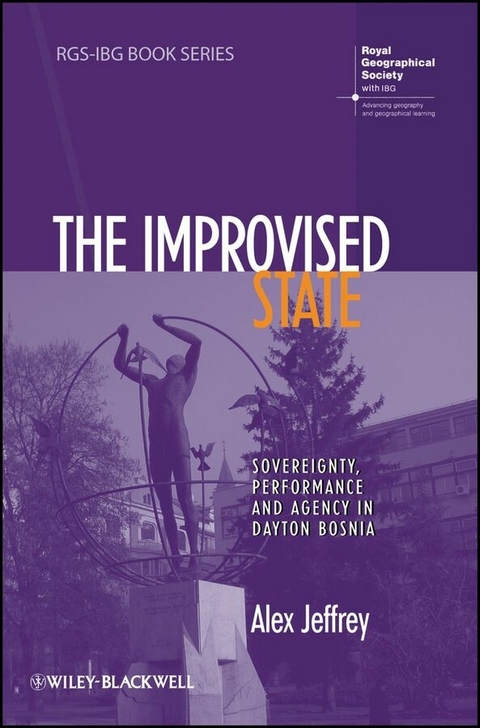
The Improvised State (eBook)
John Wiley & Sons (Verlag)
978-1-118-27879-6 (ISBN)
The Improvised State provides a highly developed account of the nature and outcomes of Bosnian state practices since the Dayton Peace Agreement. Jeffrey presents new and significant theories, based on extensive fieldwork in Bosnia, which advance understanding of state building.
- Provides a major contribution to recent academic debates as to the nature of the state after violent conflict, and offers invaluable insights into state building
- Introduces the idea of state improvisation, where improvisation refers to a process of both performance and resourcefulness
- Uses the theoretical framework of Pierre Bourdieu to explore how powerful agencies have attempted to present a coherent vision of Bosnia and Herzegovina following the conflict 1992-5
- Advances our understanding of the Bosnian state by focusing on the practices of statecraft fostered in the post-Dayton era
- Research based on four periods of residential fieldwork in Bosnia, which allowed a detailed analysis of political practices in the country
Alex Jeffrey is a University Lecturer in Human Geography at the University of Cambridge. His research has focused on the governance of post-conflict environments, particularly the former Yugoslavia, and the role of non-governmental organizations in fostering democracy. He is co-author, together with Joe Painter, of Political Geography: An Introduction to Space and Power (2009) and with Anoop Nayak on Geographical Thought: An Introduction to Ideas in Human Geography (2011).
Alex Jeffrey is a University Lecturer in Human Geography at the University of Cambridge. His research has focused on the governance of post-conflict environments, particularly the former Yugoslavia, and the role of non-governmental organizations in fostering democracy. He is co-author, together with Joe Painter, of Political Geography: An Introduction to Space and Power (2009) and with Anoop Nayak on Geographical Thought: An Introduction to Ideas in Human Geography (2011).
List of Figures ix
Series Editors' Preface x
Acknowledgements xi
Abbreviations xiii
1 Introduction 1
1.1 States, Performance and Improvisation 4
1.2 Towards a Political Anthropology of the Bosnian State 7
1.3 Critical Geopolitics and Qualitative Research Strategy
13
1.4 Structure of the Book 16
2 The Improvised State 20
2.1 The State Idea 22
2.2 Performance and Performativity 26
2.3 Improvisation: Performed Resourcefulness 32
2.4 Improvising the State 38
3 Producing Bosnia and Herzegovina 41
3.1 Fault Line 44
3.2 Barrier 50
3.3 The Balkan Vortex 62
3.4 The General Framework Agreement for Peace 67
3.5 Conclusion 70
4 Performing Brèko District 72
4.1 Brèko District and Arbitration 75
4.2 Stability: Getting the Job Done 85
4.3 Security: Constructing Legality 91
4.4 Neutralization: Making People Think 97
4.5 Conclusion 102
5 Gentrifying Civil Society 107
5.1 Building Civil Society 111
5.2 Social Capital: The Autonomy of Civil Society 115
5.3 Cultural Capital: 'Don ' t Just Ask for Another
Copy Machine!' 118
5.4 Beyond Gentrified Civil Society: Roma and Mjesne Zajednice
123
5.5 Conclusion 129
6 Enacting Justice 132
6.1 Spaces of Justice 134
6.2 Contesting the State 139
6.3 Enrolling Civil Society 145
6.4 Conclusion 153
7 Becoming European 156
7.1 Europeanization and the State 158
7.2 Nested Balkanism 162
7.3 Conclusion 166
8 Conclusion 169
References 179
Index 197
"I really enjoyed the book. It provides an
empirically-rich, methodology-cally-rigorous and
conceptually-grounded account of the state 'in action'.
It should prove to be essential reading for all those social
scientists interested in the state but will also provide
inspiration for all those interested in political geography,
understandings of power and notions of performance."
(Cultural Geographies, 27 December 2013)
"It provides an empirically-rich,
methodologically-rigorous and conceptually-grounded account of the
state 'in action'. It should prove to be essential
reading for all those social scientists interested in the state but
will also provide inspiration for all those interested in political
geography, understandings of power and notions of
performance." Professor Rhys Jones, Aberystwyth
University, UK (Cultural Geographies, January 2014, vol. 21 no.
1 165-166)
"Consistently strong throughout its sections and chapters,
Jeffrey has cemented his arguments with a good conceptual
understanding, impressive fieldwork and primary research. The
Improvised State is an original contribution to both the
theoretical and research fields of political geography and critical
international relations scholarship." David Campbell, Honorary
Professor, Durham University and University of Queensland
"In this persuasive book, Alex Jeffrey illuminates the central
role of performance in the production of state power and
demonstrates in fascinating detail why and how this is so --
and with what effects. The argument is thoroughly researched,
contextually sensitive, and crisply written. The Improvised
State is a compelling study for scholars, students, and
practitioners working on state power, international organizations,
and post-conflict societies, in Europe and elsewhere." Merje
Kuus, University of British Columbia
| Erscheint lt. Verlag | 30.7.2012 |
|---|---|
| Reihe/Serie | RGS-IBG Book Series |
| RGS-IBG Book Series | RGS-IBG Book Series |
| Sprache | englisch |
| Themenwelt | Naturwissenschaften ► Geowissenschaften ► Geografie / Kartografie |
| Sozialwissenschaften ► Politik / Verwaltung ► Politische Theorie | |
| Technik | |
| Schlagworte | Anthropogeographie • democratic theory • Geographie • Geography • Human geography • Improvised State, Dayton Peace Agreement, Bourdieu, Bosnia Herzegovina 92, RGS, Bosnian sovereignty • Political Geography • Political Science • Politikwissenschaft • Politische Geographie • Theorie der Demokratie |
| ISBN-10 | 1-118-27879-8 / 1118278798 |
| ISBN-13 | 978-1-118-27879-6 / 9781118278796 |
| Informationen gemäß Produktsicherheitsverordnung (GPSR) | |
| Haben Sie eine Frage zum Produkt? |
 EPUB (Adobe DRM)
Kopierschutz: Adobe-DRM
Adobe-DRM ist ein Kopierschutz, der das eBook vor Mißbrauch schützen soll. Dabei wird das eBook bereits beim Download auf Ihre persönliche Adobe-ID autorisiert. Lesen können Sie das eBook dann nur auf den Geräten, welche ebenfalls auf Ihre Adobe-ID registriert sind.
Details zum Adobe-DRM
Dateiformat: EPUB (Electronic Publication)
EPUB ist ein offener Standard für eBooks und eignet sich besonders zur Darstellung von Belletristik und Sachbüchern. Der Fließtext wird dynamisch an die Display- und Schriftgröße angepasst. Auch für mobile Lesegeräte ist EPUB daher gut geeignet.
Systemvoraussetzungen:
PC/Mac: Mit einem PC oder Mac können Sie dieses eBook lesen. Sie benötigen eine
eReader: Dieses eBook kann mit (fast) allen eBook-Readern gelesen werden. Mit dem amazon-Kindle ist es aber nicht kompatibel.
Smartphone/Tablet: Egal ob Apple oder Android, dieses eBook können Sie lesen. Sie benötigen eine
Geräteliste und zusätzliche Hinweise
Buying eBooks from abroad
For tax law reasons we can sell eBooks just within Germany and Switzerland. Regrettably we cannot fulfill eBook-orders from other countries.
aus dem Bereich