


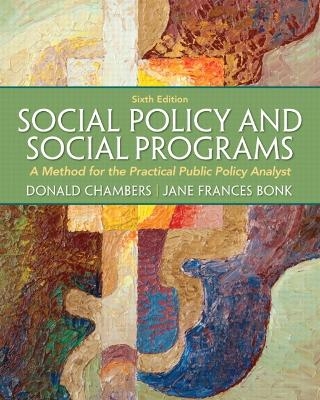
Social Policy and Social Programs
Pearson
9780205222940 (ISBN)
- Titel ist leider vergriffen;
keine Neuauflage - Artikel merken
Packages
Access codes for Pearson's MyLab & Mastering products may not be included when purchasing or renting from companies other than Pearson; check with the seller before completing your purchase.
Used or rental books
If you rent or purchase a used book with an access code, the access code may have been redeemed previously and you may have to purchase a new access code.
Access codes
Access codes that are purchased from sellers other than Pearson carry a higher risk of being either the wrong ISBN or a previously redeemed code. Check with the seller prior to purchase.
--Explores the basics of social policy and program analysis, such as designing new programs or evaluating and improving existing ones.
Social Policy and Social Programs is distinctive in providing specific criteria for judging the effectiveness of social policies and programs. These criteria can be applied to the analysis of widely different social services such as counseling and therapeutic services, supportive assistance, and “hard” benefits like food stamps, cash, and housing vouchers.
By focusing especially on social problems, policies, and programs in major practice areas like child welfare, health, poverty, and mental illness, the author provides students with the tools they need to understand and evaluate the programs in which they are doing their field placements.
Upon completing this book readers will be able to:
Analyze the effectiveness of current social programs
Create new programs based on the criteria provided
Apply what they have learned to evaluate their field placement programs
0205222943 / 9780205222940 Social Policy and Social Programs: A Method for the Practical Public Policy Analyst Plus MySearchLab with eText -- Access Card Package
Package consists of:
0205052762 / 9780205052769 Social Policy and Social Programs: A Method for the Practical Public Policy
0205239927 / 9780205239924 MySearchLab with Pearson eText -- Valuepack Access Card
Donald Chambers received his undergraduate degree in Biology and Psychology from Stanford University in 1950, his Masters degree in Social Work from the University of Nebraska in 1952 and his Doctoral degree from Washington University (St. Louis) in 1967. He practiced as a social worker in Nebraska for nine years and was Director of a regional mental health clinic in Pocatello, Idaho for three years before his appointment to the staff of the Mental Health Institute at Clarinda, Iowa. He retired after 27 years as a Professor in the School of Social Welfare at the University of Kansas where he taught social policy courses and evaluation research for many years. He did research at the British Library in London, England, on policy topics, primarily the British Workman's Compensation system and the British tradition of social policy. In various years he was the recipient of Fulbright Research awards for the study of adoption law and administration in Central American countries. He is the author of a book on Evaluation Research as well as on a method for the analysis of Social Policy and Programs. Over the years he published in leading policy journals in both England and the United States. Jane Bonk has a Bachelor of Liberal Arts for St. John’s College, a Masters from the School of Social Services Administration, University of Chicago, and earned a Ph.D. from Jane Addams College of Social Work, University of Illinois at Chicago. She has worked as a practitioner and an administrator for over thirty years in both non-profit and for-profit social welfare organizations in child welfare and mental health. She has taught at the Master’s Level in social work. Currently, she is a Commissioner for the Council on Accreditation (COA) where she has been very active in implementing The Hague Treaty for International Adoption.
Found in this Section:
1. Brief Table of Contents
2. Full Table of Contents
1. BRIEF TABLE OF CONTENTS
Preface
PART ONE: CREATING THE CONTEXT FOR SOCIAL POLICY ANALYSIS: THE SOCIAL PROBLEM CONTEXT
Chapter 1: Analyzing the Social Problem Background of Social Policies and Social Programs
PART TWO: A STYLE OF POLICY ANALYSIS FOR THE PRACTICAL PUBLIC POLICY ANALYST
Chapter 2: An Overview of a Style of Policy Analysis: A Value-Critical Approach
Chapter 3: The Analysis of Policy Goals and Objectives in Social Programs and Policies
Chapter 4: Who Gets What: The Analysis of Types of Benefits and Services
Chapter 5: Who Gets What, How Much, and Under What Conditions: Analysis of Eligibility Rules
Chapter 6: Analysis of Service-Delivery Systems and Social Policy and Program Design
Chapter 7: How Do We Pay for Social Welfare Policies and Programs? Analysis of Financing
Chapter 8: Analysis of Interactions among Policy Elements
PART THREE: ANALYSIS OF SOCIAL POLICIES AND SOCIAL PROGRAMS USING BASIC CONCEPTS AND EVALUATION CRITERIA: AN EXAMPLE
Chapter 9: An Example of Social Policy and Social Program Analysis: Selected Features of Federal Child Welfare Legislation since 1970 Concerned with Child Abuse
Notes
Photo Credits
Index
2. FULL TABLE OF CONTENTS
Preface
PART ONE: CREATING THE CONTEXT FOR SOCIAL POLICY ANALYSIS: THE SOCIAL PROBLEM CONTEXT
Chapter 1: Analyzing the Social Problem Background of Social Policies and Social Programs
The Nature of Social Problems
Social Problem Analysis
Problem Definition
Causes and Consequences
Ideology and Values
Gainers and Losers
Using the Conclusions of Social Problem Analysis to Design Social Policies and Programs and to Judge Their “Fit” to the Social Problem
Summary
PART TWO: A STYLE OF POLICY ANALYSIS FOR THE PRACTICAL PUBLIC POLICY ANALYST
Chapter 2: An Overview of a Style of Policy Analysis: A Value-Critical Approach
The Policy and Program Analysis Process: An Overview of the Six Fundamental Policy Elements
Criteria for a Value-Critical Appraisal of Social Policy and Programs
Summary
Chapter 3: The Analysis of Policy Goals and Objectives in Social Programs and Policies
Introduction
Definitions and Basic Concepts for Analysis of Goals and Objectives
Different Types of Goals and Objectives
Long-Term/Short-Term Goals and Objectives
Goals Differ from Latent Social Functions
Distinguishing between Goals and Objectives
Objectives (Not Goals) Must Contain Target Group Specifications and Performance Standards
Why Have Both Goals and Objectives?
Setting Goals and Objectives in the Personal Social Services
Social Control and Program and Practice Objectives
Goals and Objectives Vary According to the Developmental Stage of the Program
Methods of Identifying Goals and Objectives
Step 1: Locate the Enabling Legislation
Step 2: Locate Legislative History
Step 3: Locate Staff and Committee Studies and Reports
Step 4: Check Other “Official” Sources
Locating Sources for Goals and Objectives in State-Administered and Private Social Programs
Evaluating Program or Policy System Goals and Objectives: A Value-Critical Approach
Evaluating the Fit between Goals and Objectives and the Social Problem Analysis
Evaluating Goals and Objectives against Traditional Economic Criteria: Adequacy, Equity, and Efficiency
Adequacy
Equity With Respect to Goals and Objectives
Efficiency With Respect to Goals and Objectives
Some Evaluation Criteria Unique to Goals and Objectives
Clarity
Measurability
Manipulability
Concern with Outcomes, Not Services Provided
The Analyst’s Own Value Perspectives in Evaluating the Merit of Goals and Objectives
Summary
Chapter 4: Who Gets What: The Analysis of Types of Benefits and Services
Introduction
A Classification Scheme for Benefit and Service Types
Summary of Types of Benefits and Services
Multiple and Interrelated Benefits
Criteria for Evaluating the Merit of Benefit and Service Types
Stigmatization, Cost-Effectiveness, Substitutability, Target Efficiency, and Trade-Offs
The Political and Public Administration Viewpoint
Criteria for Evaluating the Merit of Benefit Types: Consumer Sovereignty, Coercion, and Intrusiveness
Criteria for Evaluating the Fit of the Benefit/Service Type to the Social Problem Analysis
Criteria for Evaluating the Merit of Benefit Forms: Adequacy, Equity, and Efficiency
Summary
Chapter 5: Who Gets What, How Much, and Under What Conditions: Analysis of Eligibility Rules
Introduction
Types of Eligibility Rules
Eligibility Rules Based on Prior Contributions
Eligibility by Administrative Rule and Regulation
Eligibility by Private Contract
Eligibility by Professional Discretion
Eligibility by Administrative Discretion
Eligibility by Judicial Decision
Eligibility by Means Testing
Establishing Attachment to the Workforce
Eligibility Inclusion and Exclusion
Criteria for Evaluating the Merit of Eligibility Rules
Fit with the Social Problem Analysis
Criteria Specific to Eligibility Rules
Trade-Offs in Evaluating Eligibility Rules
Overwhelming Costs, Overutilization, and Underutilization
Work Disincentives, Incentives, and Eligibility Rules
Procreational Incentives, Marital Instability, and Generational Dependency
Opportunities for Political Interference via Weak Eligibility Rules
Summary
Chapter 6: Analysis of Service-Delivery Systems and Social Policy and Program Design
Introduction
Social Policy and Program Design
Program Theory (The Logic Model)
Program Specification
Some Different Types of Administration and Delivery of Social Service Programs, Benefits, and Services
Centralized Service-Delivery Systems
Client-Centered Management and “Inverted Hierarchy” Service-Delivery Systems
Federated Service-Delivery Organizations
Case-Management Service-Delivery Systems
Staffing with Indigenous Workers as a Service-Delivery Strategy
Referral Agencies in Delivering Social Service
Program Consumer/Beneficiary, Client-Controlled Organizations as a Service-Delivery Strategy
Racial, Ethnic, and Religious Agencies as a Service-Delivery Strategy
Privatization of Service Delivery
Criteria for Evaluating Program Administration and Service Delivery
Introduction
Services and Benefits Should Be Integrated and Continuous
Services and Benefits Should Be Easily Accessible
Organizations Should Be Accountable for Their Actions and Decisions
Citizens and Consumers Should Be Participating in Organizational Decision Making
Organizations and Their Staff Must Be Able to Relate to Racial, Gender, and Ethnic Diversity
Organizations Must Resist the Temptation to Self-Perpetuate
Summary
Chapter 7: How Do We Pay for Social Welfare Policies and Programs? Analysis of Financing
Introduction
Evaluative Criteria Specific to Financing
Chapter 8: Analysis of Interactions among Policy Elements
Introduction
Coentitlement
Disentitlement
Contrary Effects
Duplication
Summary
PART THREE: ANALYSIS OF SOCIAL POLICIES AND SOCIAL PROGRAMS USING BASIC CONCEPTS AND EVALUATION CRITERIA: AN EXAMPLE
Chapter 9: An Example of Social Policy and Social Program Analysis: Selected Features of Federal Child Welfare Legislation since 1970 Concerned with Child Abuse
The Social Problem Context
Definition of the Social Problem
The Ideological Perspective
Causal Analysis
Gainers and Losers
The Judicial Context
The Historical Context
The Social Program and Policy System
Introduction
Goals and Objectives
Eligibility Rules
Form of Benefit and/or Service
Administration and Service Delivery
Financing
Interactions between Basic Policy Elements and between This and Other Programs
Notes
Photo Credits
Index
| Erscheint lt. Verlag | 24.1.2013 |
|---|---|
| Sprache | englisch |
| Maße | 100 x 100 mm |
| Gewicht | 100 g |
| Themenwelt | Schulbuch / Wörterbuch |
| Sozialwissenschaften ► Pädagogik ► Sozialpädagogik | |
| Sozialwissenschaften ► Politik / Verwaltung ► Staat / Verwaltung | |
| Sozialwissenschaften ► Soziologie | |
| ISBN-13 | 9780205222940 / 9780205222940 |
| Zustand | Neuware |
| Informationen gemäß Produktsicherheitsverordnung (GPSR) | |
| Haben Sie eine Frage zum Produkt? |
aus dem Bereich


