


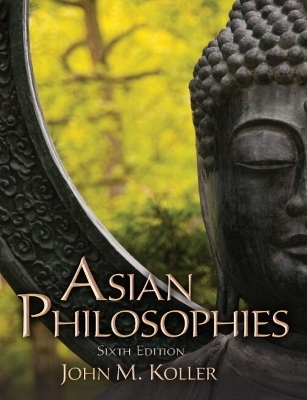
Asian Philosophies Plus MySearchLab with eText -- Access Card Package
Pearson
978-0-205-88537-4 (ISBN)
- Titel ist leider vergriffen;
keine Neuauflage - Artikel merken
Packages
Access codes for Pearson's MyLab & Mastering products may not be included when purchasing or renting from companies other than Pearson; check with the seller before completing your purchase.
Used or rental books
If you rent or purchase a used book with an access code, the access code may have been redeemed previously and you may have to purchase a new access code.
Access codes
Access codes that are purchased from sellers other than Pearson carry a higher risk of being either the wrong ISBN or a previously redeemed code. Check with the seller prior to purchase.
--With an inside view from an expert in the field, solid scholarship, and a clear and engaging writing style, Asian Philosophies invites students and professors to think along with the great thinkers of the Asian traditions. John M. Koller is a scholar and teacher who has devoted his life to understanding Asian thought and practice. He wrote this text to give readers access to the rich philosophical and religious ideas of both South and East Asia.
In This Section: I. Author Bio II. Author Letter I. Author Bio John M. Koller is a Professor of Asian and Comparative Philosophy at Rensselaer Polytechnic Institute. His research areas include Buddhism and Psychoanalysis, and Philosophy of Religion. He is the author of more than fifty journal articles and chapters in edited books as well as five books. In addition, he is the recipient of several prestigious teaching awards: Selected Outstanding Educator of America, 1975; Named Outstanding World Philosopher, 2005; Wm. H. Wiley Distinguished Faculty Award, 1986; and Rensselaer Distinguished Teaching Fellow, 1990-92. II. Author Letter Dear Colleague, Asian Philosophies introduces students to the main questions and methods of philosophy through a careful consideration of the major Asian philosophical traditions. It was written to help students answer three important questions. First, what are the key ideas that have shaped Asian cultures? Second, what are the fundamental values that have guided the lives of Asian peoples over the millennia? Third, how have the great thinkers of Asia thought about these ideas and values? In trying to answer these questions, students learn how to think about and answer their own important philosophical questions: Who am I, What is the best way to live? What can we know? Thinking along with—and sometimes against—the great philosophers stimulates them to think more deeply and carefully about their own philosophical questions. When I first started teaching, at St. Thomas University, my students and I examined only Western traditions, adopting as our guides Plato and Aristotle, Descartes and Hume and Sartre and Wittgenstein, philosophers who both I and my teachers at St. Thomas and the University of Chicago had found exciting. I learned that helping students find inspiring guides from among the great philosophers really opened their minds to the joys of philosophy. Later, after my immersion in Asian philosophies at the East-West Center and the University of Hawaii, I was able to help my students choose as philosophical guides great philosophers from among the Asian traditions as well. At the University of Hawaii I was fortunate to have terrific teachers. Professors Chung-ying Cheng and Wing-tsit Chan introduced me to Chinese philosophy. Professor Kenneth Inada introduced me to Buddhist philosophy and Yasutani Roshi introduced me to zazen. Professor S.K. Saksena guided me through the intricacies of Indian philosophy for two wonderful years. Professors T.R.V. Murti, Kalidas Bhattacharya, and D.M. Datta were postgraduate mentors in India, while Professor George Artola and Babu Krishnacharya helped me learn Sanskrit. In my books and articles, as in all of my teaching, I have tried to pass along to my students what I have been fortunate enough to have learned from my teachers, my colleagues and students. My experience in teaching at a variety of colleges – as diverse as St. Thomas, Chaminade College, Colorado State University, Rensselaer Polytechnic, and SUNY Stony Brook – has convinced me that teaching is primarily about motivating students to inquire and helping them learn, not about passing along information. Asian Philosophies attempts to help students ask and answer the big questions of life, which despite significant cultural differences are basically the same everywhere. Studying the great philosophical traditions of Asia, makes it possible for us to understand these traditions’ carefully considered answers to the most important questions of life, answers that are supported by profound insights and good reasons. Because these answers have guided the thought and action of the peoples of Asia over the centuries, they provide the basic clues to the guiding ideas and values of Asian societies today. And in today’s world, where the very future of humankind depends upon understanding and cooperation among people with diverse values and ideas, it is imperative that these values and ideas be understood. I would be delighted to hear from anyone teaching or studying this book, and will gladly respond to your questions and concerns. And, of course, I would appreciate any suggestions for improvements. My email is kollej@rpi.edu. With my very best wishes, John M. Koller Professor Emeritus Rensselaer Polytechnic Institute
PART I
PHILOSOPHIES OF SOUTH ASIA
CHAPTER 1
Historical Perspectives CHAPTER 2
Vedas and Upanishads
CHAPTER 3
The Jain Vision CHAPTER 4
Buddhism: The Basic Teachings
CHAPTER 5
Interdependent Arising and Development of Mahayana
CHAPTER 6
Madhyamaka and Yogacara
CHAPTER 7
Society and the Individual
CHAPTER 8
Self and the World: Sankhya-Yoga
CHAPTER 9
Knowledge and Reality: Nyaya-Vaisheshika CHAPTER 10
Self and Reality: Mimamsa and Vedanta
CHAPTER 11
Theistic Developments CHAPTER 12
Islam
CHAPTER 13
Tradition and Modernity
PART II
EAST ASIAN PHILOSOPHIES
CHAPTER 14
Historical Overview of East Asian Philosophies
CHAPTER 15
Yinyang Philosophy in the Book of Changes
CHAPTER 16
Confucianism: The Thought of Confucius
CHAPTER 17
Development of Confucianism: Mengzi, Xunzi, and Dong Zhongshu CHAPTER 18
Daoism: The Daodejing
Chapter 19
Zhuangzi's Daoism CHAPTER 20
Chinese Buddhism
CHAPTER 21
Neo-Confucianism: The Grand Harmony
CHAPTER 22
Korean Philosophy
CHAPTER 23
Japanese Philosophy
CHAPTER 24
Recent Thought
Glossary
Pronunciation Guide
Index
| Erscheint lt. Verlag | 10.11.2011 |
|---|---|
| Sprache | englisch |
| Maße | 175 x 229 mm |
| Gewicht | 476 g |
| Themenwelt | Geisteswissenschaften ► Philosophie ► Östliche Philosophie |
| Geisteswissenschaften ► Religion / Theologie | |
| Sozialwissenschaften ► Pädagogik ► Allgemeines / Lexika | |
| Sozialwissenschaften ► Pädagogik ► Bildungstheorie | |
| ISBN-10 | 0-205-88537-3 / 0205885373 |
| ISBN-13 | 978-0-205-88537-4 / 9780205885374 |
| Zustand | Neuware |
| Informationen gemäß Produktsicherheitsverordnung (GPSR) | |
| Haben Sie eine Frage zum Produkt? |


