Food and Culture
Routledge (Verlag)
978-0-415-52104-8 (ISBN)
- Titel erscheint in neuer Auflage
- Artikel merken
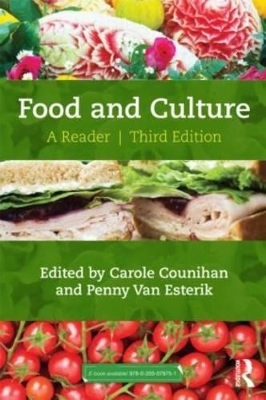
The third edition includes 40 original essays and reprints of previously published classics under 5 Sections: FOUNDATIONS, HEGEMONY AND DIFFERENCE, CONSUMPTION AND EMBODIMENT, FOOD AND GLOBALIZATION, and CHALLENGING, CONTESTING, AND TRANSFORMING THE FOOD SYSTEM.
17 of the 40 articles included are either, new to this edition, rewritten by their original authors, or edited by Counihan and van Esterik.
A bank of test items applicable to each article in the book is available to instructors interested in selecting this edition for course use. Simply send an e.mail to the publisher at companionaccess@informa.com.
Carole Counihan is Professor Emerita of Anthropology at Millersville University in Pennsylvania and editor-in-chief of Food and Foodways. Her earlier books include Around the Tuscan Table: Food, Family, and Gender in Twentieth-Century Florence, Food in the USA, and The Anthropology of Food and Body: Gender, Meaning, and Power. Penny Van Esterik is Professor of Anthropology at York University in Toronto, Canada where she teaches nutritional anthropology, in addition to doing research on food and globalization in Southeast Asia. She is a founding member of WABA (World Alliance for Breastfeeding Action) and writes on infant and young child feeding, including her earlier book, Beyond the Breast-Bottle Controversy.
Foreword from The Gastronomical Me, M.F.K. Fisher
Introduction to the Third Edition
Carole Counihan and Penny Van Esterik
Foundations
Why Do We Overeat
Margaret Mead
This piece questions attitudes towards food and eating in a world where food is overabundant and we face the ambiguity of overindulgence and guilt.
Toward a Psychosociology of Contemporary Food Consumption
Roland Barthes
French structuralists explain how food acts as a system of communication and provides a body of images that mark eating situations.
Short excerpt from Distinction
Pierre Bourdieu
Bourdieu addresses differences between taste of luxury and taste of necessity through his theory of class distinction.
The Culinary Triangle
Claude Lévi-Strauss
This classic structuralist statement, often critiqued, shows how food preparation can be analyzed as a triangular semantic field, much like language.
The Abominations of Leviticus
Mary Douglas
Douglas applies structural analysis to the establishment of religious dietary rules as a means to develop self-control, distinction, and a sense of belonging based on the construction of holiness.
The Abominable Pig
Marvin Harris
Materialists like Harris reject symbolic and structuralist explanations and explain food prohibitions based on economic and ecological utility.
Industrial Food: Towards the Development of a World Cuisine
Jack Goody
The early industrialization of food processing was made possible by advancements in preservation, mechanization, marketing, and transport of food items. These advancements also separated urban and rural societies from food manufacturing.
Time, Sugar, and Sweetness
Sidney W. Mintz
Colonialism made high-status sugar produced in the Caribbean into a working class staple.
Hegemony and Difference: Race, class and gender
More than Just the 'Big Piece of Chicken': The Power of Race, Class, and Food in American Consciousness
Psyche Williams-Forson
Ethnographic, historical, and literary research reveals not only controlling and damaging stereotypes about African Americans and chicken but also the ways Black women have used chicken as a form of resistance and community survival.
The Overcooked and the Underdone: Masculinities in Japanese Food Programming
T.J.M. Holden
Cooking shows featuring male chefs predominate on Japanese television and propagate one-dimensional definitions of masculinity based on power, authority, and ownership of consumer commodities.
Domestic divo? Televised treatments of masculinity, femininity and food
Rebecca Swenson
Swenson analyzes how the programs of The Food Network manifest gender stereotypes while also providing an avenue for challenging ideas of male and female roles regarding food.
Japanese Mothers and Obentos: The Lunch Box as Ideological State Apparatus
Anne Allison
Japanese mothers, in preparing elaborate lunch-boxes for their preschool children, reproduce state ideologies of power.
Mexicanas’ Food Voice and Differential Consciousness in the San Luis Valley of Colorado
Carole Counihan
Food-centered life histories portray the voices and perspectives of traditionally muted Hispanic women of rural southern Colorado whose food stories reveal differential behaviors and consciousness which promote empowerment.
Feeding Lesbigay Families
Christopher Carrington
Because feeding work is complex, laborious, and highly gendered, it is problematic in lesbigay families because a full accounting of it would destroy illusions of equality and call into question masculinity of gay men who do it and femininity of lesbians who do not.
Thinking Race through Corporeal Feminist Theory: Divisions and Intimacies at the Minneapolis Farmers’ Market
Rachel Slocum
By applying feminist materialist theory Slocum analyses the embodiment of race and its manifestations through food practices and behavior displayed at the farmers’ market.
The Raw & the Rotten: Punk Cuisine
Dylan Clark
Punk cuisine – based on scavenged, rotten, and/or stolen food – challenges the hierarchy, commodification, toxicity, and environmental destruction of the capitalist food system.
Consumption and Embodiment
Fast, Feast, and Flesh: The Religious Significance of Food to Medieval Women
Caroline Bynum
Medieval women used food for personal religious expression, including giving food away, exuding foods from their bodies, and undertaking fasts to gain religious and cultural power.
Not just 'a white girl's thing': The changing face of food and body image problems
Susan Bordo
Bordo argues that eating disorders and body image issues are created through social and media pressures that target all women regardless of race or class.
Demedicalizing Anorexia: Opening a New Dialogue
Richard O’ Connor
This paper offers a biocultural approach to anorexia that stresses how young people obsess not over beauty but over an ascetic search for self-control.
Feeding Hard Bodies: Food and Masculinities in Men’s Fitness Magazines
Fabio Parasecoli
Men’s fitness magazines define masculinity through discussions of food and body, increasingly involving men in concerns about constructing corporeal perfection and regulating consumption to build muscle and strength.
Cooking Skill, the Senses, and Memory: the Fate of Practical Knowledge
David Sutton
Practical knowledge of food preparation is an embodied skill that uses all the senses. Standardization of modern food practices affects the social dimensions of this type of experiential learning.
Not `from Scratch’: Thai Food Systems and Public Eating
Gisèle Yasmeen
The urban phenomenon of public eating in Thailand is a reflection of changes in gender, labor, and household dynamics in a (post)industrial food system.
Rooting Out the Causes of Disease: Why Diabetes is So Common Among Desert Dwellers
Gary Paul Nabhan
Skyrocketing adult-onset diabetes among desert dwelling Seri Indians of Northern Mexico suggests that changes in diet have caused this major health problem and that traditional desert foods – especially legumes, cacti, and acorns – are protective.
Between Obesity and Hunger: The Capitalist Food Industry
Robert Albritton
Political economists identify how the industrial food system manipulates the price of commodity goods in order to shape the diet of Americans. This global capitalist food system with its cheap and addictive foods promotes both hunger and obesity.
Food and Globalization
As Mother Made It": The Cosmopolitan Indian Family, "Authentic" Food and the Construction of Cultural Utopia
Tulasi Srinivas
This article examines the growing consumption of packaged foods by middle-class South Asian Indians in Bangalore and Boston and focuses on the relationship between authenticity, meanings of motherhood, and definitions of the family.
`Real Belizean Food’: Building Local Identity in the Transnational Caribbean
Richard Wilk
Transformations in Belizean food from colonial times to the present demonstrate transnational political, economic and culinary influences that have affected the ways Belizean people define themselves and their nation.
Let’s Cook Thai. Recipes for Colonialism
Lisa Heldke
Cultural food colonialism is reproduced by food adventurers who seek out ethnic foods to satisfy their taste for the exotic other.
Slow Food and the politics of `Virtuous Globalisation’
Alison Leitch
This chapter provides a brief history of the Slow Food movement’s politics and controversies.
Taco Bell, Maseca, and Slow Food: A Postmodern apocalypse for Mexico’s Peasant Cuisine?
Jeffrey M. Pilcher
The case of Mexico highlights challenges to the program of Italy’s Slow Food Movement which offers strategies for the maintenance of traditional, local, and sustainable Mexican food but which does not address problems of class and food access.
Food Workers as Individual Agents of Culinary Globalization: Pizza and Pizzaioli in Japan
Rossella Ceccarini
This chapter examines globalization of food through a case study of pizza in Japan through the transnational experiences of Japanese and Italian pizza chefs.
Of Hamburger and Social Space, Consuming McDonald’s in Beijing
Yungxiang Yan
In Beijing, Chinese consumers localize fast food by linking it to being American and being modern. They enjoy the standardization of meals, the hospitable service, the democratic environment, and the cleanliness, which create a desirable space to socialize and linger.
On the Move for Food: Three Women Behind the Tomato’s Journey
Deborah Barndt
The neoliberal model of production has contributed to the feminization of labor and poverty as told through the stories of two Mexican and one Canadian worker forced to adapt to the flexibility of labor in the global food system.
Challenging, Contesting, and Transforming the Food System
The Chain Never Stops
Eric Schlosser
The mistreatment of meatpacking workers in the United States is linked to the high rates of trauma in this dangerous industry and reveals general problems of corporate food production.
Fast food/organic food: reflexive tastes and the making of `yuppie chow’
Julie Guthman
This article examines salad greens to study the development of modern organic food production, its roots in the counter culture movement of the 1960’s, and its transformation into a gentrified commodity reserved for a privileged niche market.
The Politics of Breastfeeding: An Advocacy update
Penny Van Esterik
The commodification of baby food has had severe consequences, but advocacy groups actively resist the promotional tactics of transnational food and pharmaceutical companies.
The Political Economy of Food Aid in an era of Agricultural Biotechnology
Jennifer Clapp
The advent of genetically modified organisms (GMOs) has seriously affected food aid, even in the context of famine and extreme hunger.
The Political Economy of Obesity: The Fat Pay All
Alice Julier
The culture-wide denigration of the "obesity epidemic" is not only due to its health consequences, but also to the political and economic benefits to the food corporations, the diet industry, and the health professions.
Want Amid Plenty: From Hunger to Inequality
Janet Poppendieck
Because of great need, many U.S. volunteers feed the hungry, but charity not only fails to solve the underlying causes of hunger – poverty and inequality – but contributes to it by offering token rather than structural solutions and taking the government off the hook.
Community Food Security: "For Us, By Us": The Nation of Islam and the Pan African Orthodox Christian Church
Priscilla McCutcheon
McCutcheon looks at Black Nationalist religious organizations that aim to achieve racial self-reliance through community food movements.
Learning democracy through food justice movements.
Charles Z. Levkoe
The modern detachment of people from their food sources has fostered a surge of community involvement in the food movement. Through engagement in food justice organizations the public is relearning democratic citizenship and empathy for activism.
| Zusatzinfo | Food and Culture 2nd ed |
|---|---|
| Verlagsort | London |
| Sprache | englisch |
| Maße | 174 x 246 mm |
| Gewicht | 1134 g |
| Themenwelt | Sozialwissenschaften ► Ethnologie |
| Sozialwissenschaften ► Soziologie | |
| ISBN-10 | 0-415-52104-1 / 0415521041 |
| ISBN-13 | 978-0-415-52104-8 / 9780415521048 |
| Zustand | Neuware |
| Informationen gemäß Produktsicherheitsverordnung (GPSR) | |
| Haben Sie eine Frage zum Produkt? |
aus dem Bereich