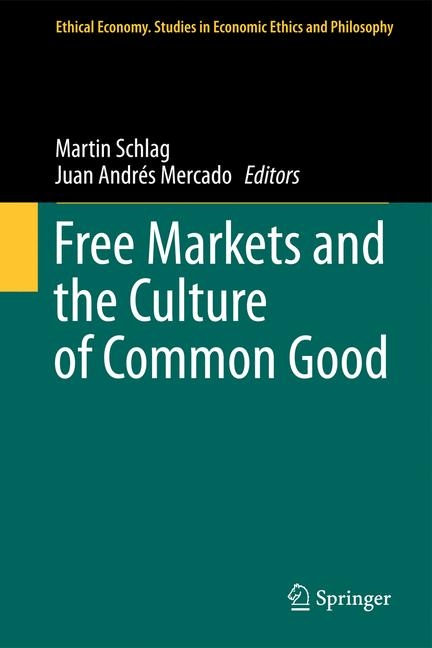
Free Markets and the Culture of Common Good (eBook)
260 Seiten
Springer Netherland (Verlag)
978-94-007-2990-2 (ISBN)
Recent economic development and the financial and economic crisis require a change in our approach to business and finance. This book combines theology, economy and philosophy in order to examine in detail the idea that the functioning of a free market economy depends upon sound cultural and ethical foundations.
The free market is a cultural achievement, not only an economic phenomenon subject to technical rules of trade and exchange. It is an achievement which lives by and depends upon the values and virtues shared by the majority of those who engage in economic activity. It is these values and virtues that we refer to as culture. Trust, credibility, loyalty, diligence, and entrepreneurship are the values inherent in commercial rules and law. But beyond law, there is also the need for ethical convictions and for global solidarity with developing countries. This book offers new ideas for future sustainable development and responds to an increasing need for a new sense of responsibility for the common good in societal institutions and good leadership.
Recent economic development and the financial and economic crisis require a change in our approach to business and finance. This book combines theology, economy and philosophy in order to examine in detail the idea that the functioning of a free market economy depends upon sound cultural and ethical foundations. The free market is a cultural achievement, not only an economic phenomenon subject to technical rules of trade and exchange. It is an achievement which lives by and depends upon the values and virtues shared by the majority of those who engage in economic activity. It is these values and virtues that we refer to as culture. Trust, credibility, loyalty, diligence, and entrepreneurship are the values inherent in commercial rules and law. But beyond law, there is also the need for ethical convictions and for global solidarity with developing countries. This book offers new ideas for future sustainable development and responds to an increasing need for a new sense of responsibility for the common good in societal institutions and good leadership.
Part 1: Free Market Economy and the Role of State Authorities.- Capitalism, Free Market Economy, and the Common Good: the Role of State Authorities in the Economic Sector. Martin Rhonheimer.- Indivisible Goods and Common Good. A Response to Martin Rhonheimer. Russell Hittinger.- Market and Common Good. João César das Neves.- Beyond the Market/State Binary Code: The Common Good as Relational Good. Pierpaolo Donati.- The encyclical Caritas in veritate between Christian tradition and modern economy. Martin Schlag.- From a “Culture of Greed” to a Culture of Common Good. Michel Camdessus.- Free Markets and the Common Good. A Few Methodological Remarks. Rocco Buttiglione.- A Multidisciplinary Model of Economics. Alejandro Cañadas.- A Paradigm Shift in the Social Teaching of the Church. From “Rerum Novarum” (1891) to “Caritas in veritate” (2009). Paul Josef Cardinal Cordes.- Financial Markets: A Tool for Transferring and managing risk? Michel Baroni.- Part 2: Social Responsibility, Entrepreneurship and virtues.- Catholic Small and Medium Enterprise Ministry: Resurrected Capital. Andreas Widmer.- Corporate Social Responsibility in the Encyclical Caritas in veritate. Antonio Argandoña.- The Ethical Anchoring of Corporate Social Responsibility and the Critique of CSR. Stefano Zamagni.- Can CSR, Market Efficiency and Financial Rewards Interact Positivels in Periods of Crisis? Youssef El-Khalil.- Ethical Dimensions of Finance. Lord Brian Griffiths of Fforestfach.- Capitalism and Social Change: Some Thoughts on How to Change the World. Alan M. Webber.- The German Social Market Economy – theory, practice, and impulses of Caritas in Veritate for enhancements. Andrea Schneider.- Is Business Compatible with the Culture of Common Good? Joan Fontrodona, Alexis Bañon and Alejo J. Sison.- Entrepreneurship and virtues. Rafael Alvira.
| Erscheint lt. Verlag | 23.4.2012 |
|---|---|
| Reihe/Serie | Ethical Economy | Ethical Economy |
| Zusatzinfo | XII, 260 p. |
| Verlagsort | Dordrecht |
| Sprache | englisch |
| Themenwelt | Geisteswissenschaften ► Philosophie ► Allgemeines / Lexika |
| Geisteswissenschaften ► Philosophie ► Ethik | |
| Geisteswissenschaften ► Religion / Theologie | |
| Naturwissenschaften | |
| Sozialwissenschaften | |
| Technik | |
| Wirtschaft ► Allgemeines / Lexika | |
| Wirtschaft ► Volkswirtschaftslehre ► Ökonometrie | |
| Schlagworte | Business Ethics • Capitalism and Social Change • Caritas in Veritate • Catholic Social Teaching • Christian Tradition and Modern Economy • Common Good • Corporate Social Responsibility • CSR • Culture of Common Good • Culture of Greed • Ethical Dimensions of Finance • Financial Rewards • Free Market Economy • Free Markets and the Common Good • market efficiency • Martin Rhonheimer • Papal Encyclical • Periods of Crisis • Rerun Novarum • Role of State Authorities in Economic Sectors • Small and Medium Enterprise • SME's • Social Responsibility • Social Teaching of the Church |
| ISBN-10 | 94-007-2990-1 / 9400729901 |
| ISBN-13 | 978-94-007-2990-2 / 9789400729902 |
| Informationen gemäß Produktsicherheitsverordnung (GPSR) | |
| Haben Sie eine Frage zum Produkt? |
 PDF (Wasserzeichen)
Größe: 2,0 MB
DRM: Digitales Wasserzeichen
Dieses eBook enthält ein digitales Wasserzeichen und ist damit für Sie personalisiert. Bei einer missbräuchlichen Weitergabe des eBooks an Dritte ist eine Rückverfolgung an die Quelle möglich.
Dateiformat: PDF (Portable Document Format)
Mit einem festen Seitenlayout eignet sich die PDF besonders für Fachbücher mit Spalten, Tabellen und Abbildungen. Eine PDF kann auf fast allen Geräten angezeigt werden, ist aber für kleine Displays (Smartphone, eReader) nur eingeschränkt geeignet.
Systemvoraussetzungen:
PC/Mac: Mit einem PC oder Mac können Sie dieses eBook lesen. Sie benötigen dafür einen PDF-Viewer - z.B. den Adobe Reader oder Adobe Digital Editions.
eReader: Dieses eBook kann mit (fast) allen eBook-Readern gelesen werden. Mit dem amazon-Kindle ist es aber nicht kompatibel.
Smartphone/Tablet: Egal ob Apple oder Android, dieses eBook können Sie lesen. Sie benötigen dafür einen PDF-Viewer - z.B. die kostenlose Adobe Digital Editions-App.
Buying eBooks from abroad
For tax law reasons we can sell eBooks just within Germany and Switzerland. Regrettably we cannot fulfill eBook-orders from other countries.
aus dem Bereich