


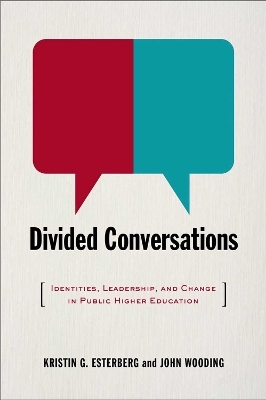
Divided Conversations
Identities, Leadership, and Change in Public Higher Education
Seiten
2013
Vanderbilt University Press (Verlag)
978-0-8265-1899-6 (ISBN)
Vanderbilt University Press (Verlag)
978-0-8265-1899-6 (ISBN)
Through their interviews with faculty and administrators (from department chairs and deans to provosts and presidents) from a sample of eight public universities in the Northeast and their own experiences in both worlds, the authors provide a unique window into the life experiences and identities of those who struggle to make universities work. The book examines the culture of academic institutions and attempts to understand why change in public higher education is so difficult to accomplish.
Many faculty believe that one of their own who becomes an administrator has gone over to ""the dark side."" One provost recalled going for a beer with a faculty colleague and hearing the colleague complain about the latest memo ""from the administration."" He had to remind his friend of many years that he was the author of the offending document. Now he was ""the administration."" He realised that former colleagues now appeared in his office wearing suits and ties and referring to him by his title rather than his first name.
The disciplines serve as the tribes into which individual scholars are organised; the discipline is where a faculty member finds his community and identity. Administrators, on the other hand, identify with each other in trying to get the tribes to work together. Though most administrators came from the faculty ranks, their career paths take a different shape, especially in terms of mobility to another institution. It's not surprising that the two groups talk past each other.
A chapter is devoted to chairs of departments, who occupy an interesting middle ground. To their faculty, they can come across as a nurturing parent or a petty bureaucrat. The authors recommend training for chairs and administrative internships offered by the American Council on Education and other organisations.
The men and women on the campuses of the public universities described in the book make clear the challenges that universities face in terms of budgets, legislative politics, collective bargaining, rankings, and control of academic programs. If public institutions are truly to serve a public purpose, faculty and administrators must find ways to engage each other in shared conversation and management and find ways of engaging the university with the community.
Many faculty believe that one of their own who becomes an administrator has gone over to ""the dark side."" One provost recalled going for a beer with a faculty colleague and hearing the colleague complain about the latest memo ""from the administration."" He had to remind his friend of many years that he was the author of the offending document. Now he was ""the administration."" He realised that former colleagues now appeared in his office wearing suits and ties and referring to him by his title rather than his first name.
The disciplines serve as the tribes into which individual scholars are organised; the discipline is where a faculty member finds his community and identity. Administrators, on the other hand, identify with each other in trying to get the tribes to work together. Though most administrators came from the faculty ranks, their career paths take a different shape, especially in terms of mobility to another institution. It's not surprising that the two groups talk past each other.
A chapter is devoted to chairs of departments, who occupy an interesting middle ground. To their faculty, they can come across as a nurturing parent or a petty bureaucrat. The authors recommend training for chairs and administrative internships offered by the American Council on Education and other organisations.
The men and women on the campuses of the public universities described in the book make clear the challenges that universities face in terms of budgets, legislative politics, collective bargaining, rankings, and control of academic programs. If public institutions are truly to serve a public purpose, faculty and administrators must find ways to engage each other in shared conversation and management and find ways of engaging the university with the community.
Kristin G. Esterberg is Provost and Academic Vice President at Salem State University, USA. She is a former chair of the Sociology Department at the University of Massachusetts Lowell, where she also served as Deputy Provost. She is the author of a book on gender and sexuality and a book on qualitative research methods. John Wooding served as Provost at the University of Massachusetts Lowell, USA for four years, before returning to the Department of Regional Economic and Social Development, where he was a founding faculty member and chair. He is the coauthor of two books on the work environment.
| Erscheint lt. Verlag | 28.2.2013 |
|---|---|
| Verlagsort | Tennessee |
| Sprache | englisch |
| Maße | 149 x 226 mm |
| Gewicht | 456 g |
| Themenwelt | Sozialwissenschaften ► Pädagogik ► Erwachsenenbildung |
| ISBN-10 | 0-8265-1899-0 / 0826518990 |
| ISBN-13 | 978-0-8265-1899-6 / 9780826518996 |
| Zustand | Neuware |
| Informationen gemäß Produktsicherheitsverordnung (GPSR) | |
| Haben Sie eine Frage zum Produkt? |
Mehr entdecken
aus dem Bereich



aus dem Bereich
Lernende in ihrem Lernprozess wirksam begleiten und unterstützen. Ein …
Buch | Softcover (2024)
WBV Media (Verlag)
CHF 27,95


