


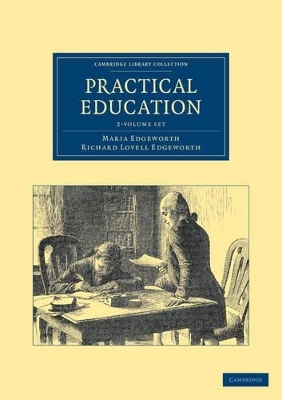
Practical Education 2 Volume Set
Seiten
2012
Cambridge University Press
978-1-108-04749-4 (ISBN)
Cambridge University Press
978-1-108-04749-4 (ISBN)
- Keine Verlagsinformationen verfügbar
- Artikel merken
Richard Lovell Edgeworth's influential two-volume work of 1788, written with his daughter Maria, derives its authority and innovative features from Edgeworth's own experiences of raising twenty children. Arguing for the formative character of early childhood experiences in general, Edgeworth discusses topics including play, good behaviour, and public and private schools.
The scientist Richard Lovell Edgeworth (1744–1817), educated at Trinity College, Dublin, and Oxford, was a Member of the Lunar Society of Birmingham, where he exchanged ideas with other scientists, including James Watt, and was known for his significant mechanical inventions. However, Edgeworth's real interest was education: in this 1788 two-volume work, written with his daughter, the poet Maria Edgeworth (1768–1849), he draws on his own experience of raising twenty children (by his four wives), from which the work derives its authority and innovative character. The work was very influential, and led to his Essays on Professional Education (1809; also reissued in this series). The two volumes discuss the theories of philosophers and educationalists, while in general arguing for the importance and formative character of early childhood experiences. Volume 1 deals with areas such as play, obedience and behaviour, and Volume 2, with creativity, and public and private education.
The scientist Richard Lovell Edgeworth (1744–1817), educated at Trinity College, Dublin, and Oxford, was a Member of the Lunar Society of Birmingham, where he exchanged ideas with other scientists, including James Watt, and was known for his significant mechanical inventions. However, Edgeworth's real interest was education: in this 1788 two-volume work, written with his daughter, the poet Maria Edgeworth (1768–1849), he draws on his own experience of raising twenty children (by his four wives), from which the work derives its authority and innovative character. The work was very influential, and led to his Essays on Professional Education (1809; also reissued in this series). The two volumes discuss the theories of philosophers and educationalists, while in general arguing for the importance and formative character of early childhood experiences. Volume 1 deals with areas such as play, obedience and behaviour, and Volume 2, with creativity, and public and private education.
Volume 1: Preface; 1. Toys; 2. Tasks; 3. On attention; 4. Servants; 5. Acquaintance; 6. On temper; 7. On obedience; 8. On truth; 9. On rewards and punishments; 10. On sympathy and sensibility; 11. On vanity, pride, and ambition; 12. Books. Volume 2: 13. On grammar, and classical literature; 14. On geography and chronology; 15. On arithmetick; 16. Geometry; 17. On mechanicks; 18. Chemistry; 19. On public and private education; 20. On female accomplishments, masters, and governesses; 21. Memory and invention; 22. Taste and imagination; 23. Wit and judgment; 24. Prudence and economy; 25. Summary; Appendix.
| Reihe/Serie | Cambridge Library Collection - Education |
|---|---|
| Zusatzinfo | 2 Plates, black and white |
| Verlagsort | Cambridge |
| Sprache | englisch |
| Maße | 213 x 297 mm |
| Gewicht | 2040 g |
| Themenwelt | Sozialwissenschaften ► Pädagogik ► Allgemeines / Lexika |
| Sozialwissenschaften ► Pädagogik ► Bildungstheorie | |
| ISBN-10 | 1-108-04749-1 / 1108047491 |
| ISBN-13 | 978-1-108-04749-4 / 9781108047494 |
| Zustand | Neuware |
| Informationen gemäß Produktsicherheitsverordnung (GPSR) | |
| Haben Sie eine Frage zum Produkt? |
Mehr entdecken
aus dem Bereich

aus dem Bereich


