


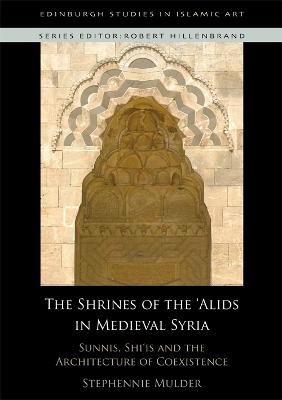
The Shrines of the 'Alids in Medieval Syria
Sunnis, Shi'is and the Architecture of Coexistence
Seiten
2014
Edinburgh University Press (Verlag)
978-0-7486-4579-4 (ISBN)
Edinburgh University Press (Verlag)
978-0-7486-4579-4 (ISBN)
- Titel ist leider vergriffen;
keine Neuauflage - Artikel merken
Though the headlines of today's newspapers suggest that the rift between Sunnis and Shi'is is eternal, the relationship between these two primary Islamic sects has not always been contentious. This book explores the relationship between Sunnis and Shi'is as expressed in the shrines of the Alids.
The first illustrated, architectural history of the 'Alid shrines, increasingly endangered by the conflict in Syria The 'Alids (descendants of the Prophet Muhammad) are among the most revered figures in Islam, beloved by virtually all Muslims, regardless of sectarian affiliation. This study argues that despite the common identification of shrines as 'Shi'i' spaces, they have in fact always been unique places of pragmatic intersectarian exchange and shared piety, even - and perhaps especially - during periods of sectarian conflict. Using a rich variety of previously unexplored sources, including textual, archaeological, architectural, and epigraphic evidence, Stephennie Mulder shows how these shrines created a unifying Muslim 'holy land' in medieval Syria, and proposes a fresh conceptual approach to thinking about landscape in Islamic art. In doing so, she argues against a common paradigm of medieval sectarian conflict, complicates the notion of Sunni Revival, and provides new evidence for the negotiated complexity of sectarian interactions in the period.
The first illustrated, architectural history of the 'Alid shrines, increasingly endangered by the conflict in Syria The 'Alids (descendants of the Prophet Muhammad) are among the most revered figures in Islam, beloved by virtually all Muslims, regardless of sectarian affiliation. This study argues that despite the common identification of shrines as 'Shi'i' spaces, they have in fact always been unique places of pragmatic intersectarian exchange and shared piety, even - and perhaps especially - during periods of sectarian conflict. Using a rich variety of previously unexplored sources, including textual, archaeological, architectural, and epigraphic evidence, Stephennie Mulder shows how these shrines created a unifying Muslim 'holy land' in medieval Syria, and proposes a fresh conceptual approach to thinking about landscape in Islamic art. In doing so, she argues against a common paradigm of medieval sectarian conflict, complicates the notion of Sunni Revival, and provides new evidence for the negotiated complexity of sectarian interactions in the period.
Stephennie Mulder is Assistant Professor in Islamic Art and Architecture at the University of Texas at Austin.
List of Figures and Maps; Series Editor’s Foreword; Acknowledgements; Introduction. ‘A Road for All Muslims’; 1. A Mashhad at Balis; 2. Aleppo, an Experiment in Islamic Ecumenism; 3. Eclectic Ecumenism: The Cemetery of Bab al-Saghir in Damascus; 4. Perpetual Patronage: Four Damascene ʿAlid Shrines; 5. A Landscape of Deeds: ‘Alid Shrines and the Construction of Islamic Sacred Topography; Conclusion 'A Time of Miracles'; Bibliography; Illustration Acknowledgements; Index.
| Reihe/Serie | Edinburgh Studies in Islamic Art |
|---|---|
| Zusatzinfo | illustrations |
| Verlagsort | Edinburgh |
| Sprache | englisch |
| Maße | 172 x 244 mm |
| Gewicht | 944 g |
| Themenwelt | Kunst / Musik / Theater ► Kunstgeschichte / Kunststile |
| Geisteswissenschaften ► Geschichte | |
| Geisteswissenschaften ► Religion / Theologie ► Islam | |
| Sozialwissenschaften ► Soziologie ► Spezielle Soziologien | |
| Technik ► Architektur | |
| ISBN-10 | 0-7486-4579-9 / 0748645799 |
| ISBN-13 | 978-0-7486-4579-4 / 9780748645794 |
| Zustand | Neuware |
| Informationen gemäß Produktsicherheitsverordnung (GPSR) | |
| Haben Sie eine Frage zum Produkt? |
Mehr entdecken
aus dem Bereich


aus dem Bereich


