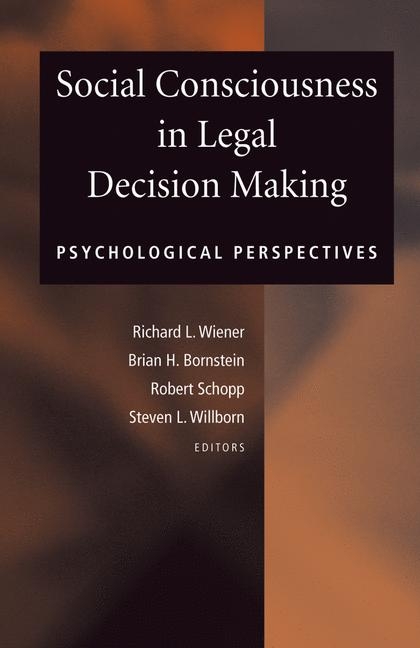
Social Consciousness in Legal Decision Making (eBook)
XIV, 284 Seiten
Springer US (Verlag)
978-0-387-46218-9 (ISBN)
This book invites the legal and psychology communities to work together in solving some of our most pressing social problems. It examines four controversial areas involving people's perceptions of others. The book is therefore a guide to understanding the valuable contribution of social scientific research in policy formulation in the law, and it addresses the role of psychology in substantive law and legal decision making.
Our basic assumption about the law is that it is designed to operate fairly and openly. But with human beings as the ultimate decision makers, how do we prevent discrimination within the legal arena, and how does the law decide whether others have behaved in a discriminatory manner? Social Consciousness in Legal Decision Making examines four controversial areas involving people's perceptions of others-racial profiling, affirmative action, workplace harassment, and hate speech/hate crime-from the perspectives of psychology, decision theory, and the law. This book's contributing experts raise these critical questions:How valid are legal assumptions about human behavior?What cognitive processes underlie biased behavior?What do personal experience and situational cues contribute to decision making?How do individuals perceptions of the law influence their judgment?Can psychology help legislators write more effective laws?In answering them, the book:Compares rational, descriptive, and normative decision-making models in legal contextsProvides important insights into legal decision making by non-specialists (police, administrators, jurors) Clarifies and broadens the role of social science in the courtsPromotes improved dialogue between the field of psychology and law to create a more socially aware jurisprudence.Social Consciousness in Legal Decision Making invites the legal and psychology communities to work together in solving some of our most pressing social problems.
Introduction Chapter 1: Law and Everyday Decision-Making: Rational, Descriptive, and Normative Models
Richard L. Wiener, University of Nebraska at Lincoln Unit I. Investigative Profiling: Legal Developments and Empirical Research Chapter 2: The Rhetoric of Racial Profiling
Sam R. Gross, University of Michigan Chapter 3: Racial Profiling, Attributions of Motive, and the Acceptance of Social Authority
Tom R. Tyler, New York University Chapter 4: Analysis Racial Profiling as a Minority Issue
Cynthia Willis-Esqueda, University of Nebraska-Lincoln Unit II. Affirmative Action: Legal Developments and Empirical Research Chapter 5: Affirmative Action and the Courts: From Plessy to Brown to Grutter, And Back?
Mark R. Killenbeck, University of Arkansas Chapter 6: The University of Michigan Cases: Social Scientific Studies of Diversity and
Fairness
Faye J. Crosby, University of California, Santa Cruz
Amy E. Smith, San Francisco State University Chapter 7: Social Science in the Courts: The View from Michigan
Steven L. Willborn, University of Nebraska-Lincoln Unit III. Workplace Discrimination: Legal Developments and Empirical Research in Sexual Harassment Chapter 8: How can we make our research on sexual harassment more useful in legal decision- making?
Barbara A. Guteks, University of Arizona Chapter 9: Totality of Circumstances in Sexual Harassment Decisions: A Decision Making Model
Richard L. Wiener, University of Nebraska-Lincoln
Ryan J. Winter, Florida International University Chapter 10: What Can Researchers Tell the Courts, and What Can the Courts Tell Researchers about Sexual Harassment?
Brian H. Bornstein, University of Nebraska-Lincoln
Meera Adya, Syracuse University Unit IV. Hate Speech and Hate Crimes: Legal Developments and Empirical Research Chapter 11: The Hate Crime Project and its Limitations: Evaluating the Societal Gains and Risk in Bias Crime Law Enforcement
Frederick M. Lawrence, George Washington University Chapter 12: Implications of automatic and controlled processes in stereotyping for hate crime perpetration and litigation
Margaret Bull Kovera, John Jay College of Criminal Justice Chapter 13: Implicit Bias and Hate Crimes: A Psychological Framework and Critical Race Theory Analysis
Jennifer S. Hunt, University of Nebraska at Lincoln Chapter 14: Psychology and Legal Decision Making: Where Should We Go From Here?Erin M. Richter, University of Nebraska-Lincoln
Richard L. Wiener, University of Nebraska-Lincoln
| Erscheint lt. Verlag | 11.5.2007 |
|---|---|
| Zusatzinfo | XIV, 284 p. 17 illus. |
| Verlagsort | New York |
| Sprache | englisch |
| Themenwelt | Geisteswissenschaften ► Psychologie ► Allgemeines / Lexika |
| Geisteswissenschaften ► Psychologie ► Klinische Psychologie | |
| Medizin / Pharmazie ► Medizinische Fachgebiete ► Psychiatrie / Psychotherapie | |
| Recht / Steuern ► Allgemeines / Lexika | |
| Recht / Steuern ► EU / Internationales Recht | |
| Sozialwissenschaften ► Politik / Verwaltung | |
| Sozialwissenschaften ► Soziologie | |
| Schlagworte | Affirmative Action • Crime • criminal justice • Diversity • hate crime • hate crimes • Justice • Profiling • racial profiling • sexual harassment • workplace discrimination |
| ISBN-10 | 0-387-46218-X / 038746218X |
| ISBN-13 | 978-0-387-46218-9 / 9780387462189 |
| Informationen gemäß Produktsicherheitsverordnung (GPSR) | |
| Haben Sie eine Frage zum Produkt? |
 PDF (Wasserzeichen)
DRM: Digitales Wasserzeichen
Dieses eBook enthält ein digitales Wasserzeichen und ist damit für Sie personalisiert. Bei einer missbräuchlichen Weitergabe des eBooks an Dritte ist eine Rückverfolgung an die Quelle möglich.
Dateiformat: PDF (Portable Document Format)
Mit einem festen Seitenlayout eignet sich die PDF besonders für Fachbücher mit Spalten, Tabellen und Abbildungen. Eine PDF kann auf fast allen Geräten angezeigt werden, ist aber für kleine Displays (Smartphone, eReader) nur eingeschränkt geeignet.
Systemvoraussetzungen:
PC/Mac: Mit einem PC oder Mac können Sie dieses eBook lesen. Sie benötigen dafür einen PDF-Viewer - z.B. den Adobe Reader oder Adobe Digital Editions.
eReader: Dieses eBook kann mit (fast) allen eBook-Readern gelesen werden. Mit dem amazon-Kindle ist es aber nicht kompatibel.
Smartphone/Tablet: Egal ob Apple oder Android, dieses eBook können Sie lesen. Sie benötigen dafür einen PDF-Viewer - z.B. die kostenlose Adobe Digital Editions-App.
Buying eBooks from abroad
For tax law reasons we can sell eBooks just within Germany and Switzerland. Regrettably we cannot fulfill eBook-orders from other countries.
aus dem Bereich