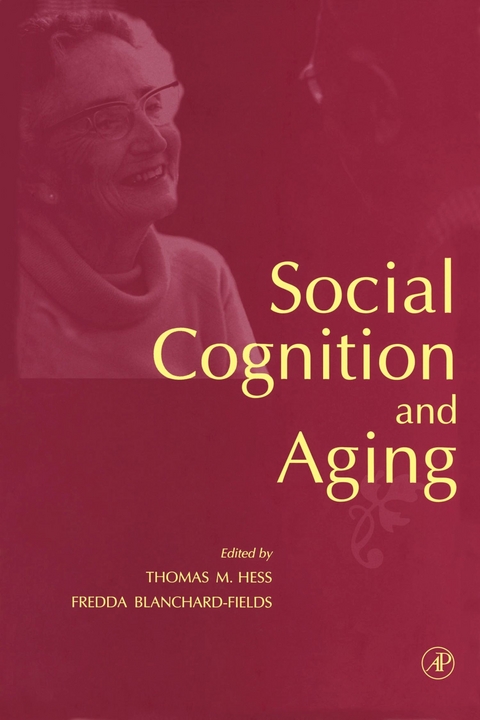
Social Cognition and Aging (eBook)
379 Seiten
Elsevier Science (Verlag)
9780080541303 (ISBN)
Most of the research done in social cognition has been conducted with younger adults and may not be applicable to a much older population. Social Cognition and Aging provides a snapshot view of research that has been done with older adults or is directly applicable to this population. Focusing on issues of self identity, social interactions, and social perceptions, this book provides a broad overview of how aging affects one's own perceptions and actions as well as how others perceive and interact with the aged. Coverage includes such topics as self-control, memory, resilience, age stereotypes, moral development, and the "e;art"e; of living. With contributions from top researchers in both gerontology and psychology, this book is an important reference for academics and professionals alike in personality, cognition, social psychology, adult development, sociology, and gerontology.
Cover
1
Contents 6
Contributors 16
Foreword 18
Chapter 1. The Social Cognitive Perspective and the Study of Aging 26
The Social Cognitive Perspective 27
Social Cognition and Aging 29
Aging and Social Cognition 32
Organization of this Book 33
References 37
Section I: Focus on Self 40
Chapter 2. The Sense Of Control And Cognitive Aging: Toward A Model Of Mediational Processes 42
Introduction 42
The Effects of Beliefs on Cognitive Performance 44
The Effects of Cognitive Performance on Control Beliefs 57
A Conceptual Model of the Relationship between Sense of Control and Cognitive Aging 60
Summary and Conclusions 62
References 63
Chapter 3. Beliefs About Memory and Aging 68
Introduction 68
Implicit Theories of Memory and Aging 70
Self-Referent Memory Beliefs 77
Implicit Theories and Self-Referent Beliefs 79
Attributions about Memory Task Performance 81
Control Beliefs, Strategy Use, and Attributions about Memory Performance 83
Summary and Conclusions 89
References 91
Chapter 4. Memory Self-Efficacy in Its Social Cognitive Context 94
What Is Memory Self-Efficacy? 95
Status and Critique of Memory Self-Efficacy Research 101
Future Research Directions 114
References 116
Chapter 5. Possible Selves in Adulthood: Incorporating Teleonomic Relevance into Studies of the Self 122
Theoretical Framework 124
Feed-Forward Processes 125
Overview of Studies 126
Methodological Issues in the Measurement of Possible Selves 128
Research Findings 131
Future Directions 136
Summary and Conclusions 137
References 137
Appendix: Possible Selves Questionnaire 142
Chapter 6. Sources of Resilience in the Agingself: Toward Integrating Perspectives 148
Adaptive Resources of the Self-System in Later Life: Assimilitative, Accommodative, and Immunizing Processes 150
Empirical Scope of the Model of Assimilative, Accommodative, and Immunizing Processes 157
Summary and Conclusions 161
References 163
Chapter 7. Auto Biographical Memory and Social Cognition: Development of the Remembered Self in Adulthood 168
An Outline 170
Definitions 170
Retrieval and Reconstruction 173
Organization 175
Organization and Social Cognition 178
The Distribution of Memories over Time 181
Summary and Conclusions 191
References 192
Section II: Focus on Others 198
Chapter 8. A Social Cognitive Perspective on Age Stereotypes 200
Age Stereotypes as Person Perception Schemas 201
Activation of Age Stereotypes in Interpersonal Interaction 204
Developmental Processes and Age Stereotyping 211
Summary and Conclusions 215
References 216
Chapter 9. Age and Memory: Perceptions of Forgetful Young and Older Adults 222
Seriousness of Forgetting 223
Attributions for Forgetting 225
Capability Impressions 229
Memory Opinion 234
Impression Management 236
Summary and Conclusions 238
References 240
Chapter 10. Social Schematicity and Causal Attributions 244
Development and Attributional Processing 247
Processing Resources and Attributional Processing 249
The Influence of Attitudes, Values, and Social Beliefs on Attributional Processing 250
Age Differences in Attributional Processing: Further Evidence 252
Summary and Conclusions 259
References 260
Chapter 11. Cognitive and Knowledge-Based Influences on Social Representations 262
A General Framework for Understanding Aging and Representational Processes 264
Cognitive Constraints on Representation 267
Knowledge-Based Influences on Representation 278
Summary and Conclusions 282
References 285
Section III: Focus on the Social Context: Interactions Between Self and Other 290
Chapter 12. Exploring Cognition in Interactive Situations: The Aging of N + 1 Minds 292
Stepping from Collaborative Cognition to Social Cognition 293
Why Examine Cognitive Aging in (Social) Collaborative Situations? 295
Examples of Research on Cognition in (Social) Collaborative Situations 304
Summary and Conclusions: Merging Social Cognition and Collaborative Cognition 309
References 311
Chapter 13. Moral Development in Maturity: Life-Span Perspectives on the Processes of Successful Aging 316
Introduction 316
Moral Reasoning Development in Maturity: A Review 320
Collaborating with Others to Solve Everyday Moral Problems 328
Individuals' Perspectives on Their Own Moral Development 334
Summary and Conclusions 336
References 338
Chapter 14. The Role of Time in the Setting of Social Goals Across the Life Span 344
Introduction 344
Motivation for Social Contact Throughout the Life Span 346
Traditional Theories of Social Behavior in Old Age 347
Socioemotional Selectivity Theory 348
Summary and Conclusions 363
References 364
Chapter 15. Social Cognition and a Psychological Approach to an Art of Life 368
Seven Constituent Features of a Life Perspective 371
Social Cognition and an Art of Life: Future Directions 388
References 392
Index 402
| Erscheint lt. Verlag | 18.6.1999 |
|---|---|
| Sprache | englisch |
| Themenwelt | Geisteswissenschaften ► Psychologie ► Allgemeine Psychologie |
| Geisteswissenschaften ► Psychologie ► Entwicklungspsychologie | |
| Geisteswissenschaften ► Psychologie ► Psychoanalyse / Tiefenpsychologie | |
| Geisteswissenschaften ► Psychologie ► Sozialpsychologie | |
| Geisteswissenschaften ► Psychologie ► Verhaltenstherapie | |
| Sozialwissenschaften ► Soziologie ► Empirische Sozialforschung | |
| ISBN-13 | 9780080541303 / 9780080541303 |
| Informationen gemäß Produktsicherheitsverordnung (GPSR) | |
| Haben Sie eine Frage zum Produkt? |
 PDF (Adobe DRM)
Kopierschutz: Adobe-DRM
Adobe-DRM ist ein Kopierschutz, der das eBook vor Mißbrauch schützen soll. Dabei wird das eBook bereits beim Download auf Ihre persönliche Adobe-ID autorisiert. Lesen können Sie das eBook dann nur auf den Geräten, welche ebenfalls auf Ihre Adobe-ID registriert sind.
Details zum Adobe-DRM
Dateiformat: PDF (Portable Document Format)
Mit einem festen Seitenlayout eignet sich die PDF besonders für Fachbücher mit Spalten, Tabellen und Abbildungen. Eine PDF kann auf fast allen Geräten angezeigt werden, ist aber für kleine Displays (Smartphone, eReader) nur eingeschränkt geeignet.
Systemvoraussetzungen:
PC/Mac: Mit einem PC oder Mac können Sie dieses eBook lesen. Sie benötigen eine
eReader: Dieses eBook kann mit (fast) allen eBook-Readern gelesen werden. Mit dem amazon-Kindle ist es aber nicht kompatibel.
Smartphone/Tablet: Egal ob Apple oder Android, dieses eBook können Sie lesen. Sie benötigen eine
Geräteliste und zusätzliche Hinweise
Buying eBooks from abroad
For tax law reasons we can sell eBooks just within Germany and Switzerland. Regrettably we cannot fulfill eBook-orders from other countries.
aus dem Bereich