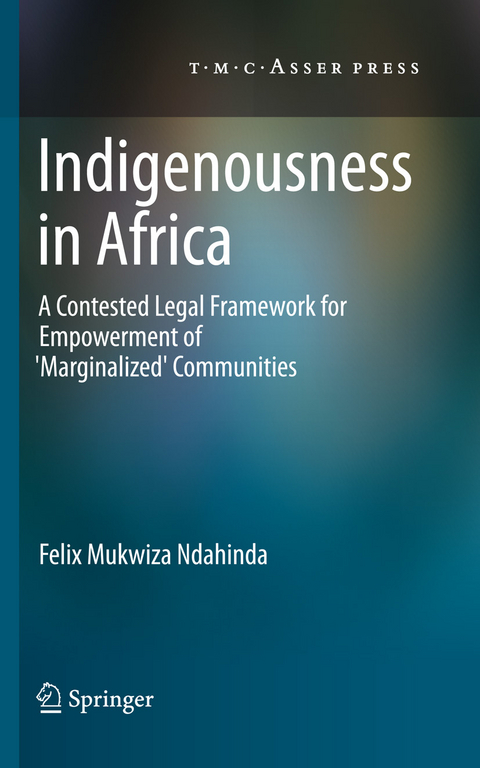
Indigenousness in Africa (eBook)
XXII, 393 Seiten
T.M.C. Asser Press (Verlag)
978-90-6704-609-1 (ISBN)
With a Foreword by Prof. Asbjorn Eide, a former Chairman of the UN Working Group on Indigenous Populations, Chairman of the UN Working Group on Minorities, President of the Advisory Committee on National Minorities of the Council of Europe Following the internationalization of the indigenous rights movement, a growing number of African hunter-gatherers, pastoralists and other communities have channelled their claims for special legal protection through the global indigenous rights movement. Their claims as the indigenous peoples of Africa are backed by many (international) actors such as indigenous rights activists, donors and some academia. However, indigenous identification is contested by many African governments, some members of non-claimant communities and a number of anthropologists who have extensively interacted with claimant indigenous groups. This book explores the sources as well as the legal and political implications of indigenous identification in Africa. By highlighting the quasi-inexistence of systematic and discursive rather than activist studies on the subject-matter, the analysis questions the appropriateness of this framework in efforts aimed at empowering claimant communities in inherently multiethnic African countries. The book navigates between various disciplines in trying to better capture the phenomenon of indigenous rights advocacy in Africa. The book is valuable reading for academics in law and all (other) social sciences such as anthropology, sociology, history, political science, as well as for economists. It is also a useful tool for policy-makers, legal practitioners, indigenous rights activists, and a wide range of NGOs. Dr. Felix Mukwiza Ndahinda is Associate Professor at the International Victimology Institute Tilburg (INTERVICT), Tilburg University, The Netherlands.
Foreword 8
Acknowledgments 11
Abbreviations 18
1 Introduction: Indigenous Identity in Africa 20
1.1…Roy Sesana, the Basarwa and Central Kalahari Game Reserve Case 20
1.2…Researching Indigenous Rights in Africa 25
1.3…Research Approach and Scope 29
References 31
Part I Indigenous Claims in Africa Under Global Perspective 33
2 Overview of Narratives on Indigenousness 35
2.1…Introduction 35
2.2…‘Indigenous’ Claims and Labels Under Historical Perspective 36
2.2.1 Notion 36
2.2.2 Some Figures on the Global Indigenous Population 37
2.2.3 Indigenousness as a Dynamic Concept 38
2.2.3.1 The Importance of the Martinez Cobo Reports in Conceptualization of Indigenousness 38
2.2.3.2 Insight into Historical Perception and Usage of the ‘Indigenous’ Attribute 42
The Genesis of International Indigenism 42
Challenges of Conceptualizing indigenousness Beyond the Americas and Australasia 44
2.2.3.3 Post-Martinez Cobo Reconceptualization of Indigenousness 46
2.3…Indigenousness and Related Concepts 52
2.3.1 Revisiting the Differentiation between Indigenousness and Minority Status 52
2.3.2 Indigenousness, Multiculturalism and Other Forms of Cultural Relativism 55
2.4…Disciplinary and Ideological Perspective on Indigenous Peoples’ Rights 58
2.4.1 Re-thinking Differences Under Various Disciplines 58
2.4.2 Human Security and Victimological Insights in Discourses on Indigenous Rights 60
2.4.3 Indigenousness and the ‘Individual Versus Group Rights’ Debate 64
2.5…Concluding Remarks 66
References 67
3 Contextual Application of Indigenousness in Africa 73
3.1…Introduction 73
3.2…The Rise of Indigenous Claims and Activism in Africa 74
3.3…Situational Characteristics of Claimant Groups 80
3.3.1 Multiethnic Composition of African States 81
3.3.2 General Characteristics of Claimant Indigenous Groups 84
3.3.2.1 Hunter-Gatherers 85
3.3.2.2 Indigenization of Pastoralists 89
3.3.2.3 Small-Scale Farmers and Challenges of Subjective Identification 98
3.4…Indigenous Peoples or Marginalized Minorities? 100
3.4.1 Heated Discourses over Identity Claims in Africa 100
3.4.2 Minority, Indigenous, Local Communities or Threatened Peoples ? 102
3.4.2.1 Political Strategies or Immutable Identities? 102
3.4.2.2 Indigenous Basters and Boers? 106
3.5…Constitutionalizing Indigenousness in African Nation-States 111
3.5.1 Constitutional accomodation of National Cultural Diversity 111
3.5.2 Equivocal Status of Indigenous Claims in Some Constitutional Orders 116
3.5.2.1 Limited Forms of Recognition 116
3.5.2.2 Indigenousness and Transnational Identities 121
3.6…Conclusion 123
References 127
Part II International and Regional Legal Position of Claimant African Indigenous Peoples 135
4 International Legal Framework and Indigenous Claims in Africa 137
4.1…Introduction 137
4.2…Normative Protection of Indigenous Peoples Under International Instruments 138
4.2.1 General Instruments and Indigenous Peoples 138
4.2.1.1 Non-Discrimination, Right to Equality and Indigenous Peoples 139
4.2.1.2 Self-Determination and Applicability of Article 27 of the ICCPR to Indigenous Peoples 143
Minority Provisions and Indigenous Peoples 143
Self-Determination of Claimant African Indigenous Peoples 147
Control of Lands, Territories and Resources 159
4.2.2 Specific International Legal Protection of Indigenous Peoples 161
4.2.2.1 The ILO Conventions on Indigenous and Tribal Peoples 161
4.2.2.2 The United Nations Declaration on the Rights of Indigenous Peoples 162
4.3…International Institutional Involvement in Indigenous Matters 170
4.3.1 Indigenous Peoples’ Rights, Development and international institutions: Convergence or Divergence? 170
4.3.2 Institutional Role of the United Nations’ WGIP, PFII and Special Rapporteur in Furthering Indigenous Rights in Africa 175
4.4…Appraisal of Legal and Institutional Developments on the Protection of Indigenous Peoples 179
References 180
5 Indigenous Claims and Rights Under African Regional Institutions 187
5.1…Introduction 187
5.2…Indigenousness and African Political Institutions 187
5.2.1 Challenges of Recognition of Diverse Identities by African Regional Bodies 188
5.2.2 Progressive Accommodation of Cultural Diversity by Regional Bodies 193
5.2.2.1 The Cultural Charter for Africa 193
5.2.2.2 The African Convention on the Conservation of Nature and Natural Resources 195
5.2.2.3 The New Partnership for Africa’s Development (NEPAD) and Related Processes 196
5.2.2.4 African Charter on the Rights and Welfare of the Child 201
5.2.2.5 African Charter on Democracy, Elections and Governance 202
5.2.2.6 African Model Law for the Protection of the Rights of Local Communities, Farmers and Breeders, and for the Regulation of Access to Biological Resources 203
5.3…Accommodation for Indigenous Peoples’ Within the African Charter System 205
5.3.1 The African Charter on Human and Peoples’ Rights 205
5.3.2 African Commission on Human and Peoples’ Rights 206
5.3.3 A Human and Peoples’ Rights Court for Africa 207
5.3.4 Peoples’ Rights Provisions of the African Charter 209
5.3.5 Relevant Jurisprudence and Practice of the ACHPR 211
5.3.6 The Working Group of Experts on Indigenous Populations/Communities 222
5.4…Conclusion 225
References 227
Part III Indigenousness in Africa Under Selected Cases 231
6 Twa Marginality and Indigenousness in Rwanda 233
6.1…Historical Perspective on Twa Marginality 233
6.1.1 The Twas as the Indigenous of Rwanda and Tropical Africa 234
6.1.2 Twas Under Revisited Historical, Anthropological and Archaeological Debates 238
6.1.2.1 On Separate Origins of Pre-colonial Inhabitants of Rwanda 238
6.1.2.2 Twas in Pre-colonial and Colonial Rwandan Society 242
6.1.2.3 Enhanced Marginality in an Ethnicized Society: The Autochthon- Allochthon Discourse 245
6.2…Twas as an Indigenous People in Rwanda 250
6.2.1 Socio-Political Landscape: Then and Now 250
6.2.2 Addressing Twa Predicament: Associative Initiatives 253
6.2.2.1 Batwa Activism: Historical Overview 253
6.2.2.2 Challenges to Indigenous Rights Advocacy and Recognition: From CAURWA to COPORWA 256
6.2.3 Substantive Claims for Special Protection: Intricate Discourses 258
6.2.3.1 Twas as a Marginalized Group and as the Poorest of the Poor 258
6.2.3.2 Together as One or Unity in Plurality? 259
6.2.3.3 Land and Shelter as the Most Pressing Needs 261
6.2.3.4 Indigenous Rights and/or Political and Socio-Economic Empowerment? 265
6.3…Conclusion: Which Path to the Future? 268
References 269
7 Indigenization of Pastoralist Maasai in Kenya 274
7.1…The Maasai Identity 274
7.1.1 A People and Its Land 274
7.1.2 Brief Historical and Contextual Background 279
7.1.2.1 Uncertain Pre-History of East African Identities 279
7.1.2.2 The Maasai in the Rift Valley: From Origins to Control of the Land 280
7.1.2.3 Maasai and the Colonial Encounter 285
Context of Colonial Encounter in Mid-Nineteenth Century 285
Maasai Moves and the Colonial Roots of Current Marginality 288
The Maasai Court Case against the Crown: Ambiguities and Aftermath 290
7.2…The Maasai Indigenous Identity in Perspective 293
7.2.1 The Indigenous Pastoralist Maasai 293
7.2.2 Maasai Indigenous Identity and Indigenous Development Organizations 296
7.2.3 Substantive Indigenous Claims 301
7.2.4 Indigenous Maasai in Multiethnic Kenya 304
7.3…Conclusion 309
References 311
Part IV Empowerment of Marginalized Ethno-Cultural Identities 316
8 Indigenousness, Human Security and Empowerment of Marginalized Identities in Africa 318
8.1…Introduction 318
8.2…Protection of Marginalized Groups: The Importance of History, Concepts, Politics and Laws 319
8.2.1 From the Protectorate System to Human Rights and Human Security 319
8.2.1.1 Protection and Preservation of the Natives under Colonialism 319
8.2.1.2 The Human Rights Revolution and Practical Limitations 323
8.2.1.3 Human Development, Human Security and Holism 325
8.3…Correlations between Indigenousness, Sustainability and Human Security in Africa 329
8.3.1 Indigenousness as a Response to Marginality and Dispossession in Africa 329
8.3.2 Indigenous Rights, Sustainability and Human Security 332
8.3.2.1 The Rights and Needs of Hunter--Gatherers and Transhumant Pastoralists 332
8.3.2.2 Sustainability of Hunting--Gathering and Transhumant Pastoralism 333
8.3.2.3 The Human Security of Hunter--Gatherers and Transhumant Pastoralists 337
8.4…Contextualizing Ideas on Individual and Community Empowerment 339
8.4.1 Identities, Boundaries, Indigenousness, Development and Empowerment 339
8.4.1.1 Balancing Identities and the State 339
8.4.1.2 Indigenousness, Development and the Boundaries of Ethnicity 341
8.4.2 Human Security, Empowerment of Individuals and Collectives: From Rhetoric to Substance? 345
8.4.2.1 Contextualizing Diagnoses of Problems and Long-Term Solutions 345
8.4.2.2 Political and Economic Empowerment 349
8.5…Conclusion 352
References 353
9 Indigenousness, Ethnicity, Marginality and Empowerment: Which Path to the Future? 358
9.1…Basarwa Indigenousness and the Essentialization of Identity 358
9.2…What Indigenous Identity and Whose Indigenous Rights in Africa? 361
9.2.1 The Contested Indigenous Rights Framework in Africa 361
9.2.2 Indigenousness as a Concept with a Loaded History 364
9.2.3 Incoherent Substance of Indigenous Claims in Africa 367
9.3…Nation-Building, Community Marginality and Empowerment 372
9.3.1 The Need for Constitutional Accommodation of All Identities 372
9.3.2 Socio-Economic and Political Empowerment 374
References 376
Appendix 1 377
Appendix 2 United Nations Declaration on the Rightsof Indigenous Peoples 385
Appendix 3 Decision on the United Nations Declarationon the Rights of Indigenous Peoples 398
Appendix 4 Sub-Regional Maps of Africa Locatingthe Various Ethno-Cultural Identities 400
Table of Cases 406
| Erscheint lt. Verlag | 27.4.2011 |
|---|---|
| Zusatzinfo | XXII, 393 p. |
| Verlagsort | The Hague |
| Sprache | englisch |
| Themenwelt | Recht / Steuern ► EU / Internationales Recht |
| Recht / Steuern ► Öffentliches Recht ► Verfassungsrecht | |
| Sozialwissenschaften ► Ethnologie | |
| Sozialwissenschaften ► Politik / Verwaltung | |
| Sozialwissenschaften ► Soziologie | |
| Schlagworte | Africa • Human Rights Law • Indigeousness identification • Minorities |
| ISBN-10 | 90-6704-609-4 / 9067046094 |
| ISBN-13 | 978-90-6704-609-1 / 9789067046091 |
| Informationen gemäß Produktsicherheitsverordnung (GPSR) | |
| Haben Sie eine Frage zum Produkt? |
 PDF (Wasserzeichen)
Größe: 4,2 MB
DRM: Digitales Wasserzeichen
Dieses eBook enthält ein digitales Wasserzeichen und ist damit für Sie personalisiert. Bei einer missbräuchlichen Weitergabe des eBooks an Dritte ist eine Rückverfolgung an die Quelle möglich.
Dateiformat: PDF (Portable Document Format)
Mit einem festen Seitenlayout eignet sich die PDF besonders für Fachbücher mit Spalten, Tabellen und Abbildungen. Eine PDF kann auf fast allen Geräten angezeigt werden, ist aber für kleine Displays (Smartphone, eReader) nur eingeschränkt geeignet.
Systemvoraussetzungen:
PC/Mac: Mit einem PC oder Mac können Sie dieses eBook lesen. Sie benötigen dafür einen PDF-Viewer - z.B. den Adobe Reader oder Adobe Digital Editions.
eReader: Dieses eBook kann mit (fast) allen eBook-Readern gelesen werden. Mit dem amazon-Kindle ist es aber nicht kompatibel.
Smartphone/Tablet: Egal ob Apple oder Android, dieses eBook können Sie lesen. Sie benötigen dafür einen PDF-Viewer - z.B. die kostenlose Adobe Digital Editions-App.
Buying eBooks from abroad
For tax law reasons we can sell eBooks just within Germany and Switzerland. Regrettably we cannot fulfill eBook-orders from other countries.
aus dem Bereich