


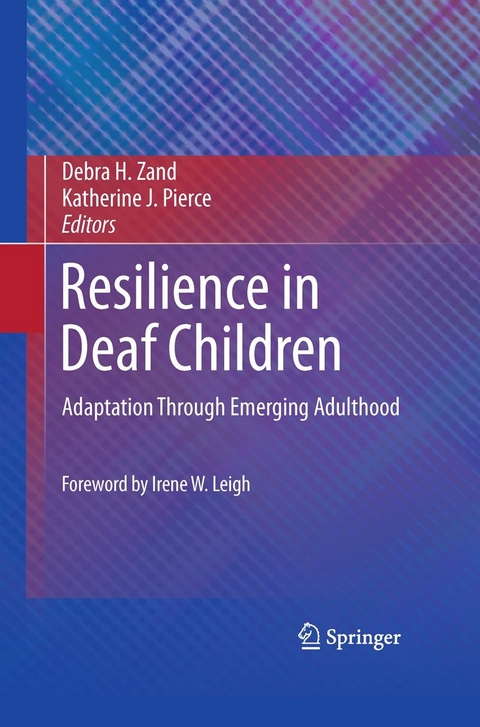
Resilience in Deaf Children (eBook)
XXI, 396 Seiten
Springer New York (Verlag)
978-1-4419-7796-0 (ISBN)
Historically, the diagnosis of deafness in a child has been closely associated with profound disability, including such typical outcomes as unmet potential and a life of isolation. A major shift away from this negative view has led to improved prospects for deaf children.
Resilience in Deaf Children emphasizes not only the capability of deaf individuals to withstand adversity, but also their positive adaptation through interactions with parents, peers, school, and community. In this engaging volume, leading researchers and professionals pay particular attention to such issues as attachment, self-concept, and social competence, which are crucial to the development of all young people. In addition, the volume offers strategies for family members, professionals, and others for promoting the well-being of deaf children and youth.
Coverage includes:
- Attachment formation among deaf infants and their primary caregivers.
- Deaf parents as sources of positive development and resilience for deaf infants.
- Enhancing resilience to mental health disorders in deaf school children.
- Strength-based guidelines for improving the developmental environments of deaf children and youth.
- Community cultural wealth and deaf adolescents' resilience.
- Self-efficacy in the management of anticipated work-family conflict as a resilience factor among young deaf adults.
Resilience in Deaf Children is essential reading for researchers, clinicians, and graduate students in clinical child, school, and developmental psychology as well as for allied researchers and professionals in such disciplines as school counseling, occupational therapy, and social work.
Dr. Zand is a clinical psychologist and Research Associate Professor at the University of Missouri-Columbia, Medical School, Department of Psychiatry. For the past 14 years, her work has focused on child and adolescent mental health and resilience. During this time, she has been responsible for writing, designing, and directing multiple federally funded longitudinal grants. Her most recent project focuses on fostering bonding between medically fragile, developmentally disabled young children and their caregivers. Dr. Zand has taught both graduate and undergraduate courses in research methods and mental health policy, mentored graduate students and junior faculty, published in peer reviewed journals, and presented findings in local, state, and national forums. Recently, she was accepted into the American Psychological Association's Leadership Institute for Women In Psychology.
Dr. Kathy Pierce, a clinical psychologist at Washington University's School of Medicine - Department of Psychiatry, specializes in novel interventions for persons with treatment resistant depression. Over the past 6 years, Dr. Pierce has worked on both industry and federally funded clinical trials, serving as a supervisor, psychometrician, treater, statistician, co-author, and/or grant writer. Prior to working at Washington University, Dr. Pierce was the Evaluation Director for a non-profit agency providing care for AIDs patients, and co-led Missouri's 'Deaf Mental Health PAH,' a statewide deaf mental health advocacy group.
Historically, the diagnosis of deafness in a child has been closely associated with profound disability, including such typical outcomes as unmet potential and a life of isolation. A major shift away from this negative view has led to improved prospects for deaf children.Resilience in Deaf Children emphasizes not only the capability of deaf individuals to withstand adversity, but also their positive adaptation through interactions with parents, peers, school, and community. In this engaging volume, leading researchers and professionals pay particular attention to such issues as attachment, self-concept, and social competence, which are crucial to the development of all young people. In addition, the volume offers strategies for family members, professionals, and others for promoting the well-being of deaf children and youth.Coverage includes:Attachment formation among deaf infants and their primary caregivers.Deaf parents as sources of positive development and resilience for deaf infants.Enhancing resilience to mental health disorders in deaf school children.Strength-based guidelines for improving the developmental environments of deaf children and youth.Community cultural wealth and deaf adolescents' resilience.Self-efficacy in the management of anticipated work-family conflict as a resilience factor among young deaf adults.Resilience in Deaf Children is essential reading for researchers, clinicians, and graduate students in clinical child, school, and developmental psychology as well as for allied researchers and professionals in such disciplines as school counseling, occupational therapy, and social work.
Dr. Zand is a clinical psychologist and Research Associate Professor at the University of Missouri-Columbia, Medical School, Department of Psychiatry. For the past 14 years, her work has focused on child and adolescent mental health and resilience. During this time, she has been responsible for writing, designing, and directing multiple federally funded longitudinal grants. Her most recent project focuses on fostering bonding between medically fragile, developmentally disabled young children and their caregivers. Dr. Zand has taught both graduate and undergraduate courses in research methods and mental health policy, mentored graduate students and junior faculty, published in peer reviewed journals, and presented findings in local, state, and national forums. Recently, she was accepted into the American Psychological Association’s Leadership Institute for Women In Psychology.Dr. Kathy Pierce, a clinical psychologist at Washington University’s School of Medicine - Department of Psychiatry, specializes in novel interventions for persons with treatment resistant depression. Over the past 6 years, Dr. Pierce has worked on both industry and federally funded clinical trials, serving as a supervisor, psychometrician, treater, statistician, co-author, and/or grant writer. Prior to working at Washington University, Dr. Pierce was the Evaluation Director for a non-profit agency providing care for AIDs patients, and co-led Missouri’s “Deaf Mental Health PAH,” a statewide deaf mental health advocacy group.
Dedication.- Foreword.- Acknowledgements.- Introduction.- Chapter 1. Critical Issues in the Application of Resilience Frameworks to the Experiences of Deaf Children and Young People.- Infancy & Toddlerhood.- Chapter 2. Attachment Formation Among Deaf Infants and their Primary Caregivers: Is Being Deaf a Risk Factor for Insecure Attachment?.- Chapter 3. Deaf Parents as Sources of Positive Development and Resilience for Deaf Infants.- Chapter 4. Risk and Resiliency of Infants/Toddlers who are Deaf: Assessment and Intervention Issues.- Childhood.- Chapter 5. Developing a Concept of Self and Other: Risk and Protective Factors.- Chapter 6. Risk and Resilience for Social Competence: Deaf Students in General Education Classrooms.- Chapter 7. Enhancing Resilience to Mental Health Disorders in Deaf School Children.- Chapter 8. Promoting Resilience: Suggestions for Families, Professionals and Students.- Adolescence.- Chapter 9. Whose Literacy Is It, Anyway? Strengths Based Guidelines for Transforming the Developmental Environments of Deaf Children and Adolescents.- Chapter 10. Building Resilience in Adolescence: The Influences of Individual, Family, School and Community Perspectives and Practices.- Chapter 11. Community Cultural Wealth and Deaf Adolescents’ Resilience.- Chapter 12. Promoting Resilience in Deaf Adolescents.- Emerging Adulthood.- Chapter 13. Self-Efficacy in the Management of Anticipated Work-Family Conflict as a Resilience Factor Among Young Deaf.- Chapter 14. Psychological Well-Being in Emerging Adults who are Deaf.- Chapter 15. Resiliency and the Emerging Deaf Adult.- Epilogue.
| Erscheint lt. Verlag | 24.2.2011 |
|---|---|
| Zusatzinfo | XXI, 396 p. |
| Verlagsort | New York |
| Sprache | englisch |
| Themenwelt | Geisteswissenschaften ► Psychologie ► Entwicklungspsychologie |
| Geisteswissenschaften ► Psychologie ► Pädagogische Psychologie | |
| Medizin / Pharmazie ► Medizinische Fachgebiete ► Psychiatrie / Psychotherapie | |
| Sozialwissenschaften ► Pädagogik ► Didaktik | |
| Sozialwissenschaften ► Pädagogik ► Sozialpädagogik | |
| Sozialwissenschaften ► Soziologie | |
| Schlagworte | Child Development • Deaf • Hard of hearing • Positive adaptation • Resilience • Risk • Well being |
| ISBN-10 | 1-4419-7796-1 / 1441977961 |
| ISBN-13 | 978-1-4419-7796-0 / 9781441977960 |
| Informationen gemäß Produktsicherheitsverordnung (GPSR) | |
| Haben Sie eine Frage zum Produkt? |
 PDF (Wasserzeichen)
DRM: Digitales Wasserzeichen
Dieses eBook enthält ein digitales Wasserzeichen und ist damit für Sie personalisiert. Bei einer missbräuchlichen Weitergabe des eBooks an Dritte ist eine Rückverfolgung an die Quelle möglich.
Dateiformat: PDF (Portable Document Format)
Mit einem festen Seitenlayout eignet sich die PDF besonders für Fachbücher mit Spalten, Tabellen und Abbildungen. Eine PDF kann auf fast allen Geräten angezeigt werden, ist aber für kleine Displays (Smartphone, eReader) nur eingeschränkt geeignet.
Systemvoraussetzungen:
PC/Mac: Mit einem PC oder Mac können Sie dieses eBook lesen. Sie benötigen dafür einen PDF-Viewer - z.B. den Adobe Reader oder Adobe Digital Editions.
eReader: Dieses eBook kann mit (fast) allen eBook-Readern gelesen werden. Mit dem amazon-Kindle ist es aber nicht kompatibel.
Smartphone/Tablet: Egal ob Apple oder Android, dieses eBook können Sie lesen. Sie benötigen dafür einen PDF-Viewer - z.B. die kostenlose Adobe Digital Editions-App.
Buying eBooks from abroad
For tax law reasons we can sell eBooks just within Germany and Switzerland. Regrettably we cannot fulfill eBook-orders from other countries.
aus dem Bereich


