Cognitive Load Theory (eBook)
XVI, 274 Seiten
Springer New York (Verlag)
9781441981264 (ISBN)
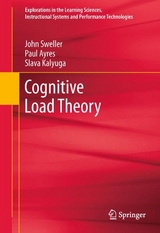
Over the last 25 years, cognitive load theory has become one of the world's leading theories of instructional design. It is heavily researched by many educational and psychological researchers and is familiar to most practicing instructional designers, especially designers using computer and related technologies.
The theory can be divided into two aspects that closely inter-relate and influence each other: human cognitive architecture and the instructional designs and prescriptions that flow from that architecture. The cognitive architecture is based on biological evolution. The resulting description of human cognitive architecture is novel and accordingly, the instructional designs that flow from the architecture also are novel. All instructional procedures are routinely tested using randomized, controlled experiments.
Roughly 1/3 of the book will be devoted to cognitive architecture and its evolutionary base with 2/3 devoted to the instructional implications that follow, including technology-based instruction. Researchers, teachers and instructional designers need the book because of the explosion of interest in cognitive load theory over the last few years. The theory is represented in countless journal articles but a detailed, modern overview presenting the theory and its implications in one location is not available.
Over the last 25 years, cognitive load theory has become one of the world's leading theories of instructional design. It is heavily researched by many educational and psychological researchers and is familiar to most practicing instructional designers, especially designers using computer and related technologies.The theory can be divided into two aspects that closely inter-relate and influence each other: human cognitive architecture and the instructional designs and prescriptions that flow from that architecture. The cognitive architecture is based on biological evolution. The resulting description of human cognitive architecture is novel and accordingly, the instructional designs that flow from the architecture also are novel. All instructional procedures are routinely tested using randomized, controlled experiments.Roughly 1/3 of the book will be devoted to cognitive architecture and its evolutionary base with 2/3 devoted to the instructional implications that follow, including technology-based instruction. Researchers, teachers and instructional designers need the book because of the explosion of interest in cognitive load theory over the last few years. The theory is represented in countless journal articles but a detailed, modern overview presenting the theory and its implications in one location is not available.
Introduction to the issues addressed by cognitive load theory.- Categories of information: What is learned based on an evolutionary perspective.- Human cognitive architecture.- Categories of cognitive load and measuring cognitive load.- Instructional effects associated with intrinsic cognitive load. -Instructional effects associated with extraneous cognitive load.- The consequences of cognitive load theory for debates on the advantages and disadvantages of minimal guidance during instruction.- Future directions and unresolved issues.
| Erscheint lt. Verlag | 7.4.2011 |
|---|---|
| Reihe/Serie | Explorations in the Learning Sciences, Instructional Systems and Performance Technologies | Explorations in the Learning Sciences, Instructional Systems and Performance Technologies |
| Zusatzinfo | XVI, 274 p. 20 illus. |
| Verlagsort | New York |
| Sprache | englisch |
| Themenwelt | Geisteswissenschaften ► Psychologie ► Allgemeine Psychologie |
| Geisteswissenschaften ► Psychologie ► Entwicklungspsychologie | |
| Geisteswissenschaften ► Psychologie ► Pädagogische Psychologie | |
| Geisteswissenschaften ► Psychologie ► Verhaltenstherapie | |
| Medizin / Pharmazie ► Medizinische Fachgebiete ► Psychiatrie / Psychotherapie | |
| Sozialwissenschaften ► Pädagogik | |
| Schlagworte | categories of information • Cognitive Load Theory • extraneous cognitive load • human cognitive architecture • human creativity • Instructional Design • instructional formatting • Learning and Instruction • long-term memory • measuring cognitive load • Modality Effect • Redundancy Effect • split-attention effect |
| ISBN-13 | 9781441981264 / 9781441981264 |
| Informationen gemäß Produktsicherheitsverordnung (GPSR) | |
| Haben Sie eine Frage zum Produkt? |
 PDF (Wasserzeichen)
DRM: Digitales Wasserzeichen
Dieses eBook enthält ein digitales Wasserzeichen und ist damit für Sie personalisiert. Bei einer missbräuchlichen Weitergabe des eBooks an Dritte ist eine Rückverfolgung an die Quelle möglich.
Dateiformat: PDF (Portable Document Format)
Mit einem festen Seitenlayout eignet sich die PDF besonders für Fachbücher mit Spalten, Tabellen und Abbildungen. Eine PDF kann auf fast allen Geräten angezeigt werden, ist aber für kleine Displays (Smartphone, eReader) nur eingeschränkt geeignet.
Systemvoraussetzungen:
PC/Mac: Mit einem PC oder Mac können Sie dieses eBook lesen. Sie benötigen dafür einen PDF-Viewer - z.B. den Adobe Reader oder Adobe Digital Editions.
eReader: Dieses eBook kann mit (fast) allen eBook-Readern gelesen werden. Mit dem amazon-Kindle ist es aber nicht kompatibel.
Smartphone/Tablet: Egal ob Apple oder Android, dieses eBook können Sie lesen. Sie benötigen dafür einen PDF-Viewer - z.B. die kostenlose Adobe Digital Editions-App.
Buying eBooks from abroad
For tax law reasons we can sell eBooks just within Germany and Switzerland. Regrettably we cannot fulfill eBook-orders from other countries.
aus dem Bereich