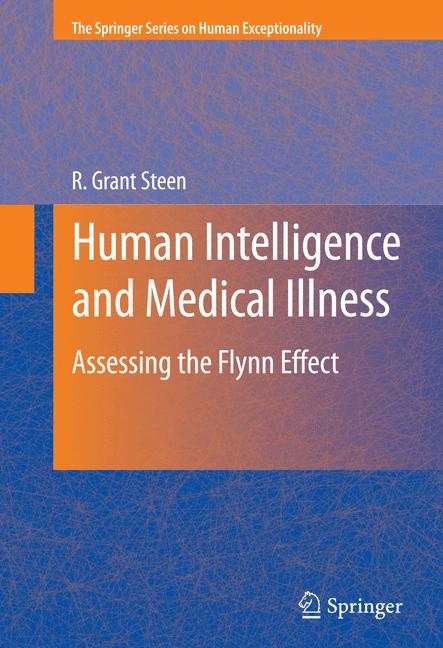
Human Intelligence and Medical Illness (eBook)
XII, 218 Seiten
Springer New York (Verlag)
978-1-4419-0092-0 (ISBN)
R. Grant Steen has written 5 books and 70 research articles, mostly about the human brain in health and disease. He has been a professor of psychiatry, pediatrics, biomedical engineering, and radiology (brain imaging), and he worked for 20 years in clinical research at various medical schools and hospitals. He earned a Doctorate in Biology from UCLA, held a National Research Service Award at the Johns Hopkins University School of Medicine, and he has been a faculty member at the University of Washington, St. Jude Children's Research Hospital, the University of Tennessee, and the University of North Carolina. Dr. Steen now consults and writes about the brain full-time.
As critics will note, psychometric tests are deeply flawed. Person-to-person differences in performance on a psychometric test are not informative about many things of great interest. An intelligence quotient (IQ) cannot characterize creativity or w- dom or artistic ability or other forms of specialized knowledge. An IQ test is simply an effort to assess an aptitude for success in the modern world, and individual scores do a mediocre job of predicting individual successes. In the early days of psychology, tests of intelligence were cobbled together with little thought as to validity; instead, the socially powerful sought to validate their power and the prominent to rationalize their success. In recent years, we have ob- ated many of the objections to IQ that were so forcefully noted by Stephen Jay Gould in The Mismeasure of Man. Nevertheless, IQ tests are still flawed and those flaws are hereby acknowledged in principle. Yet, in the analysis that follows, individual IQ test scores are not used; rather, average IQ scores are employed. In many cases - though not all - an average IQ is calculated from a truly enormous sample of people. The most common circ- stance for such large-scale IQ testing is an effort to systematically sample all men of a certain age, to assess their suitability for service in the military. Yet, it is useful and prudent to retain some degree of skepticism about the ability of IQ tests to measure individual aptitudes.
R. Grant Steen has written 5 books and 70 research articles, mostly about the human brain in health and disease. He has been a professor of psychiatry, pediatrics, biomedical engineering, and radiology (brain imaging), and he worked for 20 years in clinical research at various medical schools and hospitals. He earned a Doctorate in Biology from UCLA, held a National Research Service Award at the Johns Hopkins University School of Medicine, and he has been a faculty member at the University of Washington, St. Jude Children's Research Hospital, the University of Tennessee, and the University of North Carolina. Dr. Steen now consults and writes about the brain full-time.
Steen_FM_O.pdf 1
Anchor 1 5
Steen_Ch01_O.pdf 10
Chapter 1 10
Are People Getting Smarter? 10
What Is Intelligence? 10
The Flynn Effect 11
How Real Is the Flynn Effect? 14
What Could Explain the Flynn Effect? 15
Hypothesis: IQ Tests Tend to Measure Achievement, Not Aptitude 15
Hypothesis: IQ Is Not an Accurate Reflection of Intelligence 15
Hypothesis: IQ Tests Do Not Measure “Average” Intelligence of the Population 16
Hypothesis: Brain Evolution Is Very Rapid and It Is Happening Right Now 16
Hypothesis: Child Development Is Happening Sooner or Faster than in the Past 16
Hypothesis: The Family Environment Is Improving, Thereby Enabling Intellectual Growth 17
Hypothesis: Children Are Healthier and Better able to Demonstrate Intellectual Ability 17
Steen_Ch02_O.pdf 18
Chapter 2 18
Human IQ and Increasing Intelligence 18
What Is an Intelligence Test? 18
IQ Testing of Minorities 20
Hypothesis: IQ Tests Tend to Measure Achievement, Not Aptitude 23
Hypothesis: IQ Is Not an Accurate Reflection of Intelligence 25
Hypothesis: IQ Tests Do Not Measure “Average” Intelligence of the Population 27
Steen_Ch03_O.pdf 30
Chapter 3 30
Evolution and Increasing Intelligence 30
What is Evolution? 30
What If There Was Stringent Selection Against the Dull-Witted? 32
What If Very Intelligent People Tended to Have More Children? 34
What If Selection for Intelligence Was Indirect? 36
Hypothesis: Brain Evolution Is Very Rapid and It Is Happening Right Now 37
Human Brain Evolution Is Recent and Rapid 39
Steen_Ch04_O.pdf 41
Chapter 4 41
Brain Development and Increasing Intelligence 41
Patterns of Brain Growth and Development 42
Brain Myelination and Developmental Maturity 44
Is Education Now Better Able to Compensate for Differences in Developmental Maturity? 46
Is Increasing Environmental Complexity Producing a Rise in IQ? 48
Hypothesis: Child Development is Happening Sooner or Faster than in the Past 49
The Timing of Puberty in Adolescence 50
Steen_Ch05_O.pdf 53
Chapter 5 53
Environment and Increasing Intelligence 53
Hypothesis: The Family Environment is Improving, Thereby Enabling Intellectual Growth 53
Is the Social Environment Contributing to the Rise in IQ? 54
A New Concept of the “Environment” 56
Hypothesis: Children are Healthier and Better Able to Demonstrate Intellectual Ability 57
A New Concept of the Environment: The Example of Lead Pollution 57
The Effect of Parasitic Infestation on Growth and Intelligence 59
A Medical View of the Environment Through Time 60
The Medical Environment and the Brain 63
Steen_Ch06_O.pdf 66
Chapter 6 66
Evidence of Physical Plasticity in Humans 66
A Proof of Principle 67
What is Physical Plasticity and How Do We Measure It? 68
Unambiguous Evidence of Physical Plasticity 70
Recent Evidence of Physical Plasticity 72
Demographic Evidence of Physical Plasticity 75
Physical Plasticity and Human Disease 78
Early Life Stresses and Chronic Illness 80
Steen_Ch07_O.pdf 82
Chapter 7 82
Evidence of Mental Plasticity in Humans 82
A Proof of Principle: Posttraumatic Stress Disorder 83
Studying Mental Plasticity 86
Malnutrition and CI 87
Trace Nutrients and CI 89
Diarrhea and CI 91
Very Low Birth Weight and CI 92
Poverty and CI 93
Childhood Neglect and CI 95
Lessons from Lead Poisoning 96
Steen_Ch08_O.pdf 98
Chapter 8 98
Evidence of Cognitive Plasticity in Humans 98
The Importance of Language to Humans 98
Genes and Language Ability 99
Language Impairment 100
The Heritability of Language 101
Can the Environment Have an Impact on Language Learning? 103
Steen_Ch09_O.pdf 106
Chapter 9 106
Impact of Medical Conditions on Human IQ in the United States 106
What Medical Problems Can Impair Language Ability? 107
Can Cognitive Impairment from Poverty Be Prevented? 114
Can CI in General Be Prevented? 115
Steen_Ch10_O.pdf 117
Chapter 10 117
Impact of Medical Conditions on Human IQ Worldwide 117
What Medical Challenges Depress IQ Worldwide? 117
Steen_Ch11_O.pdf 134
Chapter 11 134
Medical Interventions for Cognitive Impairment 134
Testing a Medical Intervention 135
Language Remediation after Stroke: A Proof of Principle 135
Pharmacologic Treatment of Aphasia in Stroke 138
Why Language Learning is So Hard to Study 141
Why Clinical Trials for Language Impairment are So Hard to Do 142
Clinical Trials of Language Remediation in Children 143
Methylphenidate in Children with ADHD 146
What does Language Remediation Teach Us about Medical Intervention? 150
Steen_Ch12_O.pdf 153
Chapter 12 153
Increasing IQ in the United States 153
The Head Start Program 154
The Early Head Start Program 158
School Readiness and the ABC Project 160
Other Early Childhood Interventions 167
Can We Intervene to Augment IQ in Disadvantaged Children? 169
Steen_Ch13_O.pdf 170
Chapter 13 170
Increasing IQ and Social Justice 170
IQ and Social Justice 170
Why No Child Left Behind Is a Failure 172
Why Charter Schools Are Not the Way Forward 173
What Should We Do? 174
The Costs and Benefits of Cognitive Remediation 176
What Difference Can We Make in the United States? 178
What Difference Can the “Rising Tide” Hypothesis Make Overall? 179
Steen_BM1_O.pdf 181
Anchor 1 181
Steen_Index_O.pdf 214
| Erscheint lt. Verlag | 16.9.2009 |
|---|---|
| Reihe/Serie | The Springer Series on Human Exceptionality | The Springer Series on Human Exceptionality |
| Zusatzinfo | XII, 218 p. |
| Verlagsort | New York |
| Sprache | englisch |
| Themenwelt | Geisteswissenschaften ► Psychologie ► Allgemeine Psychologie |
| Geisteswissenschaften ► Psychologie ► Entwicklungspsychologie | |
| Geisteswissenschaften ► Psychologie ► Persönlichkeitsstörungen | |
| Geisteswissenschaften ► Psychologie ► Verhaltenstherapie | |
| Medizin / Pharmazie ► Medizinische Fachgebiete ► Psychiatrie / Psychotherapie | |
| Studium ► Querschnittsbereiche ► Prävention / Gesundheitsförderung | |
| Sozialwissenschaften ► Pädagogik | |
| Schlagworte | ADD • ADHD • Assessment • Asthma • Attention deficit disorder • Attention Deficit Hyperactivity Disorder • Brain Plasticity • Childhood Abuse • Childhood Neglect • Cognition • Cognitive impairment • Development • Developmental Psychology • Flynn Effect • Intelligence • Intelligence Quotient • Intervention • IQ • Psychiatry • Public Health |
| ISBN-10 | 1-4419-0092-6 / 1441900926 |
| ISBN-13 | 978-1-4419-0092-0 / 9781441900920 |
| Informationen gemäß Produktsicherheitsverordnung (GPSR) | |
| Haben Sie eine Frage zum Produkt? |
 PDF (Wasserzeichen)
DRM: Digitales Wasserzeichen
Dieses eBook enthält ein digitales Wasserzeichen und ist damit für Sie personalisiert. Bei einer missbräuchlichen Weitergabe des eBooks an Dritte ist eine Rückverfolgung an die Quelle möglich.
Dateiformat: PDF (Portable Document Format)
Mit einem festen Seitenlayout eignet sich die PDF besonders für Fachbücher mit Spalten, Tabellen und Abbildungen. Eine PDF kann auf fast allen Geräten angezeigt werden, ist aber für kleine Displays (Smartphone, eReader) nur eingeschränkt geeignet.
Systemvoraussetzungen:
PC/Mac: Mit einem PC oder Mac können Sie dieses eBook lesen. Sie benötigen dafür einen PDF-Viewer - z.B. den Adobe Reader oder Adobe Digital Editions.
eReader: Dieses eBook kann mit (fast) allen eBook-Readern gelesen werden. Mit dem amazon-Kindle ist es aber nicht kompatibel.
Smartphone/Tablet: Egal ob Apple oder Android, dieses eBook können Sie lesen. Sie benötigen dafür einen PDF-Viewer - z.B. die kostenlose Adobe Digital Editions-App.
Buying eBooks from abroad
For tax law reasons we can sell eBooks just within Germany and Switzerland. Regrettably we cannot fulfill eBook-orders from other countries.
aus dem Bereich