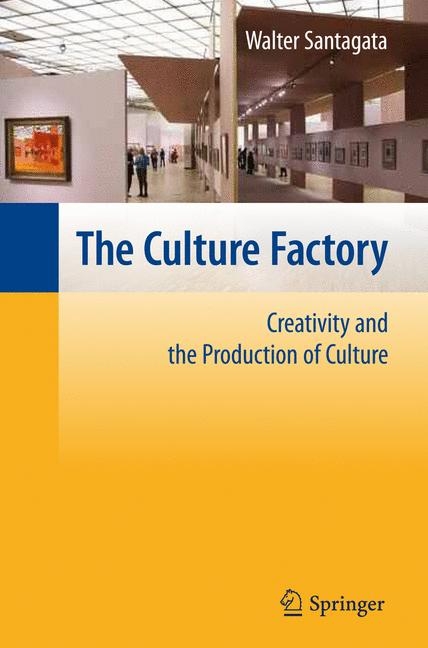
The Culture Factory (eBook)
XIV, 110 Seiten
Springer Berlin (Verlag)
978-3-642-13358-9 (ISBN)
The Culture Factory 3
Acknowledgment 7
Preface 9
Contents 11
Chapter 1: Introduction: Questions that Came from Afar 15
Torino, Italy, 2007 15
Xian, China, 2007 16
Part I: A Model of Production of Culture 19
Chapter 2: Producing Culture, Conserving Culture 20
Four Models of Cultural Policies 20
Destroying Culture 20
Neglecting Culture 21
Conserving Culture 21
Producing Culture 22
Chapter 3: The Supply Chain of Cultural Production 28
The First Phase: Selecting Artists 28
Market-Driven Selection Processes 28
Non-Market Selection Processes 29
The Second and Third Phases: Conception and Production of a Work of Art 31
The Fourth Phase: Conservation 33
The Fifth Phase: Distribution 34
The Sixth Phase: Consumption 34
Chapter 4: Creativity as a Resource, Emotions as a Prerequisite 39
Creativity as Process 40
Mind and Brain, Body and Emotions 41
Emotions Count, the Environment Counts 42
Chapter 5: Two Models of Creativity: Technological Innovation and Social Quality 45
Introduction: Defining the Creative Sector 45
Creativity and Social Quality: The Emergence of a New Model 45
Ongoing Progress in the Cultural and Creative Industries 45
Culture and Creativity 46
Why Producing Creativity and Culture Is a Key Objective for a Modern Society 47
Models of Cultural Production and Creativity 48
Creativity for Innovation 48
Creativity for Social Quality 48
Further Details on Culture and Creativity for Social Quality 49
Culture, Ethics, Art and History as Filters for Creativity 49
Culture as History and Local Territory 50
Creative Cities and Creative Spaces 51
Cultural Districts or Clusters 51
Conclusion 52
Part II: Policies that Stimulate the Productionof Culture and Make It Possible toTake the Lead in Strategic Sectors 54
Chapter 6: The Effects of Creativity on International Markets: The French Genius for Fashion 55
How Creativity Can be Renewed 55
Creativity and Generational Succession 57
France´s Creative Advantage 59
The Advantage of Being the First to Arrive 60
Chapter 7: Potential Cultural Districts and the Production of Material Culture 62
The Theoretical Basis of Cultural Districts Marshallian Localized Industries and the External Economics of Agglomeration 63
Models and Types of Cultural Districts 65
Remarkable Cases of Potential Institutional Cultural Districts 66
Districts and Museum-Based Cultural Systems 67
Tourist Cultural Districts 68
Cultural-Heritage Systems 68
America´s Urban Cultural Districts 69
Districts for Contemporary Art: The Case of Beijing and the Chinese Market 69
Cultural Districts´ Role in Developed and in Developing Countries 70
Spontaneous Versus Institutional Models of Development 70
The Two Functions of Collective Intellectual Property Rights 70
Same Players, Different Structures 71
The Material Culture´s Goods and Services 71
Evolution 72
Chapter 8: Intellectual Property Rights Take Command 73
The Growth of the Intellectual Component in Goods and Services 73
Copyright and Industrial Property Rights 74
Individual Rights and Collective Rights 76
A Procedure for Improving Quality Using Collective Trademarks 78
First Phase: Founding the Organization That Is to Hold Title to the Collective Trademark 78
Second Phase: Setting Up a Coordinating Committee 79
Third Phase: Identifying an Image 79
Fourth Phase: Establishing What Minimum Level of Quality to Accept 79
Fifth Phase: Registering the Collective Trademark 80
Sixth Phase: Arriving at Decisions Through Compromise and Consensus 80
Seventh Phase: Registration and Accreditation Rather Than Exclusion 81
Eighth Phase: Evolution and Royalties 81
Chapter 9: The Cultural and Creative Industries 83
The Italian Cultural Industry at the Start of the Twenty-First Century 85
The Content Industries 86
The Entertainment Industries 87
Industrial Design and the Material Culture Industries 88
What Is at Stake 89
International Impact 89
Social Impact 89
Economic Impact 90
Chapter 10: The Market in Contemporary Art 92
Academies of the Fine Arts 95
The Italian Market and the Lack of Independent Centers 96
The Market and Contemporary-Art Cultural Districts: The Example of Beijing 97
Chapter 11: Producing Culture by Means of Museums 100
From Museum to Cultural Center 101
In Praise of Free Admission and Voluntary Contributions 102
In Praise of Decentralization and Democratization 104
In Praise of the Museum as a Co-agent in Economic and Social Development 104
Chapter 12: Conclusions: A White Paper on Creativity and the Production of Culture 108
From Now to 2025 110
Priorities for 2025 111
References 113
| Erscheint lt. Verlag | 25.8.2010 |
|---|---|
| Übersetzer | Susan Finnel |
| Zusatzinfo | XIV, 110 p. |
| Verlagsort | Berlin |
| Sprache | englisch |
| Original-Titel | La fabbrica della cultura |
| Themenwelt | Sozialwissenschaften ► Politik / Verwaltung |
| Wirtschaft ► Volkswirtschaftslehre | |
| Schlagworte | ART • Creativity • cultural heritage • Culture • Developing Countries • Economic Development • Institutions |
| ISBN-10 | 3-642-13358-4 / 3642133584 |
| ISBN-13 | 978-3-642-13358-9 / 9783642133589 |
| Informationen gemäß Produktsicherheitsverordnung (GPSR) | |
| Haben Sie eine Frage zum Produkt? |
 PDF (Wasserzeichen)
DRM: Digitales Wasserzeichen
Dieses eBook enthält ein digitales Wasserzeichen und ist damit für Sie personalisiert. Bei einer missbräuchlichen Weitergabe des eBooks an Dritte ist eine Rückverfolgung an die Quelle möglich.
Dateiformat: PDF (Portable Document Format)
Mit einem festen Seitenlayout eignet sich die PDF besonders für Fachbücher mit Spalten, Tabellen und Abbildungen. Eine PDF kann auf fast allen Geräten angezeigt werden, ist aber für kleine Displays (Smartphone, eReader) nur eingeschränkt geeignet.
Systemvoraussetzungen:
PC/Mac: Mit einem PC oder Mac können Sie dieses eBook lesen. Sie benötigen dafür einen PDF-Viewer - z.B. den Adobe Reader oder Adobe Digital Editions.
eReader: Dieses eBook kann mit (fast) allen eBook-Readern gelesen werden. Mit dem amazon-Kindle ist es aber nicht kompatibel.
Smartphone/Tablet: Egal ob Apple oder Android, dieses eBook können Sie lesen. Sie benötigen dafür einen PDF-Viewer - z.B. die kostenlose Adobe Digital Editions-App.
Buying eBooks from abroad
For tax law reasons we can sell eBooks just within Germany and Switzerland. Regrettably we cannot fulfill eBook-orders from other countries.
aus dem Bereich