


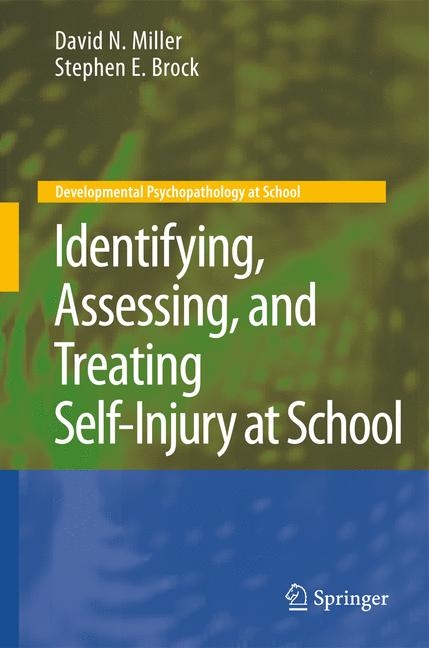
Identifying, Assessing, and Treating Self-Injury at School (eBook)
138 Seiten
Springer US (Verlag)
978-1-4419-6092-4 (ISBN)
Nonsuicidal self-injury (NSSI) among young people-most notably in the form of forearm- or wrist-cutting-occurs across cultural groups, social strata, and developmental stages, puzzling and repelling adults. Youth engaging in NSSI behaviors are at a higher risk for suicidality as well as other mental health and academic problems. And because NSSI is often first noticed in the school setting (as is the case with many children's disorders), school professionals are being encouraged to take a more proactive role in intervention.
The first book specifically geared toward education personnel, Identifying, Assessing, and Treating Self-Injury at School clearly defines NSSI, differentiating it from suicidal, borderline, and other behaviors and analyzing the psychological contexts in which it occurs. This school-based perspective gives readers a practical framework for earlier, more accurate diagnosis; relevant consulting with parents, teachers, and colleagues; and effective, science-based treatment.
Included in the coverage: an overview of causes of self-injury, current findings on prevalence and associated conditions, early screening guidelines, including risk factors and warning signs, the latest information on assessment issues and diagnostic methods, a separate chapter on psychoeducational assessment and up-to-date research on interventions for NSSI.
Identifying, Assessing, and Treating Self-Injury at School offers a solid foundation for school psychologists and allied educational professionals to understand students with NSSI and address their complex needs.
David N. Miller, Ph.D, is an Assistant Professor in the Department of Educational and Counseling Psychology at the University at Albany, State University of New York. He received his Ph.D. in school psychology from Lehigh University. A certified school psychologist, he has extensive experience working with students with emotional and behavioral problems in both public and alternative school settings, including serving as the Director of the Predoctoral Internship in Professional Psychology at Centennial School of Lehigh University. He has more than 30 professional publications and book chapters and has conducted more than 40 national and state presentations on various topics, including self-injury and suicidal behavior in children and youth. He was also co-chair of the Suicide Prevention/Intervention Workgroup of the National Association of School Psychologists School Crisis Prevention and Intervention Task Force. Dr. Miller currently serves on the editorial advisory board of School Psychology Review, Psychology in the Schools, School Psychology Forum, and the Division 16 (School Psychology) Book Series.
Stephen E. Brock, Ph.D., NCSP, is an Associate Professor at California State University Sacramento. Previously, he worked for 18 years as a school psychologist with the Lodi Unified School District (the last six of which included assignments as Lead Psychologist). His professional preparation includes a Ph.D. at the University of California, Davis. Dr. Brock currently serves on the editorial boards of both state and national school psychology association newsletters and is an Associate Editor of The California School Psychologist (a peer-reviewed journal with the second largest distribution of school psychology journals in the United States). He is Past-President of the California Association of School Psychologists and a member of the National Association of School Psychologists' Delegate Assembly and its Executive Council. Dr. Brock has authored more than 150 publications (including four books) and has made more than 80 refereed or invited state/national conference presentations. His academic work has included the study of school crisis response, suicide prevention, ADHD, autism, behavioral interventions, violence prevention, threat assessment, child development, and reading comprehension.
Nonsuicidal self-injury (NSSI) among young people-most notably in the form of forearm- or wrist-cutting-occurs across cultural groups, social strata, and developmental stages, puzzling and repelling adults. Youth engaging in NSSI behaviors are at a higher risk for suicidality as well as other mental health and academic problems. And because NSSI is often first noticed in the school setting (as is the case with many children's disorders), school professionals are being encouraged to take a more proactive role in intervention.The first book specifically geared toward education personnel, Identifying, Assessing, and Treating Self-Injury at School clearly defines NSSI, differentiating it from suicidal, borderline, and other behaviors and analyzing the psychological contexts in which it occurs. This school-based perspective gives readers a practical framework for earlier, more accurate diagnosis; relevant consulting with parents, teachers, and colleagues; and effective, science-based treatment.Included in the coverage: an overview of causes of self-injury, current findings on prevalence and associated conditions, early screening guidelines, including risk factors and warning signs, the latest information on assessment issues and diagnostic methods, a separate chapter on psychoeducational assessment and up-to-date research on interventions for NSSI.Identifying, Assessing, and Treating Self-Injury at School offers a solid foundation for school psychologists and allied educational professionals to understand students with NSSI and address their complex needs.
David N. Miller, Ph.D, is an Assistant Professor in the Department of Educational and Counseling Psychology at the University at Albany, State University of New York. He received his Ph.D. in school psychology from Lehigh University. A certified school psychologist, he has extensive experience working with students with emotional and behavioral problems in both public and alternative school settings, including serving as the Director of the Predoctoral Internship in Professional Psychology at Centennial School of Lehigh University. He has more than 30 professional publications and book chapters and has conducted more than 40 national and state presentations on various topics, including self-injury and suicidal behavior in children and youth. He was also co-chair of the Suicide Prevention/Intervention Workgroup of the National Association of School Psychologists School Crisis Prevention and Intervention Task Force. Dr. Miller currently serves on the editorial advisory board of School Psychology Review, Psychology in the Schools, School Psychology Forum, and the Division 16 (School Psychology) Book Series.Stephen E. Brock, Ph.D., NCSP, is an Associate Professor at California State University Sacramento. Previously, he worked for 18 years as a school psychologist with the Lodi Unified School District (the last six of which included assignments as Lead Psychologist). His professional preparation includes a Ph.D. at the University of California, Davis. Dr. Brock currently serves on the editorial boards of both state and national school psychology association newsletters and is an Associate Editor of The California School Psychologist (a peer-reviewed journal with the second largest distribution of school psychology journals in the United States). He is Past-President of the California Association of School Psychologists and a member of the National Association of School Psychologists’ Delegate Assembly and its Executive Council. Dr. Brock has authored more than 150 publications (including four books) and has made more than 80 refereed or invited state/national conference presentations. His academic work has included the study of school crisis response, suicide prevention, ADHD, autism, behavioral interventions, violence prevention, threat assessment, child development, and reading comprehension.
Acknowledgments 6
Contents 8
About the Author 9
1 Introduction 10
Why School Professionals Should Read This Book 11
Self-Injury Defined 13
Self-Injury, Special Education Eligibility, and Educational Support Services 15
Purpose and Plan of This Book 17
2 Causes (with Richard Lieberman) 18
Explanatory Models for NSSI in Youth 18
The Behavioral/Environmental Model 18
The Affect Regulation Model 19
The Physiological/Biological Model 19
The Suicide Model 19
The Interpersonal/Systemic Model 20
The Depersonalization Model 20
The Sexual/Sadomasochism Model 20
A Functional Model of NSSI 21
Automatic-Negative Reinforcement 22
Automatic-Positive Reinforcement 23
Social-Positive Reinforcement 23
Social-Negative Reinforcement 23
A Biopsychosocial Model of NSSI 24
Environmental Dimension 24
Family Historical Elements 24
Individual Historical Elements 25
Current Environmental Elements 27
Biological Dimension 27
Cognitive Dimension 28
Affective Dimension 29
Behavioral Dimension 29
Integration of the Five Dimensions 30
Concluding Comments 30
3 Prevalence and Associated Conditions 31
Prevalence Rates of NSSI in Youth: Issues and Challenges 31
Definitional Issues 31
Measurement Issues 32
Setting Issues 32
Sample Selection Issues 33
Demographic Issues 33
Age of Onset 33
Geographic, Cultural, and Ethnic Issues 33
Clinic-Based and Community-Based Prevalence Rates 34
Gender Issues 34
Is the Prevalence of NSSI in Youth Increasing? 35
Implications for School-Based Practitioners 35
Associated Conditions 36
NSSI and Associated Psychiatric Disorders 37
Suicide 37
Mood and Anxiety Disorders 38
Substance-Related Disorders 39
Hostility/Anger 39
Eating Disorders 40
Dissociative Disorders 40
Borderline Personality Disorder 41
Concluding Comments 42
4 Case Finding, Screening, and Referral 43
Roles and Responsibilities of School-Based Mental Health Professionals 43
Risk Factors 44
Demographics 45
Child Abuse 45
Self-Harm History 46
Family Dynamics 46
Peer Modeling 46
Psychiatric Disturbance 46
Psychological Factors 47
Self-Injury Warning Signs 48
Behavioral Warning Signs 49
Physical Warning Signs 49
Case Finding 49
Initial Referral and Screening 51
Suicide Risk Assessment 52
Evaluation of Physical Injury 54
Mental Health Screening 56
Concluding Comments 56
5 Diagnostic Assessment 58
The School-Based Assessment of NSSI: The Initial Response 58
The Issue of Contracts 60
Suggestions and Guidelines When First Responding to NSSI 60
Avoid the Use of Suicide Terminology 61
Use the Student's Own Descriptive Language Strategically 61
Gently Challenge Minimizing or Idiosyncratic Language 61
Convey Respect and Curiosity 62
Be Nonjudgmental and Compassionate 62
Physical Assessment of Self-Injury 62
Diagnostic Assessment: Assets and Limitations 63
Favazzas Diagnostic System 64
Stereotypic Self-Injury 65
Major Self-Injury 65
Compulsive Self-Injury 66
Impulsive Self-Injury 66
Walshs Classification Scheme for Direct and Indirect Self-Harm 67
Direct Self-Harm 67
Indirect Self-Harm 68
Differentiating Self-Injury from Suicidal Behavior 69
Intent 70
Level of Physical Damage and Potential Lethality 70
Frequency of the Behavior 71
Multiple Methods 71
Level of Psychological Pain 72
Constriction of Cognition 72
Helplessness and Hopelessness 72
Psychological Aftermath of the Self-Harm Incident 72
A Final Note of Caution 73
Assessment Methods, Sources, and Settings 73
Assessment Methods 74
Assessment Sources 74
Assessment Settings 74
Assessment Methods with Limited Utility 75
Recommended Assessment Methods and Practices 76
Self-Report Measures 76
Individual Student Interviews 77
Assessing Possible Comorbid Disorders 80
Concluding Comments 81
6 Psychoeducational Assessment 82
NSSI, Psychoeducational Classification, and Special Education Services 82
Definition of Emotional Disturbance 83
Definitions of Social Maladjustment 84
Psychoeducational Classification and the Medical Model 84
Going Beyond Special Education Eligibility Determination 85
A Problem-Solving Approach to Assessment 86
Functional Assessment: Linking Assessment to Intervention 87
The Cognitive-Behavioral Assessment of NSSI in Schools 89
Self-Injury Log 90
Antecedents to NSSI 91
Consequences of NSSI 93
Assessing the Role of the Internet in Student Self-Injury 95
Concluding Comments 97
7 Treatment 98
Responding to NSSI in Schools: Ethical, Legal, and Social Justice Issues 98
A Public Health Perspective on Preventing and Treating NSSI in Schools 100
School-Based Prevention of NSSI: Universal Strategies 101
Correcting Myths and Misunderstandings About NSSI 102
Promoting Student Strengths and Resiliency 102
School-Based Intervention: Responding to NSSI 103
Contagion and its Prevention in Schools 105
The Psychosocial Treatment of NSSI 106
Problem-Solving Therapy 108
Dialectical Behavior Therapy 109
DBT and the Treatment of Self-Injury 111
The Psychopharmacological Treatment of NSSI 113
Antidepressant Medication and Suicidality 114
Recommendations for Schools 115
Concluding Comments 116
Appendix: Self-Injury Internet Resources 117
American Self-Harm Information Clearing House 117
BUS (Bodies Under Siege) Central 118
Life SIGNS: Self-Injury Guidance and Network Support 118
RecoverYourLife.com 118
S.A.F.E. (Self-Abuse Finally Ends) Alternatives 118
Self-Injury: You are NOT the only one 118
Self-Injury: Support 119
SIARI (Self-Injury and Related Issues) 119
References 120
Subject Index 136
| Erscheint lt. Verlag | 5.7.2010 |
|---|---|
| Reihe/Serie | Developmental Psychopathology at School | Developmental Psychopathology at School |
| Zusatzinfo | XII, 138 p. |
| Verlagsort | New York |
| Sprache | englisch |
| Themenwelt | Geisteswissenschaften ► Psychologie ► Entwicklungspsychologie |
| Geisteswissenschaften ► Psychologie ► Pädagogische Psychologie | |
| Medizin / Pharmazie ► Medizinische Fachgebiete ► Psychiatrie / Psychotherapie | |
| Sozialwissenschaften ► Pädagogik ► Didaktik | |
| Schlagworte | Assessment • Borderline • Common self-Injury • Dissociative disorders • Eating Disorders • Education • Intervention • Major self-Injury • Personality disorder • Posttraumatic stress disorder • Psycho-educational assessment • PTSD • School-based interventions • Self-injury • Suicidal behavior • Treatment |
| ISBN-10 | 1-4419-6092-9 / 1441960929 |
| ISBN-13 | 978-1-4419-6092-4 / 9781441960924 |
| Informationen gemäß Produktsicherheitsverordnung (GPSR) | |
| Haben Sie eine Frage zum Produkt? |
 PDF (Wasserzeichen)
Größe: 1,5 MB
DRM: Digitales Wasserzeichen
Dieses eBook enthält ein digitales Wasserzeichen und ist damit für Sie personalisiert. Bei einer missbräuchlichen Weitergabe des eBooks an Dritte ist eine Rückverfolgung an die Quelle möglich.
Dateiformat: PDF (Portable Document Format)
Mit einem festen Seitenlayout eignet sich die PDF besonders für Fachbücher mit Spalten, Tabellen und Abbildungen. Eine PDF kann auf fast allen Geräten angezeigt werden, ist aber für kleine Displays (Smartphone, eReader) nur eingeschränkt geeignet.
Systemvoraussetzungen:
PC/Mac: Mit einem PC oder Mac können Sie dieses eBook lesen. Sie benötigen dafür einen PDF-Viewer - z.B. den Adobe Reader oder Adobe Digital Editions.
eReader: Dieses eBook kann mit (fast) allen eBook-Readern gelesen werden. Mit dem amazon-Kindle ist es aber nicht kompatibel.
Smartphone/Tablet: Egal ob Apple oder Android, dieses eBook können Sie lesen. Sie benötigen dafür einen PDF-Viewer - z.B. die kostenlose Adobe Digital Editions-App.
Zusätzliches Feature: Online Lesen
Dieses eBook können Sie zusätzlich zum Download auch online im Webbrowser lesen.
Buying eBooks from abroad
For tax law reasons we can sell eBooks just within Germany and Switzerland. Regrettably we cannot fulfill eBook-orders from other countries.
aus dem Bereich


