


Marginal Models (eBook)
XI, 268 Seiten
Springer-Verlag
978-0-387-09610-0 (ISBN)
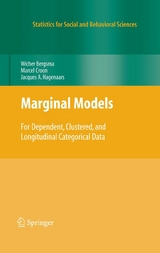
Marginal Models for Dependent, Clustered, and Longitudinal Categorical Data provides a comprehensive overview of the basic principles of marginal modeling and offers a wide range of possible applications. Marginal models are often the best choice for answering important research questions when dependent observations are involved, as the many real world examples in this book show.
In the social, behavioral, educational, economic, and biomedical sciences, data are often collected in ways that introduce dependencies in the observations to be compared. For example, the same respondents are interviewed at several occasions, several members of networks or groups are interviewed within the same survey, or, within families, both children and parents are investigated. Statistical methods that take the dependencies in the data into account must then be used, e.g., when observations at time one and time two are compared in longitudinal studies. At present, researchers almost automatically turn to multi-level models or to GEE estimation to deal with these dependencies. Despite the enormous potential and applicability of these recent developments, they require restrictive assumptions on the nature of the dependencies in the data. The marginal models of this book provide another way of dealing with these dependencies, without the need for such assumptions, and can be used to answer research questions directly at the intended marginal level. The maximum likelihood method, with its attractive statistical properties, is used for fitting the models.
This book has mainly been written with applied researchers in mind. It includes many real world examples, explains the types of research questions for which marginal modeling is useful, and provides a detailed description of how to apply marginal models for a great diversity of research questions. All these examples are presented on the book's website (www.cmm.st), along with user friendly programs.
Preface 5
Contents 9
1 Introduction 12
1.1 Marginal Models for Categorical Data 12
1.2 Historical and Comparable Approaches 16
1.3 Coefficients for the Comparison of Marginal Distributions 20
2 Loglinear Marginal Models 33
2.1 Ordinary Loglinear Models 33
2.2 Applications of Loglinear Marginal Models 44
2.3 Maximum Likelihood Inference for Loglinear Marginal Models 61
3 Nonloglinear Marginal Models 85
3.1 Comparing Item Characteristics for Different Measurement Levels 85
3.2 Comparing Associations 93
3.3 Maximum Likelihood Estimation 96
4 Marginal Analysis of Longitudinal Data 106
4.1 Trend Data 108
4.2 Panel Data: Investigating Net Changes in One Characteristic 113
4.3 Gross Changes in One Characteristic 129
4.4 Net and Gross Changes in Two Related Characteristics 139
4.5 Minimally Specified Models for Comparing Tables with Overlapping Marginals Detection of Problematic Models
5 Causal Analyses: Structural Equation Models and (Quasi-)Experimental Designs 164
5.1 SEMs - Structural Equation Models 165
5.2 Analysis of (Quasi-)Experimental Data 181
6 Marginal Modeling with Latent Variables 200
6.1 Latent Class Models 200
6.2 Latent Marginal Homogeneity 205
6.3 Loglinear and Nonloglinear Latent Class Models: Equal Reliabilities 207
6.4 Marginal causal analyses 216
6.5 Estimation of Marginal Models with Latent Variables Using the EM Algorithm 221
7 Conclusions, Extensions, and Applications 231
7.1 Marginal Models for Continuous Variables 232
7.2 Alternative Procedures and Models 236
7.3 Specific Applications 244
7.4 Problems and Future Developments 250
7.5 Software, Generalized exp-log Routines, and Website 252
References 254
Author Index 265
Subject Index 268
| Erscheint lt. Verlag | 3.4.2009 |
|---|---|
| Reihe/Serie | Statistics for Social and Behavioral Sciences | Statistics for Social and Behavioral Sciences |
| Zusatzinfo | XI, 268 p. |
| Verlagsort | New York |
| Sprache | englisch |
| Themenwelt | Mathematik / Informatik ► Informatik ► Theorie / Studium |
| Mathematik / Informatik ► Mathematik ► Statistik | |
| Mathematik / Informatik ► Mathematik ► Wahrscheinlichkeit / Kombinatorik | |
| Naturwissenschaften | |
| Sozialwissenschaften ► Soziologie ► Empirische Sozialforschung | |
| Technik | |
| Wirtschaft | |
| Schlagworte | Calculus • categorical data • correlated observations • dependent observations • Fitting • Interview • likelihood • longitudinal data • marginal homogeneity • marginal models • matched data • Modeling • Panel Data • repeated measurements • statistical method |
| ISBN-10 | 0-387-09610-8 / 0387096108 |
| ISBN-13 | 978-0-387-09610-0 / 9780387096100 |
| Informationen gemäß Produktsicherheitsverordnung (GPSR) | |
| Haben Sie eine Frage zum Produkt? |
 PDF (Wasserzeichen)
DRM: Digitales Wasserzeichen
Dieses eBook enthält ein digitales Wasserzeichen und ist damit für Sie personalisiert. Bei einer missbräuchlichen Weitergabe des eBooks an Dritte ist eine Rückverfolgung an die Quelle möglich.
Dateiformat: PDF (Portable Document Format)
Mit einem festen Seitenlayout eignet sich die PDF besonders für Fachbücher mit Spalten, Tabellen und Abbildungen. Eine PDF kann auf fast allen Geräten angezeigt werden, ist aber für kleine Displays (Smartphone, eReader) nur eingeschränkt geeignet.
Systemvoraussetzungen:
PC/Mac: Mit einem PC oder Mac können Sie dieses eBook lesen. Sie benötigen dafür einen PDF-Viewer - z.B. den Adobe Reader oder Adobe Digital Editions.
eReader: Dieses eBook kann mit (fast) allen eBook-Readern gelesen werden. Mit dem amazon-Kindle ist es aber nicht kompatibel.
Smartphone/Tablet: Egal ob Apple oder Android, dieses eBook können Sie lesen. Sie benötigen dafür einen PDF-Viewer - z.B. die kostenlose Adobe Digital Editions-App.
Buying eBooks from abroad
For tax law reasons we can sell eBooks just within Germany and Switzerland. Regrettably we cannot fulfill eBook-orders from other countries.
aus dem Bereich


