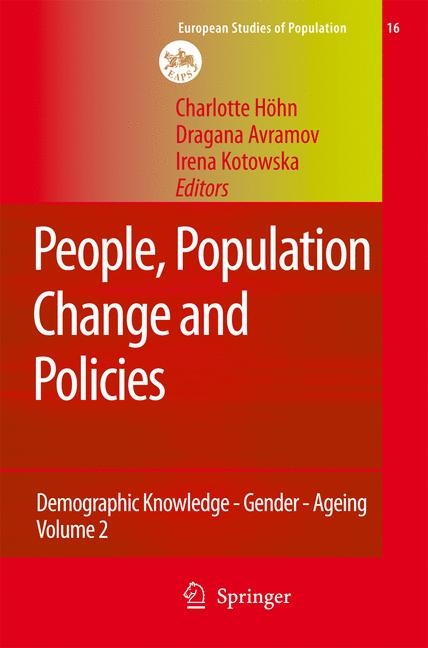
People, Population Change and Policies (eBook)
XI, 347 Seiten
Springer Netherlands (Verlag)
978-1-4020-6611-5 (ISBN)
This two-volume work explores social cohesion and the demographic challenges of low birth rates and population aging. The authors approach the topic from the perspective of citizens and key policy actors, analyzing attitudes from 14 European countries regarding the European integration process, demographic trends, and expectations towards private networks and public policies. Volume 2 focuses on demographic developments, gender issues, and aging.
European countries, including the DIALOG countries, have faced a major de- graphic change and transition in the last thirty years. They are experiencing lo- term downward trends in fertility, leading to demographic ageing. Fertility rates are now below replacement level in nearly all countries. As a result, natural p- ulation growth rates are starting to decline, or population sizes are falling o- right. At the same time, the proportion of elderly dependants continues to grow while the working-age population declines in absolute and relative terms (see Kontula and Miettinen 2005). Moreover, net immigration, which potentially could offset declines in working-age population, remains generally low in most European countries (Grant et al. 2004). There are a great number of societal problems that arise from this demographic transition. The International Monetary Fund (2004) argues that the impact of - coming demographic changes on economical growth could be substantial. The h- toric association between demographicand macro-economicvariablessuggests that the projected increase in elderly dependency ratios and the projected decline in the share of the working-age population could result in slower per capita GDP growth, and lower saving and investment (IMF 2004, 147). For example, the estimates s- gest that demographic change could reduce annual real per capita GDP growth in 1 1 advanced countries by an average of / % point by 2050, i. e. , growth would be / % 2 2 point lower than if the demographic structure had remained the same as in 2000 (IMF 2004, 147).
1. Demographic Trends, population related policies and general attitudes,- 1.1. Demographic change and family policy regimes Osmo Kontula / Ismo Soederling,- 1.2. Demographic knowledge and evaluation of demographic trends Jürgen Dorbritz,- 1.3. Who should take care for them? Expectations placed on the welfare state and its influence on attitudes towards care for the elderly Ralf Mai / Robert Naderi / Peter Schiman,-
2. Changing attitudes on population policies? A comparison between the first and second rounds of the PPAS Jürgen Dorbritz,-
3. Comparative Delphi-Study,- 3.1. 2030: Another Europe? Results from the policy-Delphi study Rossella Palomba / Pierre Dell'Anno,- 3.2. Action programs of socio-political actors. A cross-national comparision, taking account of contextual factors and opinion of the populace Alfred Bertschinger,- 3.3. Making dialogue possible: The view of Delphi panellists and citizens on female employment Adele Menneti / Maura Misiti,-
4. Gender roles,- 4.1. Family-related gender attitudes. The three dimensions: 'gender-role ideology' , 'consequences for the family' , and ' economic consuquences' Dimiter Philipov,- 4.4. Gender and Fertility - Attitudes towards gender roles and fertility behaviour Kerstin Ruckdeschel,-
5. International Solidarity and Elderly,- 5.1. Attitudes towards population ageing and older people Ronald Schoenmaeckers / Lieve Vanderleyden / Lucie Vidovicova / Marc Callens,- 5.2. Activating older workers: policies versus opinions and expectations Janina Jozwiak / Irena E. Kotowska / Anita Abramowska,- 5.3. Only fools rush in? On transition to retirement Beatrice Manea / Ladislac Rabusic / Lucie Vidovicova,-
6. Policy Implications and Conclusions,- 6.1. The Need to adapt and reform social policy: setting the stage for effective population-friendly policies Dragana Avramov / Robert Cliquet,- 6.2. Conclusions Charlotte Höhn,-
Annex: PPAS-Questionnaire(s), CD-Rom
| Erscheint lt. Verlag | 8.3.2008 |
|---|---|
| Reihe/Serie | European Studies of Population | European Studies of Population |
| Zusatzinfo | XII, 346 p. |
| Verlagsort | Dordrecht |
| Sprache | englisch |
| Themenwelt | Sozialwissenschaften ► Politik / Verwaltung |
| Sozialwissenschaften ► Soziologie ► Empirische Sozialforschung | |
| Sozialwissenschaften ► Soziologie ► Spezielle Soziologien | |
| Schlagworte | Ageing • aging • Demographic Change • Demography • Fertility and Family • Population Ageing • Population related policies • Reconciliation of work and familiy • Social Sciences |
| ISBN-10 | 1-4020-6611-2 / 1402066112 |
| ISBN-13 | 978-1-4020-6611-5 / 9781402066115 |
| Informationen gemäß Produktsicherheitsverordnung (GPSR) | |
| Haben Sie eine Frage zum Produkt? |
 PDF (Wasserzeichen)
DRM: Digitales Wasserzeichen
Dieses eBook enthält ein digitales Wasserzeichen und ist damit für Sie personalisiert. Bei einer missbräuchlichen Weitergabe des eBooks an Dritte ist eine Rückverfolgung an die Quelle möglich.
Dateiformat: PDF (Portable Document Format)
Mit einem festen Seitenlayout eignet sich die PDF besonders für Fachbücher mit Spalten, Tabellen und Abbildungen. Eine PDF kann auf fast allen Geräten angezeigt werden, ist aber für kleine Displays (Smartphone, eReader) nur eingeschränkt geeignet.
Systemvoraussetzungen:
PC/Mac: Mit einem PC oder Mac können Sie dieses eBook lesen. Sie benötigen dafür einen PDF-Viewer - z.B. den Adobe Reader oder Adobe Digital Editions.
eReader: Dieses eBook kann mit (fast) allen eBook-Readern gelesen werden. Mit dem amazon-Kindle ist es aber nicht kompatibel.
Smartphone/Tablet: Egal ob Apple oder Android, dieses eBook können Sie lesen. Sie benötigen dafür einen PDF-Viewer - z.B. die kostenlose Adobe Digital Editions-App.
Buying eBooks from abroad
For tax law reasons we can sell eBooks just within Germany and Switzerland. Regrettably we cannot fulfill eBook-orders from other countries.
aus dem Bereich