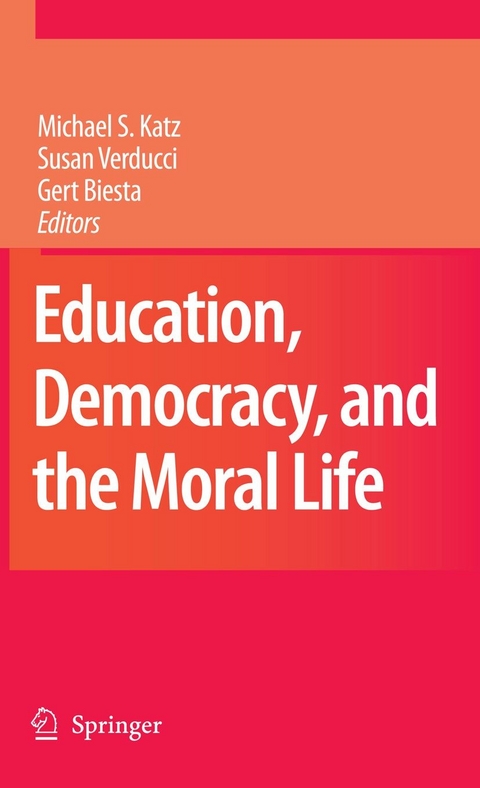
Education, Democracy and the Moral Life (eBook)
XII, 146 Seiten
Springer Netherlands (Verlag)
978-1-4020-8626-7 (ISBN)

This volume has its origin in the Francis T. Villemain Memorial lectures at San Jose State University - a lecture series established in 1992 to honor the memory of 1 Dean Francis T. Villemain. All the essays in this volume, with the exception of those by Gert Biesta, Susan Verducci, and Michael Katz, were developed from l- tures given as part of the series. The general rubric of the lectures was "e;democracy, education, and the moral life"e; - a title reflecting Villemain's lifelong love of the work of John Dewey whose preface to his famous work in 1916, Democracy and Education, suggested that the purpose of education was to develop democratic ci- zens, citizens infused with the spirit of democracy and the capacity to think and act intelligently within democratic settings. Of course, for Dewey, democracy was not to be conceived of as merely a political form of government, but as a shared form of social life, one that was inclusive rather than exclusive and one that was capable of adapting to the changing features of contemporary social and political reality. Francis T. Villemain's appreciation for the intersections of the values of dem- racy, education, and the moral life was heightened by his doctoral work at Teachers College, Columbia University in the 1950s - where Dewey's legacy remained a powerful one. But it also continued during his career at Southern Illinois University where he collaborated in compiling and editing the collected works of John Dewey.
Preface 6
Acknowledgements 8
Contents 9
Introduction Education, Democracy, and the Moral Life: Where Opposites Collide 11
1 Introduction 11
2 Collisions 12
3 Cultivating Moral Citizenship 15
4 Conclusion 17
References 18
1 Education and the Ethics of Democratic Citizenship 19
1.1 Education and Democracy: From Mann to Dewey 19
1.2 Education and Democracy: A Freirean Correction 22
1.3 Education, Democratic Citizenship, and Identity Formation 25
1.4 Anybody, Nobody, and Somebody in School 32
1.5 Education and the Ethics of Democratic Citizenship 35
1.6 Concluding Comments 38
References 39
2 Is There a Right to Education? A Philosophical Analysis Through U. S. Lenses 41
2.1 Introduction 41
2.2 Revisiting the Concept of the Right to Education 42
2.2.1 From Brown to Rodriguez: A Shift in the Discourse on Education? 47
2.3 The Right to Education as a Moral Principle not a Rule- like Welfare Entitlement 49
Bibliography 54
3 The Democratic and Educational Potential of Political Blogs 56
3.1 The Rise of Blogs 56
3.2 The Social and Political Impact of Blogs 57
3.3 Blogs and the Traditional Media 59
3.4 The Limitations of Blogs 63
3.5 Blogs as an Educational Resource 64
References 66
4 Democratic Patriotism and Multicultural Education1 67
4.1 Introduction 67
4.2 Patriotic and Anti-Patriotic History 70
4.3 Patriotic History and Democratic Idealism 75
References 77
5 Racism: What It Is and What It Isn’t1 78
5.1 Overusing “Racism” 80
5.2 Racist Jokes and Racist Persons 82
5.3 Defining “Racism” 84
5.4 Racial and Racist Stereotypes 85
5.5 Racial Discomfort or Anxiety 86
5.6 Race, Identity, and Recognition 88
5.7 Racial Motives and Racial Stereotypes 88
5.8 Conclusion 90
References 91
6 For Goodness Sake: How Religious Stories Work To Make Us Good and the Goodness that They Make1 92
6.1 Introduction 92
6.2 Religious Stories 94
6.3 Differences and Similarities 95
6.4 Function of Religious Stories 96
6.5 Consolidation Stories and the Morality Connected to Them 98
6.6 Stories that Extend Identity 101
6.7 Constitution 102
6.8 Conclusion: What Would Jesus Want? 104
References 107
7 Sporadic Democracy: Education, Democracy, and the Question of Inclusion 108
7.1 Democracy and Inclusion 108
7.2 The Role of Inclusion in Democratic Theory 110
7.3 Can Democracy Become “Normal”? 114
7.4 Rancière on Democracy and Democratisation 115
7.5 Conclusions 117
References 119
8 Public Reason and the Education of Democratic Citizens: The Role of Higher Education1* 120
8.1 The Contemporary Context for Civic Education 120
8.2 The Civic Sphere and the Practices of Democratic Citizens 122
8.2.1 Deliberation 123
8.2.2 Bargaining and Negotiation 126
8.2.3 Social Activism 128
8.3 Democratic Practices and the Role of Higher Education 129
References 132
9 Love and Hatred in the Moral Life: Educational Investigations 134
9.1 A Collective, Seductive Misconception: Our War Is the War to End All Wars 135
9.2 An Alternative Vision: Wise Love Heals Hatred 136
9.3 An Educational Hypothesis: Self-Hatred Holds the Key 137
9.4 A Teaching Story: The First-Nation Grandfather’s Two Wolves 139
9.5 A Teaching Poem: Dust of Snow 141
References 146
Index 147
"Chapter 3 The Democratic and Educational Potential of Political Blogs (p. 47-48)
Nicholas C. Burbules
Abstract Weblogs (""blogs"") have grown up. Once viewed as a personal outlet for daily diaries, chitchat, and rants, blogs have become an important public space that is transforming social and political relations. Blogs are used for many purposes, but political blogs are a locus of community building, organizing, informing, and shaping public opinion. Because they are free for those with access to a computer and the Internet, they have vastly increased the number, range, and diversity of voices gaining an outlet for their views – although with this growth has also come an increase in misinformation and unproductive ""noise."" Educators are only beginning to explore ways of using blogs in their teaching, as well as ways of teaching students how to use, read, and evaluate blogs for a range of learning purposes. In the political arena, learning with and through blogs creates a number of opportunities for students to express their own ideas and encounter a broad range of challenging views (including, for example, international views) they might have very little access to through other media. Learning to become critical interpreters of news and opinion on blogs, as with other areas of critical media literacy, is increasingly important.
3.1 The Rise of Blogs
More and more people receive their news, information, and political commentary from weblogs (""blogs""), and more and more people are providing news, information, and political commentary by creating their own blogs (O’Brien, 2004). Because blogs are free and easy to create, they have opened up the Web to a rapidly expanding authorship. There are over 70 million blogs today, with more than 120,000 new ones being created every day (Soltan, 2007). Some blogs are individual creations, others are the work of collectives. They are used for a variety of purposes, from personal online journals or diaries, to fan sites about popular performers, to soapboxes for rants on controversial issues. My main interest here are those blogs used to provide political news and commentary (which may include rants).
Blogs are easily updatable: this gives them the character, unlike more static Web pages, of providing a steady stream of new content – indeed, many ""bloggers"" will admit that, once starting a blog, the desire to post frequently becomes a bit of a compulsion. If you want people to visit and read your blog (and who doesn’t?), what attracts readers and keeps them coming back is the prospect of finding something fresh and new with each return visit. Blogs also make it easy to quote and link to the content of other blogs – in fact, some blogs are nothing but content selected and reposted from other sites. This intertextual quality and the common trend of providing a ""blogroll"" or list of other blogs dealing with related concerns, gives blogs what David Weinberger (2004) calls ""an ethos of generosity."" Many Web pages, particularly commercial sites, want viewers to visit and stay put (as it is called, giving them ""sticky eyeballs""), because the longer you stay at their site the more likely you are to buy something."
| Erscheint lt. Verlag | 14.10.2008 |
|---|---|
| Zusatzinfo | XII, 146 p. |
| Verlagsort | Dordrecht |
| Sprache | englisch |
| Themenwelt | Geisteswissenschaften |
| Sozialwissenschaften ► Pädagogik ► Allgemeines / Lexika | |
| Sozialwissenschaften ► Pädagogik ► Bildungstheorie | |
| Schlagworte | Citizenship • Democracy • Education • ethics • Morality • Moral Life • Social Science |
| ISBN-10 | 1-4020-8626-1 / 1402086261 |
| ISBN-13 | 978-1-4020-8626-7 / 9781402086267 |
| Informationen gemäß Produktsicherheitsverordnung (GPSR) | |
| Haben Sie eine Frage zum Produkt? |
 PDF (Wasserzeichen)
DRM: Digitales Wasserzeichen
Dieses eBook enthält ein digitales Wasserzeichen und ist damit für Sie personalisiert. Bei einer missbräuchlichen Weitergabe des eBooks an Dritte ist eine Rückverfolgung an die Quelle möglich.
Dateiformat: PDF (Portable Document Format)
Mit einem festen Seitenlayout eignet sich die PDF besonders für Fachbücher mit Spalten, Tabellen und Abbildungen. Eine PDF kann auf fast allen Geräten angezeigt werden, ist aber für kleine Displays (Smartphone, eReader) nur eingeschränkt geeignet.
Systemvoraussetzungen:
PC/Mac: Mit einem PC oder Mac können Sie dieses eBook lesen. Sie benötigen dafür einen PDF-Viewer - z.B. den Adobe Reader oder Adobe Digital Editions.
eReader: Dieses eBook kann mit (fast) allen eBook-Readern gelesen werden. Mit dem amazon-Kindle ist es aber nicht kompatibel.
Smartphone/Tablet: Egal ob Apple oder Android, dieses eBook können Sie lesen. Sie benötigen dafür einen PDF-Viewer - z.B. die kostenlose Adobe Digital Editions-App.
Buying eBooks from abroad
For tax law reasons we can sell eBooks just within Germany and Switzerland. Regrettably we cannot fulfill eBook-orders from other countries.
aus dem Bereich