


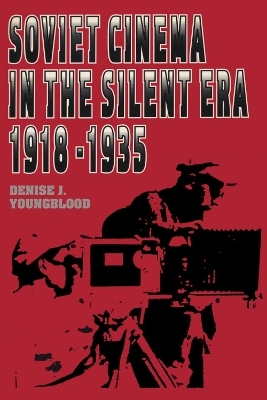
Soviet Cinema in the Silent Era, 1918–1935
Seiten
1991
University of Texas Press (Verlag)
978-0-292-77645-6 (ISBN)
University of Texas Press (Verlag)
978-0-292-77645-6 (ISBN)
The golden age of Soviet cinema, in the years following the Russian Revolution, was a time of both achievement and contradiction, as reflected in the films of Eisenstein, Pudovkin, and Kuleshov. This book considers the social, economic, and industrial factors that influenced the work of both lesser-known and celebrated directors.
The golden age of Soviet cinema, in the years following the Russian Revolution, was a time of both achievement and contradiction, as reflected in the films of Eisenstein, Pudovkin, and Kuleshov. Tensions ran high between creative freedom and institutional constraint, radical and reactionary impulses, popular and intellectual cinema, and film as social propaganda and as personal artistic expression. In less than a decade, the creative ferment ended, subjugated by the ideological forces that accompanied the rise of Joseph Stalin and the imposition of the doctrine of Socialist Realism on all the arts.
Soviet Cinema in the Silent Era, 1918–1935 records this lost golden age. Denise Youngblood considers the social, economic, and industrial factors that influenced the work of both lesser-known and celebrated directors. She reviews all major and many minor films of the period, as well as contemporary film criticism from Soviet film journals and trade magazines. Above all, she captures Soviet film in a role it never regained-that of dynamic artform of the proletarian masses.
The golden age of Soviet cinema, in the years following the Russian Revolution, was a time of both achievement and contradiction, as reflected in the films of Eisenstein, Pudovkin, and Kuleshov. Tensions ran high between creative freedom and institutional constraint, radical and reactionary impulses, popular and intellectual cinema, and film as social propaganda and as personal artistic expression. In less than a decade, the creative ferment ended, subjugated by the ideological forces that accompanied the rise of Joseph Stalin and the imposition of the doctrine of Socialist Realism on all the arts.
Soviet Cinema in the Silent Era, 1918–1935 records this lost golden age. Denise Youngblood considers the social, economic, and industrial factors that influenced the work of both lesser-known and celebrated directors. She reviews all major and many minor films of the period, as well as contemporary film criticism from Soviet film journals and trade magazines. Above all, she captures Soviet film in a role it never regained-that of dynamic artform of the proletarian masses.
Denise J. Youngblood, a former executive director of the Association for the Advancement of Soviet Studies, is Professor of History at the University of Vermont.
Preface
Preface to the Paperback Edition
Introduction
1. Beginnings (1918–23)
2. The Turning Point (1924)
3. The New Course: Sovkino Policy and Industry Response (1925–26)
4. Filmmaking and Films (1925–26)
5. Sovkino under Fire (1927–28)
6. The Crisis in Production (1927–28)
7. The Party Conference and the Attempt to Restructure (1928–29)
8. The Purge Years and the Struggle against Formalism (1929–34)
9. The Advent of Sound and the Triumph of Realism (1928–35)
Conclusion
Appendix 1. Film Production by Studio by Year (1918–35)
Appendix 2. Genres by Year
Notes
Bibliography
Index
| Reihe/Serie | Texas Film and Media Studies Series |
|---|---|
| Verlagsort | Austin, TX |
| Sprache | englisch |
| Maße | 152 x 229 mm |
| Gewicht | 454 g |
| Themenwelt | Kunst / Musik / Theater ► Film / TV |
| Sozialwissenschaften ► Kommunikation / Medien ► Medienwissenschaft | |
| ISBN-10 | 0-292-77645-4 / 0292776454 |
| ISBN-13 | 978-0-292-77645-6 / 9780292776456 |
| Zustand | Neuware |
| Informationen gemäß Produktsicherheitsverordnung (GPSR) | |
| Haben Sie eine Frage zum Produkt? |
Mehr entdecken
aus dem Bereich


aus dem Bereich


