


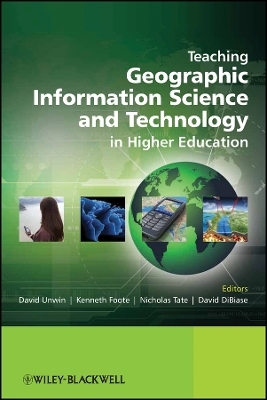
Teaching Geographic Information Science and Technology in Higher Education
John Wiley & Sons Inc (Hersteller)
978-1-119-95059-2 (ISBN)
- Keine Verlagsinformationen verfügbar
- Artikel merken
As such it will be of interest to chairs, deans, administrators, faculty in other subfields, and educators in general. The book is edited by arguably the top people in the field who bring a wealth of experience through their own teaching and research in the subject. There is simply no other book on the market and as a result of the Editors standing in the field, they are able to invite contributions from a broad range of academics in a range of institutional settings from an international perspective at all levels of higher education.
David Unwin and Nicholas Tate are the authors of Teaching Geographic Information Science and Technology in Higher Education, published by Wiley.
About the editors ix List of contributors xi Foreword xv Editors' preface xvii SECTION I GIS&T IN THE ACADEMIC CURRICULUM - INTRODUCTION 1 1 GIS&T in higher education: challenges for educators, opportunities for education 3 Kenneth E. Foote, David J. Unwin, Nicholas J. Tate and David DiBiase 2 Making the case for GIS&T in higher education 17 Diana S. Sinton 3 The internationalization of Esri higher education support, 1992-2009 37 Michael Phoenix 4 Reflections on curriculum development in the US and abroad: from core curriculum to body of knowledge 47 Karen K. Kemp SECTION II ISSUES IN CURRICULUM AND COURSE DESIGN 61 5 Using the GIS&T Body of Knowledge for curriculum design: different design for different contexts 63 Steven D. Prager 6 Scope and sequence in GIS&T education: learning theory, learning cycles and spiral curricula 81 Kenneth E. Foote 7 Building dynamic, ontology-based alternative paths for GIS&T curricula 97 Marco Painho and Paula Curvelo 8 Addressing misconceptions, threshold concepts, and troublesome knowledge in GIScience education 117 Matthew Bampton 9 Active pedagogy leading to deeper learning: fostering metacognition and infusing active learning into the GIS&T classroom 133 Richard B. Schultz 10 Where to begin? Getting started teaching GIS&T 145 Eric West 11 Issues in curriculum and course design: discussion and prospect 159 Kenneth E. Foote SECTION III PERSPECTIVES ON TEACHING GIS&T 165 12 The University of Minnesota master of geographic information science (MGIS) program: a decade of experience in professional education 167 Susanna A. McMaster and Robert B. McMaster 13 Geospatial education at US community colleges 185 Ann Johnson 14 The GIS Professional Ethics project: practical ethics for GIS professionals 199 David DiBiase, Francis Harvey, Christopher Goranson and Dawn Wright 15 An exploration of spatial thinking in introductory GIS courses 211 Injeong Jo, Andrew Klein, Robert S. Bednarz and Sarah W. Bednarz 16 Teaching spatial literacy and spatial technologies in the digital humanities 231 David J. Bodenhamer and Ian N. Gregory 17 Discussion and prospect 247 David J. Unwin SECTION IV DIGITAL WORLDS AND TEACHING GIS&T 255 18 Virtual geographic environments 257 Gary Priestnall, Claire Jarvis, Andy Burton, Martin Smith and Nick J. Mount 19 Using web-based GIS and virtual globes in undergraduate education 289 Lynn Songer 20 Trying to build a wind farm in a national park: experiences of a geocollaboration experiment in Second Life 301 Nick J. Mount and Gary Priestnall 21 From location-based services to location-based learning: challenges and opportunities for higher education 327 David M. Mountain 22 GIS is dead, long live GIS&T: an educational commentary on the opening of Pandora's Box 345 Nicholas J. Tate SECTION V DISTANCE AND E-LEARNING 359 23 Media and communications systems in cartographic education 361 William Cartwright 24 UNIGIS - networked learning over a distance 383 Josef Strobl 25 The Esri Virtual Campus 395 Nick Frunzi 26 Delivering GIScience education via blended learning: the GITTA experience 405 Robert Weibel, Patrick L..uscher, Monika Niederhuber, Thomas Grossmann and Susanne Bleisch 27 GIS&T in the open educational resources movement 421 David DiBiase 28 Experiences in 'e' and 'distance-' learning: a personal account 439 David J. Unwin CONCLUSION 451 29 Ways forward for GIS&T education 453 David DiBiase, Kenneth E. Foote, Nicholas J. Tate and David J. Unwin Index 469
| Erscheint lt. Verlag | 13.2.2012 |
|---|---|
| Verlagsort | New York |
| Sprache | englisch |
| Maße | 168 x 244 mm |
| Gewicht | 666 g |
| Themenwelt | Naturwissenschaften ► Geowissenschaften ► Geografie / Kartografie |
| Naturwissenschaften ► Geowissenschaften ► Geologie | |
| Sozialwissenschaften ► Pädagogik ► Erwachsenenbildung | |
| ISBN-10 | 1-119-95059-7 / 1119950597 |
| ISBN-13 | 978-1-119-95059-2 / 9781119950592 |
| Zustand | Neuware |
| Informationen gemäß Produktsicherheitsverordnung (GPSR) | |
| Haben Sie eine Frage zum Produkt? |


