


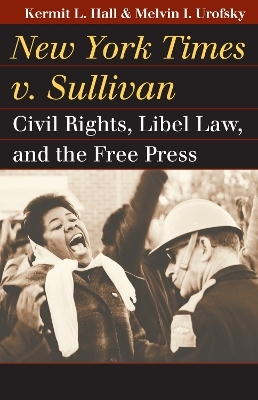
New York Times V. Sullivan
Civil Rights, Libel Law, and the Free Press
Seiten
2011
University Press of Kansas (Verlag)
978-0-7006-1803-3 (ISBN)
University Press of Kansas (Verlag)
978-0-7006-1803-3 (ISBN)
Illuminating a classic case from the turbulent civil rights era of the 1960s, two of America’s foremost legal historians - Kermit Hall and Melvin Urofsky - provide a compact and highly readable updating of one of the most memorable decisions in the Supreme Court’s canon. Their insights place this landmark case within a new and enlightening frame.
Illuminating a classic case from the turbulent civil rights era of the 1960s, two of America’s foremost legal historians—Kermit Hall and Melvin Urofsky—provide a compact and highly readable updating of one of the most memorable decisions in the Supreme Court’s canon.
When the New York Times published an advertisement that accused Alabama officials of willfully abusing civil rights activists, Montgomery police commissioner Lester Sullivan filed suit for defamation. Alabama courts, citing factual errors in the ad, ordered the Times to pay half a million dollars in damages. The Times appealed to the Supreme Court, which had previously deferred to the states on libel issues. The justices, recognising that Alabama’s application of libel law threatened both the nation’s free press and equal rights for African Americans, unanimously sided with the Times.
As memorably recounted twenty years ago in Anthony Lewis’s Make No Law, the 1964 decision profoundly altered defamation law, which the Court declared must not hinder debate on public issues even if it includes “vehement, caustic, and sometimes unpleasantly sharp attacks on government and public officials.” The decision also introduced a new First Amendment test: a public official cannot recover damages for libel unless he proves that the statement was made with the knowledge that it was false or with reckless disregard of whether it was false.
Hall and Urofsky, however, place a new emphasis on this iconic case. Whereas Lewis’s book championed freedom of the press, the authors here provide a stronger focus on civil rights and southern legal culture. They convey to readers the urgency of the civil rights movement and the vitriolic anger it inspired in the Deep South. Their insights place this landmark case within a new and enlightening frame.
Illuminating a classic case from the turbulent civil rights era of the 1960s, two of America’s foremost legal historians—Kermit Hall and Melvin Urofsky—provide a compact and highly readable updating of one of the most memorable decisions in the Supreme Court’s canon.
When the New York Times published an advertisement that accused Alabama officials of willfully abusing civil rights activists, Montgomery police commissioner Lester Sullivan filed suit for defamation. Alabama courts, citing factual errors in the ad, ordered the Times to pay half a million dollars in damages. The Times appealed to the Supreme Court, which had previously deferred to the states on libel issues. The justices, recognising that Alabama’s application of libel law threatened both the nation’s free press and equal rights for African Americans, unanimously sided with the Times.
As memorably recounted twenty years ago in Anthony Lewis’s Make No Law, the 1964 decision profoundly altered defamation law, which the Court declared must not hinder debate on public issues even if it includes “vehement, caustic, and sometimes unpleasantly sharp attacks on government and public officials.” The decision also introduced a new First Amendment test: a public official cannot recover damages for libel unless he proves that the statement was made with the knowledge that it was false or with reckless disregard of whether it was false.
Hall and Urofsky, however, place a new emphasis on this iconic case. Whereas Lewis’s book championed freedom of the press, the authors here provide a stronger focus on civil rights and southern legal culture. They convey to readers the urgency of the civil rights movement and the vitriolic anger it inspired in the Deep South. Their insights place this landmark case within a new and enlightening frame.
The late KERMIT L. HALL was president of SUNY-Albany and author, editor, or co-editor of more than two dozen books. He is best known for The Magic Mirror: Law in American History and The Oxford Companion to the Supreme Court. MELVIN I. UROFSKY is professor emeritus of history and professor of law and public policy at Virginia Commonwealth University. Among his many books are the prize winning Louis D. Brandeis: A Life; the two-volume March of Liberty: A Constitutional History of the United States; and Money and Free Speech: Campaign Finance Reform and the Courts.
| Reihe/Serie | Landmark Law Cases and American Society |
|---|---|
| Verlagsort | Kansas |
| Sprache | englisch |
| Maße | 141 x 219 mm |
| Gewicht | 315 g |
| Themenwelt | Recht / Steuern ► EU / Internationales Recht |
| Recht / Steuern ► Öffentliches Recht ► Verfassungsrecht | |
| Sozialwissenschaften ► Politik / Verwaltung | |
| ISBN-10 | 0-7006-1803-1 / 0700618031 |
| ISBN-13 | 978-0-7006-1803-3 / 9780700618033 |
| Zustand | Neuware |
| Informationen gemäß Produktsicherheitsverordnung (GPSR) | |
| Haben Sie eine Frage zum Produkt? |
Mehr entdecken
aus dem Bereich


aus dem Bereich
Staatsrecht, Verwaltungsrecht, Verwaltungsprozessrecht und …
Buch | Softcover (2025)
Vahlen (Verlag)
CHF 51,65
Buch | Softcover (2025)
Alpmann und Schmidt (Verlag)
CHF 17,95


