


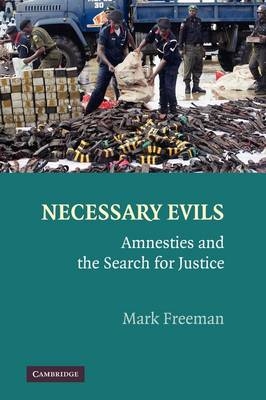
Necessary Evils
Amnesties and the Search for Justice
Seiten
2011
Cambridge University Press (Verlag)
978-1-107-40323-9 (ISBN)
Cambridge University Press (Verlag)
978-1-107-40323-9 (ISBN)
This book is about amnesties for grave international crimes that states adopt in moments of transition or social unrest. The goal of this book is to reframe and revitalise the global debate on the subject and to offer an original framework for resolving amnesty dilemmas when they arise.
This book is about amnesties for grave international crimes that states adopt in moments of transition or social unrest. The subject is naturally controversial, especially in the age of the International Criminal Court. The goal of this book is to reframe and revitalise the global debate on the subject and to offer an original framework for resolving amnesty dilemmas when they arise. Most literature and jurisprudence on amnesties deal with only a small subset of state practice and sidestep the ambiguity of amnesty's position under international law. This book addresses the ambiguity head on and argues that amnesties of the broadest scope are sometimes defensible when adopted as a last recourse in contexts of mass violence. Drawing on an extensive amnesty database, the book offers detailed guidance on how to ensure that amnesties extend the minimum leniency possible, while imposing the maximum accountability on the beneficiaries.
This book is about amnesties for grave international crimes that states adopt in moments of transition or social unrest. The subject is naturally controversial, especially in the age of the International Criminal Court. The goal of this book is to reframe and revitalise the global debate on the subject and to offer an original framework for resolving amnesty dilemmas when they arise. Most literature and jurisprudence on amnesties deal with only a small subset of state practice and sidestep the ambiguity of amnesty's position under international law. This book addresses the ambiguity head on and argues that amnesties of the broadest scope are sometimes defensible when adopted as a last recourse in contexts of mass violence. Drawing on an extensive amnesty database, the book offers detailed guidance on how to ensure that amnesties extend the minimum leniency possible, while imposing the maximum accountability on the beneficiaries.
Part I. The Debate on Amnesties: 1. Introduction; 2. Defining amnesty; 3. Amnesties and impunity; 4. Amnesties and international law; 5. Amnesties and the ICC; 6. The evolving UN position on amnesties; 7. Conclusions; Part II. The Design of Amnesties: 8. Introduction; 9. Last recourse threshold; 10. Overarching parameters for amnesty design; 11. Specific amnesty design choices; 12. Conclusions.
| Erscheint lt. Verlag | 18.8.2011 |
|---|---|
| Zusatzinfo | Worked examples or Exercises |
| Verlagsort | Cambridge |
| Sprache | englisch |
| Maße | 152 x 229 mm |
| Gewicht | 500 g |
| Themenwelt | Recht / Steuern ► EU / Internationales Recht |
| Recht / Steuern ► Öffentliches Recht ► Völkerrecht | |
| Sozialwissenschaften ► Politik / Verwaltung ► Europäische / Internationale Politik | |
| ISBN-10 | 1-107-40323-5 / 1107403235 |
| ISBN-13 | 978-1-107-40323-9 / 9781107403239 |
| Zustand | Neuware |
| Informationen gemäß Produktsicherheitsverordnung (GPSR) | |
| Haben Sie eine Frage zum Produkt? |
Mehr entdecken
aus dem Bereich


aus dem Bereich
Die Rechtsprechung des Gerichtshofs der Europäischen Union, deutscher …
Buch | Softcover (2025)
Nomos (Verlag)
CHF 53,50


