


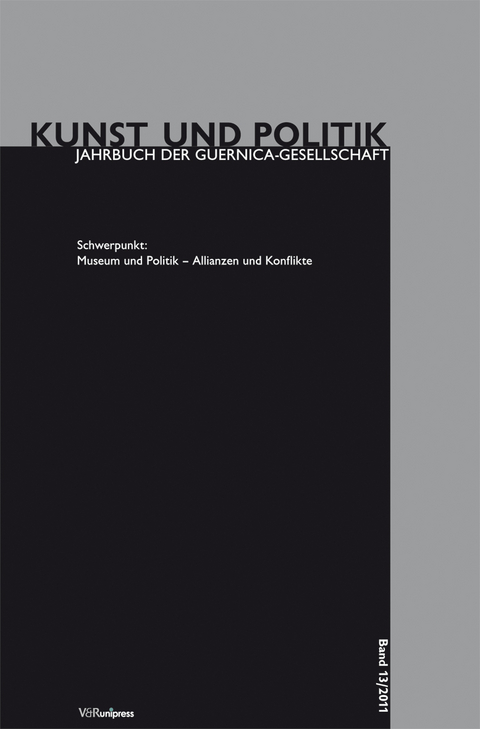
Museum und Politik – Allianzen und Konflikte
Im Zentrum dieses Bandes stehen die aktuelle gesellschaftliche Verantwortung von Museen und die politischen Erwartungen an sie. Museen sind als öffentliche Kultureinrichtungen Teil des politischen Systems, zugleich ist die Freiheit der Kunst im deutschen Grundgesetz festgeschrieben. Wie gehen Museum und Politik mit diesem Widerspruch um? Ein politologischer Beitrag und einer aus der politischen Praxis führen ins Thema ein. Die folgenden kunsthistorischen Fallanalysen stehen in Bezug dazu und machen so das Museum als politische Institution fassbar. Beiträge aus schwarzer Perspektive zeigen nicht nur Gegendiskurse zur weiß dominierten Diskussion auf, sondern bringen das 'Unbehagen im Museum' zur Sprache. Folglich diskutiert dieser Band die Bedeutung der klassischen Museumsaufgaben heute, die Rolle der Authentizität von Objekten angesichts Neuer Medien im Museum und zunehmender Internetausstellungen sowie Rückgabeforderungen von Beutekunst, die durch Kolonialismus und Nationalsozialismus in deutsche Museen gelangt ist.
Anna Greve ist Direktorin des Focke-Museums, Bremer Landesmuseum für Kunst und Kulturgeschichte.
Prof. Dr. Norbert Schneider war bis zu seiner Emeritierung Leiter des Instituts für Kunstgeschichte der Universität Karlsruhe (jetzt: Karlsruher Institut für Technologie, KIT).
Prof. Dr. Martin Papenbrock lehrt Kunstgeschichte am Karlsruher Institut für Technologie, KIT (ehemals: Institut für Kunstgeschichte der Universität Karlsruhe).
This volume focuses on the question of the current societal responsibility of museums and the political expectations placed on them. As public cultural institutions, museums are an essential part of the political system, while at the same time artistic freedom is anchored in the German Basic Law. How do museums and politics deal with this contradiction? Contributions from the perspectives of political science and political practice provide an introduction to the theme, and the subsequent art-historical case analyses refer back to them, thus making the concept of the museum as a political institution more comprehensible. Contributions from a Black perspective not only present counter-discourses to the white-dominated field of discussion, but also raise the issue of "unease in museums". Thus, the volume discusses the significance of the classic functions of museums today, the authenticity of objects in the light of the advance of new media in museums and internet exhibitions, as well as the demands for the return of art treasures looted during colonial and National Socialist occupation that found their way into German museums.The central question is: Can a museum, as a political institution, be a place of representation for all population groups?
| Erscheint lt. Verlag | 6.10.2011 |
|---|---|
| Reihe/Serie | Kunst und Politik ; Band 013 |
| Mitarbeit |
Herausgeber (Serie): Norbert Schneider, Martin Papenbrock |
| Verlagsort | Göttingen |
| Sprache | deutsch |
| Maße | 155 x 240 mm |
| Gewicht | 350 g |
| Themenwelt | Kunst / Musik / Theater ► Allgemeines / Lexika |
| Sozialwissenschaften | |
| Schlagworte | Kritische Kunstwissenschaft • Kulturpolitik • Museumspolitik • Politische Kunst |
| ISBN-10 | 3-89971-859-3 / 3899718593 |
| ISBN-13 | 978-3-89971-859-1 / 9783899718591 |
| Zustand | Neuware |
| Informationen gemäß Produktsicherheitsverordnung (GPSR) | |
| Haben Sie eine Frage zum Produkt? |
aus dem Bereich


