


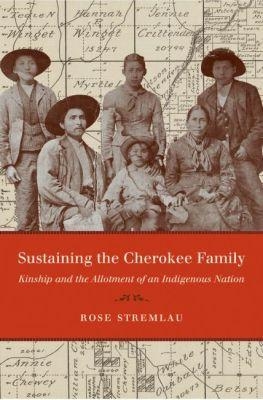
Sustaining the Cherokee Family
Kinship and the Allotment of an Indigenous Nation
Seiten
2011
|
New edition
The University of North Carolina Press (Verlag)
9780807872048 (ISBN)
The University of North Carolina Press (Verlag)
9780807872048 (ISBN)
During the late nineteenth and early twentieth centuries, the federal government sought to forcibly assimilate Native Americans into American society through systematised land allotment. Rose Stremlau illuminates the impact of this policy on the Cherokee Nation, particularly within individual families and communities in modern-day northeastern Oklahoma.
During the late nineteenth and early twentieth centuries, the federal government sought to forcibly assimilate Native Americans into American society through systematized land allotment. In Sustaining the Cherokee Family , Rose Stremlau illuminates the impact of this policy on the Cherokee Nation, particularly within individual families and communities in modern-day northeastern Oklahoma. Emphasizing Cherokee agency, Stremlau reveals that Cherokee families' organization, cultural values, and social and economic practices allowed them to adapt to private land ownership by incorporating elements of the new system into existing domestic and community-based economies. Drawing on evidence from a range of sources, including Cherokee and United States censuses, federal and tribal records, local newspapers, maps, county probate records, family histories, and contemporary oral histories, Stremlau demonstrates that Cherokee management of land perpetuated the values and behaviors associated with their sense of kinship, therefore uniting extended families. And, although the loss of access to land and communal resources slowly impoverished the region, it reinforced the Cherokees' interdependence. Stremlau argues that the persistence of extended family bonds allowed indigenous communities to retain a collective focus and resist aspects of federal assimilation policy during a period of great social upheaval. |During the late nineteenth and early twentieth centuries, the federal government sought to forcibly assimilate Native Americans into American society through systematized land allotment. Stremlau illuminates the impact of this policy on the Cherokee Nation, particularly within individual families and communities in modern-day northeastern Oklahoma.
During the late nineteenth and early twentieth centuries, the federal government sought to forcibly assimilate Native Americans into American society through systematized land allotment. In Sustaining the Cherokee Family , Rose Stremlau illuminates the impact of this policy on the Cherokee Nation, particularly within individual families and communities in modern-day northeastern Oklahoma. Emphasizing Cherokee agency, Stremlau reveals that Cherokee families' organization, cultural values, and social and economic practices allowed them to adapt to private land ownership by incorporating elements of the new system into existing domestic and community-based economies. Drawing on evidence from a range of sources, including Cherokee and United States censuses, federal and tribal records, local newspapers, maps, county probate records, family histories, and contemporary oral histories, Stremlau demonstrates that Cherokee management of land perpetuated the values and behaviors associated with their sense of kinship, therefore uniting extended families. And, although the loss of access to land and communal resources slowly impoverished the region, it reinforced the Cherokees' interdependence. Stremlau argues that the persistence of extended family bonds allowed indigenous communities to retain a collective focus and resist aspects of federal assimilation policy during a period of great social upheaval. |During the late nineteenth and early twentieth centuries, the federal government sought to forcibly assimilate Native Americans into American society through systematized land allotment. Stremlau illuminates the impact of this policy on the Cherokee Nation, particularly within individual families and communities in modern-day northeastern Oklahoma.
Rose Stremlau is assistant professor of history and American Indian studies at the University of North Carolina at Pembroke.
| Erscheint lt. Verlag | 26.9.2011 |
|---|---|
| Reihe/Serie | First Peoples: New Directions in Indigenous Studies |
| Verlagsort | Chapel Hill |
| Sprache | englisch |
| Maße | 161 x 234 mm |
| Gewicht | 493 g |
| Themenwelt | Geschichte ► Allgemeine Geschichte ► Neuzeit (bis 1918) |
| Geisteswissenschaften ► Geschichte ► Regional- / Ländergeschichte | |
| Sozialwissenschaften ► Ethnologie | |
| Sozialwissenschaften ► Soziologie | |
| ISBN-13 | 9780807872048 / 9780807872048 |
| Zustand | Neuware |
| Informationen gemäß Produktsicherheitsverordnung (GPSR) | |
| Haben Sie eine Frage zum Produkt? |
Mehr entdecken
aus dem Bereich

aus dem Bereich


