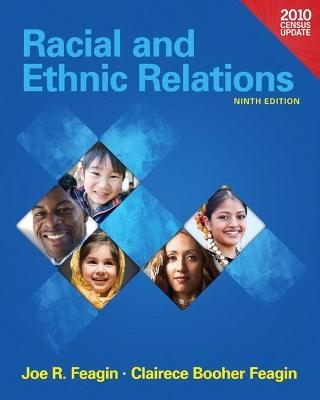
Racial and Ethnic Relations, Census Update
Pearson (Verlag)
978-0-205-02499-5 (ISBN)
- Titel erscheint in neuer Auflage
- Artikel merken

Racial and Ethnic Relations, 9/e examines the “what”, “why”, and “how” of racial and ethnic oppression and conflict.
Drawing on a broad array of sources, this text provides readers with access to important research and literature on racial and ethnic groups in the United States and, to a lesser extent, in certain other countries around the globe. It is designed for courses in Majority-Minority Relations, Racial and Ethnic Relations, Cultural Diversity, and Multiculturalism in departments of Sociology and Ethnic Studies.
The Census Update program incorporates 2010 Census data into a course—simply and easily. The components of the Census Update Program include an updated census edition with all charts and graphs—to reflect the results of the 2010 Census. In addition, A Short Introduction to the U.S. Census is available and an updated MySocKit.
Teaching & Learning Experience
Personalize Learning—MySocKit delivers proven results in helping students succeed, provides engaging experiences that personalize learning, and comes from a trusted partner with educational expertise and a deep commitment to helping students and instructors achieve their goals.
Improve Critical Thinking — Encourages students to critically evaluate racial inequality and conflict.
Engage Students — A broad array of sources and new research help students delve into the sociology of inter-group relations.
Explore Theory — Power-conflict approach.
Support Instructors — MySocKit enables instructors to assess student progress and adapt course material to meet the specific needs of the class.
Note: MySocKit does not come automatically packaged with this text. To purchase MySocKit, please visit: www.mysockit.com or you can purchase a ValuePack of the text + MySocKit (at no additional cost). ValuePack ISBN-10: 0205172210 / ValuePack ISBN-13: 9780205172214
Dr. Joe Feagin, currently Ella C. McFadden Professor at Texas A & M University, was born in San Angelo (Texas), got his early education in Houston, and graduated from Baylor University in 1960. He acquired his Ph.D. in sociology at Harvard University in 1966. Feagin has taught at the University of Massachusetts (Boston), University of California (Riverside), University of Texas, University of Florida, and Texas A&M University. Dr. Feagin has done much research and conceptual work on race, racism, and sexism issues and has served as the Scholar-in-Residence at the U.S. Commission on Civil Rights. He has written 58 scholarly books and nearly 200 scholarly articles in his research areas. Feagin’s major books include Systemic Racism (Routledge 2006), Social Problems: A Power-Conflict Perspective (6th ed., Prentice-Hall, 2006); Liberation Sociology, with H. Vera (Westview, 2001); Racist America (Routledge 2000); The First R: How Children Learn Race and Racism, with D. Van Ausdale (Rowman & Littlefield 2001); Racial and Ethnic Relations, with C. Feagin (7th ed.; Prentice-Hall 2008); The Many Costs of Racism, with K. McKinney (Rowman & Littlefield 2003); White Men on Race, with E. O'Brien (Beacon 2003); Black in Blue: African-American Police Officers and Racism, with K. Bolton (Routledge 2004); Two Faced Racism: Whites in the Backstage and Frontstage, with L. Picca (Routledge 2007); and The White Racial Frame (Routledge 2010). Feagin’s books have won numerous national and professional association prizes; his book, Ghetto Revolts (Macmillan 1973), was nominated for a Pulitzer Prize. He is the 2006 recipient of a Harvard Alumni Association lifetime achievement award and was the 1999-2000 president of the American Sociological Association.
IN THIS SECTION:
1.) BRIEF
2.) COMPREHENSIVE
BRIEF TABLE OF CONTENTS: Part I: The Racial and Ethnic Mosaic
Chapter 1: Basic Concepts in the Study of Racial and Ethnic Relations
Chapter 2: Adaptation and Conflict: Racial and Ethnic Relations in Theoretical Perspective
Part II: A Nation of Immigrants: An Overview of the Economic and Political Conditions of Selected Racial and Ethnic Groups
Chapter 3: English Americans and the Anglo-Protestant Culture
Chapter 4: Irish Americans and Italian Americans
Chapter 5: Jewish Americans
Chapter 6: Native Americans
Chapter 7: African Americans
Chapter 8: Mexican Americans
Chapter 9: Puerto Rican and Cuban Americans
Chapter 10: Japanese Americans
Chapter 11: Chinese, Filipino, Korean, Vietnamese, and Asian-Indian Americans
Chapter 12: Arab and Other Middle Eastern Americans
Chapter 13: Ongoing Racial and Ethnic Issues in the United States: Some Final Considerations
Part III: Global Realities
Chapter 14: Colonialism and Postcolonialism: The Global Expansion of Racism
COMPREHENSIVE TABLE OF CONTENTS:
*Summary and Key Terms appear at the end of each chapter.
Part I: The Racial and Ethnic Mosaic
Chapter 1: Basic Concepts in the Study of Racial and Ethnic Relations
Issues of Race and Racism
Ethnic Groups
A Note on Cultures
A Racial Framing of Society
Prejudices and Stereotypes
Discrimination
Chapter 2: Adaptation and Conflict: Racial and Ethnic Relations in Theoretical Perspective
Racial and Ethnic Hierarchies
Migration and Group Contact
Patterns of Racial and Ethnic Adaptation
Assimilation and Other Order Perspectives
Power-Conflict Theories
Part II: A Nation of Immigrants: An Overview of the Economic and Political Conditions of Selected Racial and Ethnic Groups
Immigration, the Economy, and Government
Commercial Capitalism and the Slave Society: 1600s—1860s
Industrial Capitalism: 1860s—1910s
Advanced Industrial (Multinational) Capitalism: 1910s—2000s
Chapter 3: English Americans and the Anglo-Protestant Culture
The English Migrations
Nativist Reactions to Later European Immigrants
The Dominant Culture and Major U.S. Institutions
English Americans Today
Chapter 4: Irish Americans and Italian Americans
Irish Americans
Irish Immigration: An Overview
Stereotypes
Protest and Conflict
Politics and Political Institutions
The Irish in the Economy
Education
Religion
Assimilation Theories and the Irish
Italian Americans
Italian Immigration
Stereotypes
Conflict
Politics
The Economy
Education
Religion
Assimilation or Ethnogenesis?
A Note on Ethnic Diversity Among White Americans
Chapter 5: Jewish Americans
Migration
Prejudice and Stereotypes
Oppression and Conflict
Politics
The Economy
Education
Religion and Zionism
Assimilation or Pluralism?
Chapter 6: Native Americans
Conquest by Europeans and European Americans
Racist Images and Stereotypes
Politics
Protest and Conflict
The Economy
Education
Religion
Assimilation and Colonialism
Chapter 7: African Americans
Forced Migration and Slavery
Racist Ideologies and Associated Stereotypes
Interracial Conflict
The Economy
Politics and Protest
Education
Religion and Culture
Recent Immigrants from Africa and the Caribbean
Assimilation for African Americans?
Chapter 8: Mexican Americans
The Conquest Period, 1500—1853
Past and Present Immigration
Immigrants
Stereotypes and Related Images
Conflict and Protest
The Economy
Politics and Protest
Education
Religion
Assimilation or Internal Colonialism?
Chapter 9: Puerto Rican and Cuban Americans
Puerto Ricans
From Spanish to U.S. Rule
Migration to the Mainland
Prejudices and Stereotypes
Economic and Related Conditions: The Mainland
Education
Politics
Protest
Religion
Assimilation or Colonialism?
Cuban Americans
Patterns of Immigration
Intergroup Conflict
Stereotypes and Discrimination
The Economic Situation
Politics
Religion
Assimilation or Colonialism?
Chapter 10: Japanese Americans
Introduction: Asian Americans
Japanese Americans
Migration: An Overview
Stereotypes
Repression and Violent Attacks
The Political Arena
The Economy
Education
Religion
Assimilation Perspectives
Chapter 11: Chinese, Filipino, Korean, Vietnamese, and Asian-Indian Americans
Migration: An Overview
Stereotypes
Discrimination and Conflict
Organizing and Activism in the Political Arena
The Economy
Education
Full Assimilation for Asian Americans?
Chapter 12: Arab and Other Middle Eastern Americans
Middle Eastern Americans
Arab Americans
Migration
Stereotyping and Prejudice
Oppression, Discrimination, and Conflict
Politics and Political Emergence
The Economy
Education
Religion
Adaptation and Assimilation Issues
Chapter 13: Ongoing Racial and Ethnic Issues in the United States: Some Final Considerations
A Nation of Immigrants
The Melting Pot: Early Images of Immigrant Incorporation
Multicultural and Multiracial Democracy Issues
Equality and a Pluralistic Democracy
Part III: Global Realities
Chapter 14: Colonialism and Postcolonialism: The Global Expansion of Racism
Colonialism and Racism
The History and Legacy of Colonialism
To Whom Does Southern Africa Belong?
Brazil: The Legacy of Slavery and the Illusion of Equality
Colonialism and Colonizer in France: The Violence of Inclusion and Exclusion
The Future of Colonialism and Post-Colonialism
| Erscheint lt. Verlag | 19.1.2012 |
|---|---|
| Sprache | englisch |
| Maße | 202 x 252 mm |
| Gewicht | 830 g |
| Themenwelt | Sozialwissenschaften ► Ethnologie |
| Sozialwissenschaften ► Soziologie ► Empirische Sozialforschung | |
| ISBN-10 | 0-205-02499-8 / 0205024998 |
| ISBN-13 | 978-0-205-02499-5 / 9780205024995 |
| Zustand | Neuware |
| Informationen gemäß Produktsicherheitsverordnung (GPSR) | |
| Haben Sie eine Frage zum Produkt? |
aus dem Bereich