


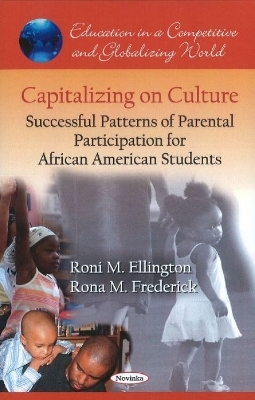
Capitalizing on Culture
Successful Patterns of Parental Participation for African American Students
Seiten
2011
Nova Science Publishers Inc (Verlag)
978-1-61728-763-3 (ISBN)
Nova Science Publishers Inc (Verlag)
978-1-61728-763-3 (ISBN)
Using qualitative data from high achieving African American mathematics students matriculating through undergraduate mathematics programs, this book argues that African Americans have both historically and currently utilised social and cultural capital to produce high academic achievers, in spite of the 'educational debt'.
Conversations regarding the "achievement gap" fail to consider the historical, economic, sociopolitical and moral backdrop that created the "education debt" experienced by African Americans. The "achievement gap," or rather the "education debt," is the result of systemic inequities that have accumulated over hundreds of years, which denied access to quality education for African Americans. As a result, African American students were not given the appropriate resources to achieve at the levels of white students and were systematically left behind. Using qualitative data from high achieving African American mathematics students matriculating through undergraduate mathematics programs, this book argues that African Americans have both historically and currently utilised social and cultural capital to produce high academic achievers, in spite of the "educational debt".
Conversations regarding the "achievement gap" fail to consider the historical, economic, sociopolitical and moral backdrop that created the "education debt" experienced by African Americans. The "achievement gap," or rather the "education debt," is the result of systemic inequities that have accumulated over hundreds of years, which denied access to quality education for African Americans. As a result, African American students were not given the appropriate resources to achieve at the levels of white students and were systematically left behind. Using qualitative data from high achieving African American mathematics students matriculating through undergraduate mathematics programs, this book argues that African Americans have both historically and currently utilised social and cultural capital to produce high academic achievers, in spite of the "educational debt".
Introduction; Social & Cultural Capital Theory; Findings; Discussion; Conclusion; Index.
| Erscheint lt. Verlag | 8.2.2011 |
|---|---|
| Verlagsort | New York |
| Sprache | englisch |
| Maße | 215 x 140 mm |
| Gewicht | 96 g |
| Themenwelt | Sozialwissenschaften ► Ethnologie |
| Sozialwissenschaften ► Pädagogik ► Sonder-, Heil- und Förderpädagogik | |
| Sozialwissenschaften ► Soziologie | |
| ISBN-10 | 1-61728-763-6 / 1617287636 |
| ISBN-13 | 978-1-61728-763-3 / 9781617287633 |
| Zustand | Neuware |
| Informationen gemäß Produktsicherheitsverordnung (GPSR) | |
| Haben Sie eine Frage zum Produkt? |
Mehr entdecken
aus dem Bereich



aus dem Bereich
was Eltern und Pädagogen wissen müssen
Buch | Softcover (2023)
Kohlhammer (Verlag)
CHF 47,60
das Struktur-Lege-Verfahren als Kompass
Buch | Softcover (2024)
modernes lernen (Verlag)
CHF 33,50


