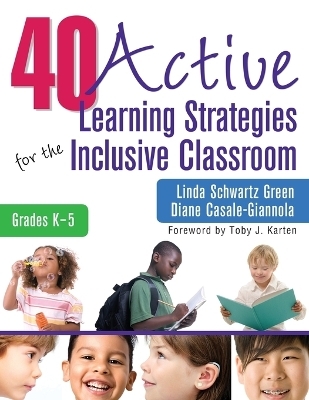
40 Active Learning Strategies for the Inclusive Classroom, Grades K–5
Corwin Press Inc (Verlag)
978-1-4129-8170-5 (ISBN)
"An excellent tool to help teachers help students, this book would be particularly useful within a professional learning community or in a mentoring setting."
—Jim Hoogheem, Retired Principal
Fernbrook Elementary School, Maple Grove, MN "This book got me excited to teach in an inclusive setting! The tips and directions will work with every child and will ensure that ALL students can learn in the same environment."
—Rachel Aherns, Instructional Strategist I
Westridge Elementary School, West Des Moines, IA
Engage all learners with research-based strategies from acclaimed educators
Research indicates that students of all ages and demographics benefit from active learning strategies. The challenge is translating what we know into what we do. Award-winning educators Linda Schwartz Green and Diane Casale-Giannola build that bridge with more than 40 easy-to-implement strategies for today′s inclusive classroom. This practical guide includes:
Field-tested practices that are easily adaptable to various grade levels and subjects
Vignettes that demonstrate how to apply today′s brain-compatible strategies in the classroom
Tools for differentiating instruction to serve ALL students, including high-ability students, those with ADHD or learning disabilities, and English learners
Grounded in foundational research and educational literature, these strategies include directions for use, sample applications across content areas, and how-to′s for groups and individuals. Teachers and administrators will find this comprehensive guidebook an indispensable at-your- fingertips resource for enhancing student engagement, furthering professional development, and increasing positive learning outcomes.
Learn more about Linda Green′s PD offerings Consulting Description: Active Learning for the Inclusive Classroom, K-5 Consulting Description: Active Learning for the Inclusive Classroom, 6-12 Dr. Linda Green has a B.A. in English from University of Bridgeport, an M.A. in Special Education and Reading from Eastern New Mexico University, and a Ph.D. in Psychological & Cultural Studies and Special Education from University of Nebraska at Lincoln. She holds certifications in Special Education and Teacher of English and is currently as Associate Professor of Education at Centenary College. She has worked as a special education teacher and a consultant, preparing and implementing workshops on a variety of topics related to special education. Dr. Green is a member of the Council for Exceptional Children (CEC) and the Teacher Education Division of CEC. She presents regularly at national special education conferences, is a reviewer of conference proposals for national special education conferences, and a reviewer of manuscripts for special education texts for major education publishers. Dr. Green has taught most of the special education courses at Centenary on both the undergraduate and graduate level, and she developed and is the current director of the M.A. program in Special Education. She also serves as the director of the Teachers of Students with Disabilities Certification Program. She received the Centenary College Distinguished Teacher Award in 2000. She is the founding advisor of the Centenary College Student Chapter of the Council for Exceptional Children. Dr. Diane Casale-Giannola is currently a Associate Professor in the School of Education at Rider University. She received her Master’s of Science, specializing in Special Education, from Albany University and her Ph.D. from New York University. She also holds an Advanced Certificate in Educational Supervision and Administration from Brooklyn College. Dr. Casale-Giannola is an active researcher, presenter, and consultant, focusing on how to assess and address the needs of diverse student populations. She is an active member of the New Jersey Council for Exceptional Children and Council for Exceptional Children, including participating in the CEC scholarship committee and sponsoring the first state-wide Student CEC professional conference. She also is on the Special Education Advisory Board, which consults with community and university members to support pre-service teachers to effectively teach and service individuals with disabilities in the community and their families.
Foreword
Acknowledgments
About the Authors
1. Engaging Students in the Inclusive Classroom: Research and Theoretical Underpinning
The Blueberry Story: The Teacher Gives the Businessman a Lesson
Inclusion: Definition and Research
Students in the Inclusive Classroom: Who Are We Teaching?
Helping Teachers Meet the Inclusion Challenge
What Is Active Learning?
Brain-Based Learning
Information Processing
Connections to Differentiated Instruction
Supporting State Standards and Assessments
Motivating Learners With Active Learning Strategies
Access Is Not Enough: The Critical Need to Address Diverse Student Populations
The Beginning
2. Selecting and Implementing Active Learning Strategies for the Inclusive Classroom
Introduction
Classifications and Characteristics
Other Diverse Populations
Assessing Students and Identifying Learning Characteristics
Using Strategies: Before, During, and After
How to Choose a Strategy to Meet Individual Student Needs
Learner Characteristics Described
How to Choose a Strategy to Meet Individual Teacher Needs
Learning Communities
And Now, the Next Step on Our Journey
3. Grouping for Instruction: Who Goes Where With Whom to Do What?
Introduction
How Do I Manage Everyone?
Whole Group Instruction
Small Group Instruction
Different Ways to Form Groups
Tips for Choosing and Using Instructional Groups in the Inclusive Classroom
And Now (Drum Roll, Please) . . . the Strategies
4. Active Learning Strategies
Introduction
1. Acrostic Topics (Using a concept name to create acrostic poems)
2. Baggie Stories (Students produce a visual story of specific content)
3. Ball Toss (The game of catch facilitates Q & A)
4. Barometer (Students take a stand on controversial issues by voting with their feet)
5. Chain Reaction (A variation of the old word game Telephone using academic concepts or phrases)
6. Classification Capers (Students develop criteria to sort and classify objects, pictures, or word cards)
7. Classroom Box Bingo (Completing a Bingo grid by walking around the class to get the information)
8. Exit Cards (End of lesson questions or comments to identify student progress or process)
9. Fishbowl (One group observes another in role play and shares feedback)
10. Four Corners (Students respond to questions by choosing one of four choices in each classroom corner)
11. Howdy Partner! (Students find a partner with the same topic by sharing descriptors)
12. If I Were . . . (A student completes a sentance stem ased on a given topic, and another student makes a related comment)
13. Information Rings (Constructing connected flash cards of data)
14. Job Wanted Poster (Students construc a job wanted advertisement using their knowledge of a particular character or historical figure)
15. Line Up! (Students line up in order based on sequential content-particularly facts that students need to know automaticity)
16. Listening Teams (Each group is given one question or issue to report on after a lecture or other direct instruction)
17. Outline Plus (A detalied outline with strategic blank spaces to support video instruction)
18. Paper Pass (Sharing and commenting on peer perspectives)
19. People Movers (Students move around the room to create visual representations of a concept)
20. Play Dough Construction (Using play dough to create concept representations)
21. Puzzle Pieces (Students walk around the class with Q & A cards to find matches)
22. Quick Questions (Students are given answers and have to come up with the questions)
23. Rainbow Ball (A paper ball that students toss and catch, with a question on each layer that students answer)
24. Round Robin (Students participate in group rotations responding to a topic or question)
25. Sentence Starter Poster Session (Using sentence starters to create posters that summarize key points of a given topic)
26. Snowball Fight (Students create questions on paper balls and throw them to each other for answers)
27. The Spider Web (Class stands in a circle using a ball of yarn to create a spiderwebe while responding to a statement or question)
28. Think, Pair, Share (Student pairs share information, reflect, and comment)
29. Timeline (Student groups research sequential content and create a visual timeline)
30. Two Truths and a Lie (with variations) (Students state three facts about a topic and peers identify which one is not true)
31. Venn Hoops (Constructing Venn diagrams with hula hoops)
32. Walking in Their Shoes (Students consider a given situation from the point of view of a character, animal, or historical figure)
33. What′s in the Bag? (Students collect objects to share information about a common theme)
34. What Up? (Using signs and signals for each student to respond to a query)
35. What Would It Say? (Students match phrases that inanimate objects might have said if these objects could talk)
36. Who Am I? What Am I? (Students provide clues to concepts and peers guess what they are)
37. 52 Things to Do (The number on a playing card indicates how much information students schare on a topic)
Participation Prompts
38. Conversation Cues: Talking Tickets and Talking Circles
39. Conversation Cards
40. The Whip
5. The Journey Continues
References
| Verlagsort | Thousand Oaks |
|---|---|
| Sprache | englisch |
| Maße | 215 x 279 mm |
| Gewicht | 510 g |
| Themenwelt | Sozialwissenschaften ► Pädagogik ► Didaktik |
| Sozialwissenschaften ► Pädagogik ► Schulpädagogik / Grundschule | |
| ISBN-10 | 1-4129-8170-0 / 1412981700 |
| ISBN-13 | 978-1-4129-8170-5 / 9781412981705 |
| Zustand | Neuware |
| Informationen gemäß Produktsicherheitsverordnung (GPSR) | |
| Haben Sie eine Frage zum Produkt? |
aus dem Bereich