


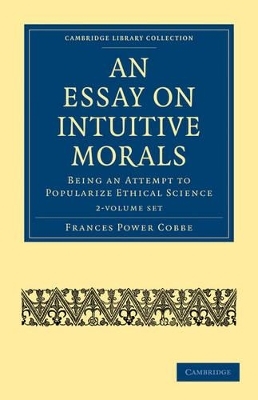
An Essay on Intuitive Morals 2 Volume Set
Being an Attempt to Popularize Ethical Science
Seiten
2010
Cambridge University Press
978-1-108-02028-2 (ISBN)
Cambridge University Press
978-1-108-02028-2 (ISBN)
- Keine Verlagsinformationen verfügbar
- Artikel merken
Frances Power Cobbe (1822–1904) was an Irish writer and social reformer best known for her contributions to Victorian feminism. These volumes, first published anonymously in 1855, discuss Cobbe's religious beliefs, which blended Immanuel Kant's moral philosophy with theistic philosophy.
Frances Power Cobbe (1822–1904) was an Irish writer, social reformer and activist best known for her contributions to Victorian feminism and women's suffrage. After the death of her father in 1857, Cobbe travelled extensively across Europe before becoming a leader-writer addressing public issues for the London newspaper The Echo in 1868. She continued to publish on the topics of feminism, social problems and theology for the rest of her life. These volumes, first published anonymously in 1855, introduced Cobbe's theistic religious beliefs, which blend a belief in Divinity with Immanuel Kant's idea of freedom of will, in which a person's moral imperative is independent of outside authority and provides proof of the existence of God. Cobbe discusses Kant's moral philosophy, explaining the religious beliefs which formed the basis for her later discussions of Christianity.
Frances Power Cobbe (1822–1904) was an Irish writer, social reformer and activist best known for her contributions to Victorian feminism and women's suffrage. After the death of her father in 1857, Cobbe travelled extensively across Europe before becoming a leader-writer addressing public issues for the London newspaper The Echo in 1868. She continued to publish on the topics of feminism, social problems and theology for the rest of her life. These volumes, first published anonymously in 1855, introduced Cobbe's theistic religious beliefs, which blend a belief in Divinity with Immanuel Kant's idea of freedom of will, in which a person's moral imperative is independent of outside authority and provides proof of the existence of God. Cobbe discusses Kant's moral philosophy, explaining the religious beliefs which formed the basis for her later discussions of Christianity.
Volume 1: Preface; 1. What is the moral law?; 2. Where the moral law is found; 3. That the moral law can be obeyed; 4. Why the moral law should be obeyed. Volume 2: Preface; Introduction; 1. The canon of religious duty; 2. Religious offences; 3. Religious faults; 4. Religious obligations.
| Erscheint lt. Verlag | 16.9.2010 |
|---|---|
| Reihe/Serie | Cambridge Library Collection - Philosophy |
| Zusatzinfo | Worked examples or Exercises |
| Verlagsort | Cambridge |
| Sprache | englisch |
| Maße | 330 x 252 mm |
| Gewicht | 880 g |
| Themenwelt | Geisteswissenschaften ► Philosophie ► Ethik |
| Sozialwissenschaften | |
| ISBN-10 | 1-108-02028-3 / 1108020283 |
| ISBN-13 | 978-1-108-02028-2 / 9781108020282 |
| Zustand | Neuware |
| Informationen gemäß Produktsicherheitsverordnung (GPSR) | |
| Haben Sie eine Frage zum Produkt? |
Mehr entdecken
aus dem Bereich
aus dem Bereich
Moral Reasoning and Contemporary Moral Issues
Media-Kombination (2024)
WW Norton & Co
CHF 129,95


