


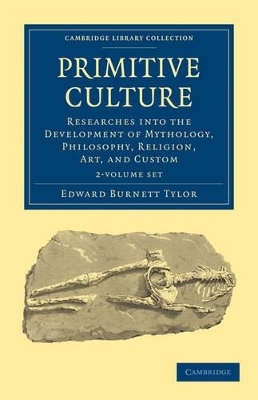
Primitive Culture 2 Volume Set
Researches into the Development of Mythology, Philosophy, Religion, Art, and Custom
Seiten
2010
Cambridge University Press
978-1-108-01752-7 (ISBN)
Cambridge University Press
978-1-108-01752-7 (ISBN)
- Keine Verlagsinformationen verfügbar
- Artikel merken
Edward Burnett Tylor (1832–1917) was an English anthropologist who is widely considered the founder of anthropology as a scientific discipline. First published in 1871, this influential two-volume work explains Tylor's idea of cultural evolution in relation to anthropology.
Edward Burnett Tylor (1832–1917) was an English anthropologist who is widely considered the founder of anthropology as a scientific discipline. He was the first Professor of Anthropology at the University of Oxford from 1896 to 1909, and developed a broad definition of culture which is still used by scholars. First published in 1871, this classic two-volume work explains Tylor's idea of cultural evolution in relation to anthropology, a social theory which states that human cultures invariably change over time to become more complex. Unlike his contemporaries, Tylor did not link biological evolution to cultural evolution, asserting that all human minds are the same irrespective of a society's state of evolution. His book was extremely influential in popularising the study of anthropology and establishing cultural evolution as the main theoretical framework followed by anthropologists in the nineteenth and early twentieth centuries.
Edward Burnett Tylor (1832–1917) was an English anthropologist who is widely considered the founder of anthropology as a scientific discipline. He was the first Professor of Anthropology at the University of Oxford from 1896 to 1909, and developed a broad definition of culture which is still used by scholars. First published in 1871, this classic two-volume work explains Tylor's idea of cultural evolution in relation to anthropology, a social theory which states that human cultures invariably change over time to become more complex. Unlike his contemporaries, Tylor did not link biological evolution to cultural evolution, asserting that all human minds are the same irrespective of a society's state of evolution. His book was extremely influential in popularising the study of anthropology and establishing cultural evolution as the main theoretical framework followed by anthropologists in the nineteenth and early twentieth centuries.
Volume 1: Preface; 1. The science of culture; 2. The development of culture; 3. Survival in culture; 4. Survival in culture continued; 5. Emotional and imitative language; 6. Emotional and imitative language continued; 7. The art of counting; 8. Mythology; 9. Mythology continued; 10. Mythology continued; 11. Animism. Volume 2: 12. Animism continued; 13. Animism continued; 14. Animism continued; 15. Animism continued; 16. Animism continued; 17. Animism continued; 18. Rites and ceremonies; 19. Conclusion; Index.
| Erscheint lt. Verlag | 2.12.2010 |
|---|---|
| Reihe/Serie | Cambridge Library Collection - Anthropology |
| Verlagsort | Cambridge |
| Sprache | englisch |
| Maße | 252 x 322 mm |
| Gewicht | 1500 g |
| Themenwelt | Sozialwissenschaften ► Ethnologie |
| Sozialwissenschaften ► Soziologie | |
| ISBN-10 | 1-108-01752-5 / 1108017525 |
| ISBN-13 | 978-1-108-01752-7 / 9781108017527 |
| Zustand | Neuware |
| Informationen gemäß Produktsicherheitsverordnung (GPSR) | |
| Haben Sie eine Frage zum Produkt? |
Mehr entdecken
aus dem Bereich
aus dem Bereich
A Toolkit for a Global Age
Media-Kombination (2023)
WW Norton & Co
CHF 124,95


