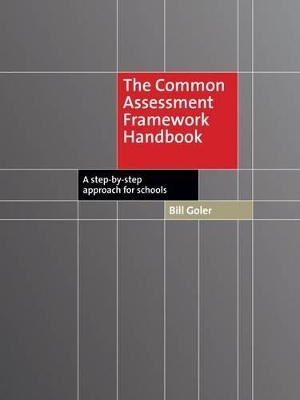
The Common Assessment Framework Handbook
Optimus Publishing
9781905538652 (ISBN)
- Titel ist leider vergriffen;
keine Neuauflage - Artikel merken
Chapter 1 - An understanding of Every Child Matters The aim of the first chapter is to give you a clear understanding of the indicators of vulnerability used by the CAF. It takes you through what the five outcomes from Every Child Matters (ECM) mean in practical terms and what circumstances will best help children and young people to realise them. It will also help you to understand the unique position of schools in terms of the knowledge they already have of children and young people and how the CAF is the tool you should use to identify any unmet needs. Chapter 2 - An overview of the Common Assessment Framework and the supporting tools and processes This chapter focuses on the basic principles behind the CAF and the tools and processes that local authorities must put in place to support it. It enables you to identify the current level of staff awareness in your school using the questionnaire provided and to offer CAF awareness training to all school staff using the materials provided here and on the accompanying CD. Chapter 3 - When might a Common Assessment be helpful? Chapter 3 focuses on understanding the types of situation in which a CAF might be helpful. It contains a series of case studies describing the circumstances of a number of children and young people. The case studies are about children of different ages and genders explored in relation to the five ECM outcomes. Chapter 4 - The pre-assessment checklist This chapter looks at the pre-assessment checklist form, which you can use to help you decide if the child or young person is vulnerable in terms of the five ECM outcomes. Included are further case studies and matching completed sample checklists which help illustrate how this pre-assessment tool might be used. A questionnaire is included to support your completion of the checklist by assisting your assessment whether the child/young person has a good chance of achieving the five outcomes or whether they are vulnerable and at risk. Chapter 5 - Carrying out a full Common Assessment This section of the book explores how you might gather the information you need from parents and children/young people to help you complete the CAF. It includes a number of questionnaires which can be used with adults, young people between 12 years and 16 years and children from 7 years to 11 years. You will also find suggestions for using role-play and small toy activities to explore the thoughts and feelings of children between 5 and 7 years of age. Chapter 6 - Using the information to complete a CAF Chapter 6 includes three case studies covering infants, junior and secondary aged pupils as well as sample pre-assessment and full CAF forms for each case study, including one where parental consent is refused and a young person agrees to a CAF on their own behalf. It explains how to identify from the all the information you have collected what is significant enough to be recorded on the CAF form. Chapter 7 - The multi-agency meeting This chapter takes you through your first multi-agency meeting and how to prepare for and conduct it, and includes example letters inviting colleagues to this first meeting.
| Zusatzinfo | line drawings |
|---|---|
| Verlagsort | London |
| Sprache | englisch |
| Maße | 225 x 297 mm |
| Themenwelt | Sozialwissenschaften ► Pädagogik ► Didaktik |
| ISBN-13 | 9781905538652 / 9781905538652 |
| Zustand | Neuware |
| Informationen gemäß Produktsicherheitsverordnung (GPSR) | |
| Haben Sie eine Frage zum Produkt? |
aus dem Bereich