


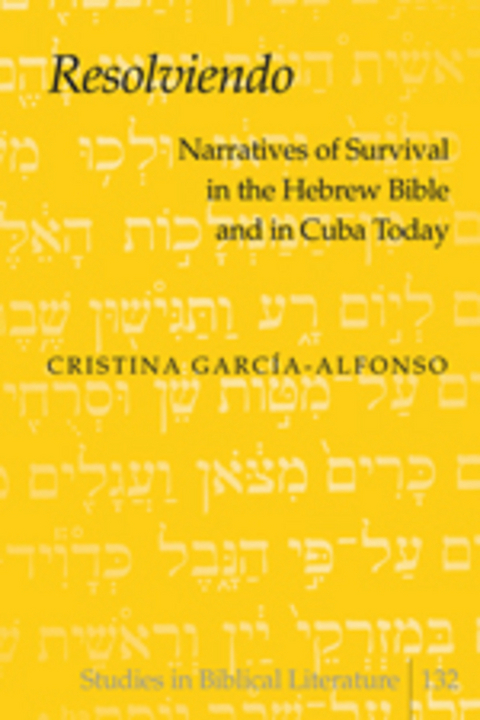
«Resolviendo»
Narratives of Survival in the Hebrew Bible and in Cuba Today
Seiten
2010
|
New edition
Peter Lang Publishing Inc (Verlag)
978-1-4331-0704-7 (ISBN)
Peter Lang Publishing Inc (Verlag)
978-1-4331-0704-7 (ISBN)
- Titel z.Zt. nicht lieferbar
- Versandkostenfrei
- Auch auf Rechnung
- Artikel merken
The story of Rahab ("Joshua 2") has traditionally been interpreted as the account of a foreign woman and prostitute who changes the course of her life when she converts to Yahweh. In this book, the author's readings of the biblical narratives from a perspective of resolviendo offer insights into the struggle for survival many Cubans face today.
The story of Rahab (Joshua 2) has traditionally been interpreted as the account of a foreign woman and prostitute who changes the course of her life when she converts to Yahweh. In return for her faithful act of saving the spies sent by Joshua to search the land of Canaan, Rahab and her family obtain salvation once her city of Jericho is destroyed. The story of Jael (Judges 4:17-23) has commonly been read as Jael’s violent act of killing Sisera, King Jabin’s commander in chief, with a tent peg to his temple while he was asleep. Jael is perceived as someone who fails to fulfill the hospitality codes of her society. The story of Jephthah and his unnamed daughter (Judges 10:6-12:7) describes the tragic event in which Jephthah makes a foolish and horrible vow offering his innocent daughter in sacrifice to God. Typically this text is read as Jephthah being immensely irresponsible and his daughter being the poor victim who pays for her father’s oath.
Cristina García-Alfonso proposes that the stories of Rahab, Jael, and Jephthah can be particularly enriched and give hope to contemporary contexts of hardship when they are read through the Cuban notion of resolviendo (survival). Using narrative criticism along with different contemporary approaches to the texts including feminist and post-colonial approaches, García-Alfonso’s readings of the biblical narratives from a perspective of resolviendo offer insights in the struggle for survival many Cubans face today. Also explored are the implications that a reading through the notion of resolviendo or survival can have for other contexts in contemporary societies where survival is at stake.
The story of Rahab (Joshua 2) has traditionally been interpreted as the account of a foreign woman and prostitute who changes the course of her life when she converts to Yahweh. In return for her faithful act of saving the spies sent by Joshua to search the land of Canaan, Rahab and her family obtain salvation once her city of Jericho is destroyed. The story of Jael (Judges 4:17-23) has commonly been read as Jael’s violent act of killing Sisera, King Jabin’s commander in chief, with a tent peg to his temple while he was asleep. Jael is perceived as someone who fails to fulfill the hospitality codes of her society. The story of Jephthah and his unnamed daughter (Judges 10:6-12:7) describes the tragic event in which Jephthah makes a foolish and horrible vow offering his innocent daughter in sacrifice to God. Typically this text is read as Jephthah being immensely irresponsible and his daughter being the poor victim who pays for her father’s oath.
Cristina García-Alfonso proposes that the stories of Rahab, Jael, and Jephthah can be particularly enriched and give hope to contemporary contexts of hardship when they are read through the Cuban notion of resolviendo (survival). Using narrative criticism along with different contemporary approaches to the texts including feminist and post-colonial approaches, García-Alfonso’s readings of the biblical narratives from a perspective of resolviendo offer insights in the struggle for survival many Cubans face today. Also explored are the implications that a reading through the notion of resolviendo or survival can have for other contexts in contemporary societies where survival is at stake.
The Author: Cristina García-Alfonso is a native of Matanzas, Cuba, where she graduated from the Seminario Evangélico de Teología with a licenciature in theology. She was subsequently ordained to the ministry in the Fraternity of Baptists Churches of Cuba (FIBAC). García-Alfonso earned her M.A. in theological studies from Episcopal Divinity School in Boston, Massachusetts, and her Th.M. from Candler School of Theology, Emory University in Atlanta, Georgia. She was also awarded her Ph.D. from Brite Divinity School in Fort Worth, Texas.
| Erscheint lt. Verlag | 4.3.2010 |
|---|---|
| Reihe/Serie | Studies in Biblical Literature ; 132 | Studies in Biblical Literature ; 132 |
| Mitarbeit |
Herausgeber (Serie): Hemchand Gossai |
| Verlagsort | New York |
| Sprache | englisch |
| Maße | 160 x 230 mm |
| Gewicht | 370 g |
| Themenwelt | Geschichte ► Teilgebiete der Geschichte ► Religionsgeschichte |
| Religion / Theologie ► Christentum ► Bibelausgaben / Bibelkommentare | |
| Religion / Theologie ► Christentum ► Kirchengeschichte | |
| Geisteswissenschaften ► Religion / Theologie ► Judentum | |
| Sozialwissenschaften ► Soziologie ► Gender Studies | |
| Schlagworte | Hardcover, Softcover / Religion/Theologie/Judentum • Rahab (biblical figure), Jael (biblical figure), Jephthahïs Daughter (biblical f • Rahab (biblical figure), Jael (biblical figure), Jephthah’s Daughter (biblical figure), Bible—Narrative Criticism, Gender Studies, Cuba- Social Conditions, Cuba- Economic Conditions 1990- |
| ISBN-10 | 1-4331-0704-X / 143310704X |
| ISBN-13 | 978-1-4331-0704-7 / 9781433107047 |
| Zustand | Neuware |
| Informationen gemäß Produktsicherheitsverordnung (GPSR) | |
| Haben Sie eine Frage zum Produkt? |
Mehr entdecken
aus dem Bereich


aus dem Bereich


