


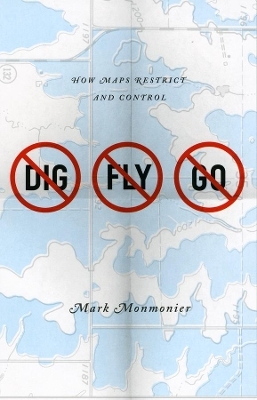
No Dig, No Fly, No Go
How Maps Restrict and Control
Seiten
2010
University of Chicago Press (Verlag)
9780226534688 (ISBN)
University of Chicago Press (Verlag)
9780226534688 (ISBN)
Some maps help us find our way; others restrict where we go and what we do. These maps control behavior, regulating activities from flying to fishing, prohibiting students from one part of town from being schooled on the other, and banishing certain individuals and industries to the periphery. This title tackles this aspect of mapping.
Some maps help us find our way; others restrict where we go and what we do. These maps control behavior, regulating activities from flying to fishing, prohibiting students from one part of town from being schooled on the other, and banishing certain individuals and industries to the periphery. This restrictive cartography has boomed in recent decades as governments seek to regulate activities as diverse as hiking, building a residence, opening a store, locating a chemical plant, or painting a house anything but regulation colors. It is this aspect of mapping - its power to prohibit - that celebrated geographer Mark Monmonier tackles in "No Dig, No Fly, No Go". Restrictive mapping has been indispensable in settling the American West, claiming slices of Antarctica, protecting fragile ocean fisheries, and keeping sex offenders away from playgrounds. But it has also been used for opprobrium: during one of the darkest moments in American history, cartographic exclusion orders helped send thousands of Japanese Americans to remote detention camps.
Tracing the power of prohibitive mapping at multiple levels - from regional to international - and multiple dimensions - from property to cyberspace - Monmonier demonstrates how much boundaries influence our experience, from homeownership and voting to taxation and airline travel. A worthy successor to his critically acclaimed How to Lie with Maps, the book is replete with all of the hallmarks of a Monmonier classic, including the wry observations and witty humor. Written for anyone who votes, owns a home, or aspires to be an informed citizen, "No Dig, No Fly, No Go" will change the way we look at maps forever.
Some maps help us find our way; others restrict where we go and what we do. These maps control behavior, regulating activities from flying to fishing, prohibiting students from one part of town from being schooled on the other, and banishing certain individuals and industries to the periphery. This restrictive cartography has boomed in recent decades as governments seek to regulate activities as diverse as hiking, building a residence, opening a store, locating a chemical plant, or painting a house anything but regulation colors. It is this aspect of mapping - its power to prohibit - that celebrated geographer Mark Monmonier tackles in "No Dig, No Fly, No Go". Restrictive mapping has been indispensable in settling the American West, claiming slices of Antarctica, protecting fragile ocean fisheries, and keeping sex offenders away from playgrounds. But it has also been used for opprobrium: during one of the darkest moments in American history, cartographic exclusion orders helped send thousands of Japanese Americans to remote detention camps.
Tracing the power of prohibitive mapping at multiple levels - from regional to international - and multiple dimensions - from property to cyberspace - Monmonier demonstrates how much boundaries influence our experience, from homeownership and voting to taxation and airline travel. A worthy successor to his critically acclaimed How to Lie with Maps, the book is replete with all of the hallmarks of a Monmonier classic, including the wry observations and witty humor. Written for anyone who votes, owns a home, or aspires to be an informed citizen, "No Dig, No Fly, No Go" will change the way we look at maps forever.
Mark Monmonier is distinguished professor of geography at Syracuse University's Maxwell School of Citizenship and Public Affairs and the author of many books, including, most recently, Coast Lines: How Mapmakers Frame the World and Chart Environmental Change and From Squaw Tit to Whorehouse Meadow, also published by the University of Chicago Press.
| Sprache | englisch |
|---|---|
| Maße | 15 x 23 mm |
| Gewicht | 397 g |
| Themenwelt | Naturwissenschaften ► Geowissenschaften ► Geografie / Kartografie |
| Sozialwissenschaften | |
| ISBN-13 | 9780226534688 / 9780226534688 |
| Zustand | Neuware |
| Informationen gemäß Produktsicherheitsverordnung (GPSR) | |
| Haben Sie eine Frage zum Produkt? |
Mehr entdecken
aus dem Bereich


aus dem Bereich
Buch | Hardcover (2024)
Schweizerbart'sche, E. (Verlag)
CHF 33,55
Zahlen, Fakten und Geschichten : in über 1000 Infografiken, Karten …
Buch | Hardcover (2025)
Marmota Maps (Verlag)
CHF 55,90
Sammlung vermessungstechnischer Aufgaben mit ausführlichen Lösungen
Buch | Softcover (2025)
Wichmann, H (Verlag)
CHF 37,80


