


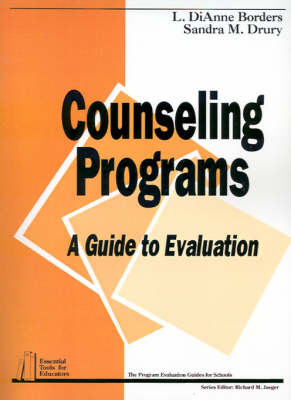
Counseling Programs
A Guide to Evaluation
Seiten
1992
SAGE Publications Inc (Verlag)
978-0-8039-6036-7 (ISBN)
SAGE Publications Inc (Verlag)
978-0-8039-6036-7 (ISBN)
This guide demonstrates how to conduct effective evaluation of school counselling programmes. The book shows how to use evaluation to improve the quality of programmes, how to document resources necessary for improvement and how to become convincing advocates for counselling services. Case studies are presented to illustrate the evaluation process from start to finish.
If you think you don′t have time to evaluate your school counseling programs, think again. Now you can save time and avoid the frustration of conducting an evaluation that does not provide relevant or valid information. Best of all, with this new guide, you don′t need advanced courses in research design or sophisticated research statistics. As funding for education dwindles, you need to evaluate your programs on an ongoing basis to document the needs of students, teachers, and parents, as well as the effectiveness of your programs. Through a series of mini case studies that illustrate the evaluation process from start to finish, the authors show you how to use evaluations to improve the quality of your programs, how to document resources necessary for improvement, and how to become convincing advocates for your services and, in effect, improve your professional life. This book is part of a seven-volume series for evaluating programs and services in today′s K-12 schools. The "master plan" for this series is found in Evaluating School Programs: An Educator′s Guide by James R. Sanders. It describes the steps involved in conducting the evaluation, including ways to focus the evaluation, identify specific evaluation questions, and collect, organize, analyze, and report the information. All volumes in the series, including this one, are designed to be mutually complementary and used in conjunction with Evaluating School Programs.
If you think you don′t have time to evaluate your school counseling programs, think again. Now you can save time and avoid the frustration of conducting an evaluation that does not provide relevant or valid information. Best of all, with this new guide, you don′t need advanced courses in research design or sophisticated research statistics. As funding for education dwindles, you need to evaluate your programs on an ongoing basis to document the needs of students, teachers, and parents, as well as the effectiveness of your programs. Through a series of mini case studies that illustrate the evaluation process from start to finish, the authors show you how to use evaluations to improve the quality of your programs, how to document resources necessary for improvement, and how to become convincing advocates for your services and, in effect, improve your professional life. This book is part of a seven-volume series for evaluating programs and services in today′s K-12 schools. The "master plan" for this series is found in Evaluating School Programs: An Educator′s Guide by James R. Sanders. It describes the steps involved in conducting the evaluation, including ways to focus the evaluation, identify specific evaluation questions, and collect, organize, analyze, and report the information. All volumes in the series, including this one, are designed to be mutually complementary and used in conjunction with Evaluating School Programs.
Introduction
Vignette 1
Determining Students′ Preferences for Small Groups
Vignette 2
Evaluating Individual Counseling Services
Vignette 3
Using Control Groups in Program Evaluation
Vignette 4
Evaluating Classroom Guidance
Vignette 5
Assessing Parents′ Opinions of the Overall Program
Vignette 6
Surveying Teachers′ Opinions of Selected Progam Components
| Erscheint lt. Verlag | 24.11.1992 |
|---|---|
| Reihe/Serie | Essential Tools for Educators series |
| Verlagsort | Thousand Oaks |
| Sprache | englisch |
| Maße | 215 x 279 mm |
| Gewicht | 340 g |
| Themenwelt | Sozialwissenschaften ► Pädagogik ► Didaktik |
| ISBN-10 | 0-8039-6036-0 / 0803960360 |
| ISBN-13 | 978-0-8039-6036-7 / 9780803960367 |
| Zustand | Neuware |
| Informationen gemäß Produktsicherheitsverordnung (GPSR) | |
| Haben Sie eine Frage zum Produkt? |
Mehr entdecken
aus dem Bereich

aus dem Bereich
29 Regeln für eine kluge Lehre – Das LENA-Modell
Buch | Softcover (2024)
Carl-Auer Verlag
CHF 34,90
Impulse für ein gutes Miteinander und Füreinander
Buch | Softcover (2025)
Verlag Herder
CHF 27,95
Ein Unterrichtsprogramm zur Vermittlung von Lesestrategien. …
Buch | Softcover (2024)
Vandenhoeck & Ruprecht (Verlag)
CHF 25,20


