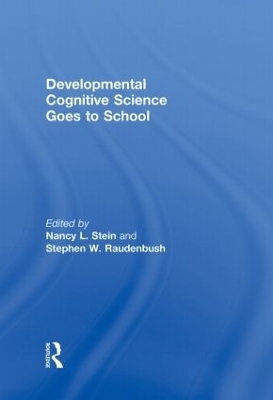
Developmental Cognitive Science Goes to School
Routledge (Verlag)
978-0-415-98883-4 (ISBN)
Developmental Cognitive Science Goes to School:
presents evidence-based studies that describe models of complex learning within specific subject-area disciplines
focuses on domain knowledge and how this knowledge is structured in different domains across the curriculum
gives critical attention to the topic of the ability to overcome errors and misconceptions
addresses models that should be used to begin instruction for populations of children who normally fail at schooling.
This is a must-read volume for all researchers, students, and professionals interested in evidence-based educational practices and issues related to domain-specific teaching and learning.
Stephen Raudenbush, Nancy L. Stein
1. Developmental and Learning Sciences go to School: An Overview Nancy L. Stein
Part I: Reading, Learning, and Teaching
2. Instructional Influences on Growth of Early Reading: Individualizing Student Learning Frederick J. Morrison & Carol M. Connor
3. Literacies for Learning: A Multiple Source Comprehension Illustration Susan R. Goldman, Yasuhiro Ozuru, Jason L.G. Braasch, Flori H. Manning, Kimberly A. Lawless, Kimberley W. Gomez, & Michael J. Slanovits
4. Constraints on Learning from Expository Science Texts Jennifer Wiley & Christopher A. Sanchez
5. Two Challenges: Teaching Academic Language and Working Productively with Schools Catherine E. Snow & Claire White
6. Learning to Remember: Mothers and Teachers Talking with Children Peter A. Ornstein, Catherine A. Haden, & Jennifer L. Coffman
Part II: Science and Learning
7. A Theory of Coherence and Complex Learning in the Physical Sciences: What Works (and What Doesn't) Nancy L. Stein, Marc W. Hernandez, & Florencia K. Anggoro
8. Science Classrooms as Learning Labs Rochel Gelman & Kimberly Brenneman
9. A Research-Based Instructional Model for Integrating Meaningful Learning in Elementary Science and Reading Comprehension: Implications for Policy and Practice Nancy R. Romance & Michael R. Vitale
10. Children's Cognitive Algebra and Intuitive Physics as Foundations of Early Learning in the Sciences Friedrich Wilkening
11. Learning Newtonian Physics with Conversational Agents and Interactive Simulations Arthur C. Graesser, Don Franceschetti, Barry Gholson, & Scotty Craig
Part III: Mathematical Learning
12. Emerging Ability to Determine Size: Use of Measurement Janellen Huttenlocher, Susan C. Levine, & Kristin R. Ratliff
13. Number Development in Context: Variations in Home and School Input During the Preschool Years Susan C. Levine, Elizabeth A. Gunderson, & Janellen Huttenlocher
14. Analogy and Classroom Mathematics Learning Lindsey E. Richland
15. Gestures in the Mathematics Classroom: What's the Point? Martha W. Alibali, Mitchell J. Nathan, & Yuka Fujimori
16. Perceptual Learning and Adaptive Learning Technology: Developing New Approaches to Mathematics Learning in the Classroom Christine M. Massey, Philip J. Kellman, Zipora Roth, & Timothy Burke
17. Algebraic Misconceptions: A Test for Teacher (and Researcher Use) for Diagnosing Misconceptions of the Variable Joan Lucariello & Michele Tine
18. Towards Instructional Design for Grounded Mathematics Learning: The Case of the Binomial Dor Abrahamson
Part IV: Theoretical and Methodological Concerns
19. Linking Cognitive and Developmental Research and Theory to Problems of Educational Practice: A Consideration of Agendas and Issues James W. Pellegrino
20. The Evolution of Head Start: Why the Combination of Politics and Science Changed Program Management More than Program Design Thomas D. Cook, Manyee Wong, & Vivian C. Wong
21. Connecting Classroom Developmental Science to Educational Policy by Studying Classroom Instruction Stephen W. Raudenbush
Index
| Erscheint lt. Verlag | 27.1.2011 |
|---|---|
| Zusatzinfo | 13 Tables, black and white; 30 Line drawings, black and white; 3 Halftones, black and white |
| Verlagsort | London |
| Sprache | englisch |
| Maße | 152 x 229 mm |
| Gewicht | 830 g |
| Themenwelt | Geisteswissenschaften ► Psychologie ► Allgemeine Psychologie |
| Geisteswissenschaften ► Psychologie ► Pädagogische Psychologie | |
| Geisteswissenschaften ► Psychologie ► Verhaltenstherapie | |
| Sozialwissenschaften ► Pädagogik | |
| ISBN-10 | 0-415-98883-7 / 0415988837 |
| ISBN-13 | 978-0-415-98883-4 / 9780415988834 |
| Zustand | Neuware |
| Informationen gemäß Produktsicherheitsverordnung (GPSR) | |
| Haben Sie eine Frage zum Produkt? |
aus dem Bereich