


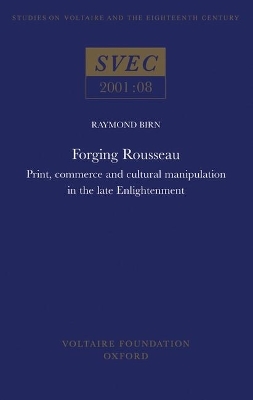
Forging Rousseau
Print, Commerce and Cultural Manipulation in the Late Enlightenment
Seiten
2001
Voltaire Foundation (Verlag)
9780729407700 (ISBN)
Voltaire Foundation (Verlag)
9780729407700 (ISBN)
Inspired by questions and techniques of l’histoire du livre’, this books investigates how print technology in the service of cultural discipleship created the liteary icon known as Jean-Jacques Rousseau.
During his lifetime Rousseau asserted an author-centred interpretation of literary property that brought him celebrity and income. However, following the condemnations of Emile and Du contrat social, it also brought him extraordinary personnal grief. After Rousseau’s death in July 1778, three disciples envisioned a massive testament of rehabilitation, the Collection complète des oeuvres de Jean-Jacques Rousseau, citoyen de Genève. Containing the first editions of the Confessions, Rêveries du promeneur solitaire, and considerable correspondence, the Collection complète offered up Rousseau the martyred sage speaking the language of autobiography. Readers were invited to appropriate lessons from the tragic life. Indeed, the absorption of Rousseau’s texts was intended to stir up, manipulate, and change their own lives.
Though the Collection complète was an extraordinary literary phenomenon, it proved to be a commercial disaster. Competing editorial agendas tore apart the disciples, and piracies of their edition damaged the enterprise. Rousseau’s ‘widow’ and blood relatives claimed literary property rights inheritance. Subsequently, as the French Revolution unfolded, established strategies behind the marketing of Rousseau shifted. The flexible moral messages of autobiography yelded place to a static political one – that of Rousseau as author of Du contrat social, the père de la patrie, en embalmed corpse lying in state in the Panthéon.
Forging Rousseau is a unique type of cultural analysis, contextualising the commercial publishing history of Rousseau’s works in the milieux of the late Enlightenment and Revolutionary period. It is sensitive to major issues concerning book history today: what constitutes an edition, what constitutes a piracy, and competing definitions of intellectual property, icon construction, and literary inheritance.
During his lifetime Rousseau asserted an author-centred interpretation of literary property that brought him celebrity and income. However, following the condemnations of Emile and Du contrat social, it also brought him extraordinary personnal grief. After Rousseau’s death in July 1778, three disciples envisioned a massive testament of rehabilitation, the Collection complète des oeuvres de Jean-Jacques Rousseau, citoyen de Genève. Containing the first editions of the Confessions, Rêveries du promeneur solitaire, and considerable correspondence, the Collection complète offered up Rousseau the martyred sage speaking the language of autobiography. Readers were invited to appropriate lessons from the tragic life. Indeed, the absorption of Rousseau’s texts was intended to stir up, manipulate, and change their own lives.
Though the Collection complète was an extraordinary literary phenomenon, it proved to be a commercial disaster. Competing editorial agendas tore apart the disciples, and piracies of their edition damaged the enterprise. Rousseau’s ‘widow’ and blood relatives claimed literary property rights inheritance. Subsequently, as the French Revolution unfolded, established strategies behind the marketing of Rousseau shifted. The flexible moral messages of autobiography yelded place to a static political one – that of Rousseau as author of Du contrat social, the père de la patrie, en embalmed corpse lying in state in the Panthéon.
Forging Rousseau is a unique type of cultural analysis, contextualising the commercial publishing history of Rousseau’s works in the milieux of the late Enlightenment and Revolutionary period. It is sensitive to major issues concerning book history today: what constitutes an edition, what constitutes a piracy, and competing definitions of intellectual property, icon construction, and literary inheritance.
Acknowledgments
Introduction
Part I: Rousseau and intellectual property rights
1 Up to and including La nouvelle Héloise
2 Emile and the Œuvre Complète
Part II: The trois amis and the widow Rousseau
3 Girardin, Moultou and Du Peyrou
4 Rousseau without borders
5 Thérèse
Part III: The Collection conplète des oeuvres de J-J. Rousseau, citoyen de Genève
6 Competing editorial vision
7 Publishing
8 What readers found in the Collection complète
9 Europe’s booksellers abd the fate of the Collection complète
10 Publishing Part II of the Confessions
11 From print to the Panthéon
Bibliography
Index
| Reihe/Serie | Oxford University Studies in the Enlightenment ; 2001:08 |
|---|---|
| Zusatzinfo | 1 port. |
| Verlagsort | Liverpool |
| Sprache | Multiple languages |
| Maße | 156 x 234 mm |
| Gewicht | 550 g |
| Themenwelt | Sozialwissenschaften ► Kommunikation / Medien ► Buchhandel / Bibliothekswesen |
| ISBN-13 | 9780729407700 / 9780729407700 |
| Zustand | Neuware |
| Informationen gemäß Produktsicherheitsverordnung (GPSR) | |
| Haben Sie eine Frage zum Produkt? |
Mehr entdecken
aus dem Bereich


aus dem Bereich
2. Wissenschaftliche Bibliotheken (AVWB) und Staatliche Bücherei- und …
Buch | Softcover (2024)
De Gruyter Saur (Verlag)
CHF 55,90


